Fantastic Delites: Human lab mice wheel stunt

People zip into mouse suits, step into a giant wheel, and start running. Keep the pace. Do not tumble. Hold the speed long enough and the reward drops. A free pack of Fantastic Delites, earned the hard way.

This “human lab mice” stunt from Fantastic Delites and agency Clemenger BBDO follows the earlier interactive vending machine installation, where the Delite-o-matic pushed people through button mashing and silly tasks for the same prize. Here, “human lab mice” means real people dressed as mice, running the wheel like a lab experiment. The idea stays consistent. If the snack is worth it, you will work for it.

The mechanism is brutally clear. The audience understands the rules in one glance, then sticks around for the inevitable slips, recoveries, and wipeouts. That is what makes it shareable. The product is the trophy, but the entertainment is the price of entry.

In Australian FMCG sampling, the fastest way to earn attention is to turn trial into a story people want to watch, not a handout people walk past.

Why the “lab mice” framing works

It flips the usual sampling dynamic. Instead of the brand chasing you with freebies, you chase the freebie. The mouse wheel is a physical metaphor for craving and persistence, and the costumes make the whole thing socially safe to laugh at.

Extractable takeaway: When you can make the “try” itself entertaining and socially safe, the crowd becomes your distribution, and the product becomes a trophy instead of a handout.

What the brand is really buying

This is not a rational product argument. It is a proof-by-behaviour message, meaning the audience infers quality from what people do, not what the brand claims. When real people are willing to look ridiculous for a snack, the snack gets a shortcut to “it must taste good.” The activation also turns one giveaway into many impressions, because spectators become the media. This kind of sampling is worth doing only when the challenge is the content and the reward stays modest. The real question is whether your sampling earns spectators before it earns trial.

Sampling takeaways for challenge-for-reward

  • Make the rules readable from 10 meters away. If people cannot explain it instantly, they will not stop.
  • Build a loop that produces moments. Near-fails, fails, retries, wins. That is natural entertainment.
  • Keep the reward proportional. Small prize, big fun. The contrast is the joke.
  • Design for a crowd. If spectators are part of the experience, distribution comes for free.

A few fast answers before you act

What happens in the Fantastic Delites “lab mice” stunt?

Participants wear mouse costumes and run inside a giant wheel. They have to maintain speed long enough to earn a free pack of Fantastic Delites from the Delite-o-matic.

Why does this count as effective sampling?

Because it turns product trial into a public spectacle. The giveaway is small, but the attention is large, and the story is easy to retell.

How is this connected to the Delite-o-matic?

It uses the same behavioural premise. People will do surprisingly effortful things for a free snack, and that behaviour becomes the message.

What is the key design principle behind this kind of activation?

Clarity plus consequence. Clear rules create instant understanding. Visible failure creates tension and humour. Together they keep people watching.

What is the biggest risk with “challenge for reward” stunts?

Making the challenge feel unfair or too slow. If success looks impossible, the crowd loses interest. If success looks too easy, there is no drama.
Jameson Irish Whiskey: Blippar Space Invaders

Outdoor ads that turn into a game

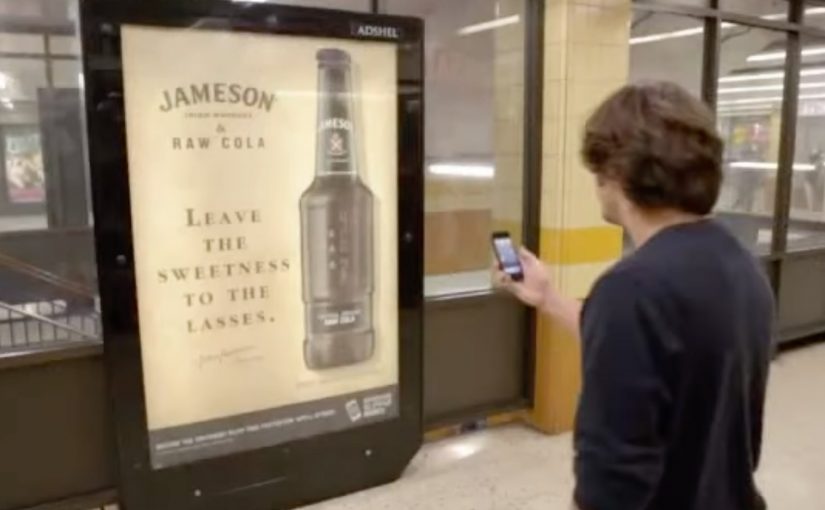
Jameson Irish Whiskey recently launched a huge outdoor campaign, teaming up with augmented reality specialist Blippar for image recognition technology. Here, “image recognition” means the app matches what the camera sees to known Jameson creative and then triggers the experience.

People with the Blippar app could scan any Jameson Irish Whiskey ad or bottle and immediately get immersed in a Jameson Irish Whiskey version of Space Invaders.

How the Blippar scan-to-play mechanic worked

The mechanism was straightforward. A phone camera scan triggered Blippar’s image recognition. That recognition launched an interactive AR experience on the device.

In practice, the physical media became the “portal”. The ad or bottle was the entry point. The phone was the display and controller. The game was the reward.

In spirits and FMCG outdoor campaigns, scan-to-play AR works best when the payoff is immediate and the controls feel natural in a standing, on-the-street context.

Why it landed, and where the interaction could be smoother

The win is immediacy. Scan and you are inside the brand world without a long setup. Because recognition launches the game instantly, it converts a fleeting poster glance into play time.

Extractable takeaway: If you turn physical media into a “scan to reward” portal, deliver the reward within seconds and design controls that match the real-world posture of the moment.

After playing the game myself, I found it would have been a better experience if they had allowed viewer control through tilting the phone around, instead of non-stop tapping at the screen. However, it is still good to see more brands innovating like this.

What the brand was really buying

This was not just about novelty. It was about extending an outdoor campaign into a personal, interactive moment that people could not get from a standard print execution.

The real question is whether your outdoor media can earn voluntary attention, not just reach.

The intent was clear. Increase attention time. Add talk value. Create a reason to engage with the bottle and the ads beyond the first glance.

This pattern is worth copying when you can reward immediately and keep interaction comfortable enough to sustain play.

What to steal for your next AR activation

  • Make the entry point universal. “Scan any ad or bottle” reduces friction and increases participation.
  • Reward immediately. If the scan does not pay off fast, the experience loses the environment it depends on.
  • Design the controls for comfort. Favor natural motion and simple gestures over repetitive tapping when sessions run longer than a few seconds.
  • Use AR to earn time, not impressions. The value is the extra seconds of focused attention, not the novelty headline.

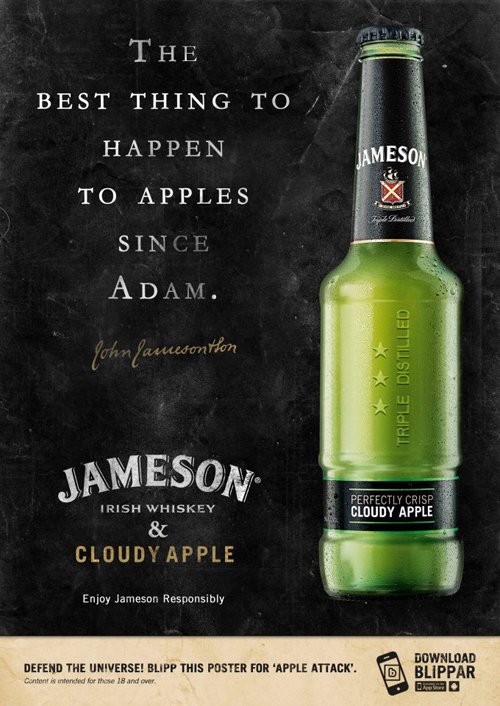
If you would like to give it a try, download the Blippar app on your smartphone and scan the below bottle to start playing.

Jameson Irish Whiskey


A few fast answers before you act

What was Jameson doing with Blippar?

They used Blippar’s image recognition so people could scan Jameson ads or bottles and launch an interactive AR game experience on a smartphone.

What was the core mechanic?

Scan the physical creative with the Blippar app. The scan triggers recognition. The phone immediately launches the game.

Why does scan-to-play work well for outdoor advertising?

It turns a passive glance into an active moment. The ad becomes a portal to content that holds attention longer than print.

What interaction improvement could make this smoother?

More natural viewer control, such as tilting the phone, can reduce fatigue compared to continuous tapping during gameplay.

What is the main takeaway for brands?

Use AR to earn time and engagement by delivering an immediate reward, and make the control scheme comfortable enough to sustain play.

Fantastic Delites: Delite-O-Matic

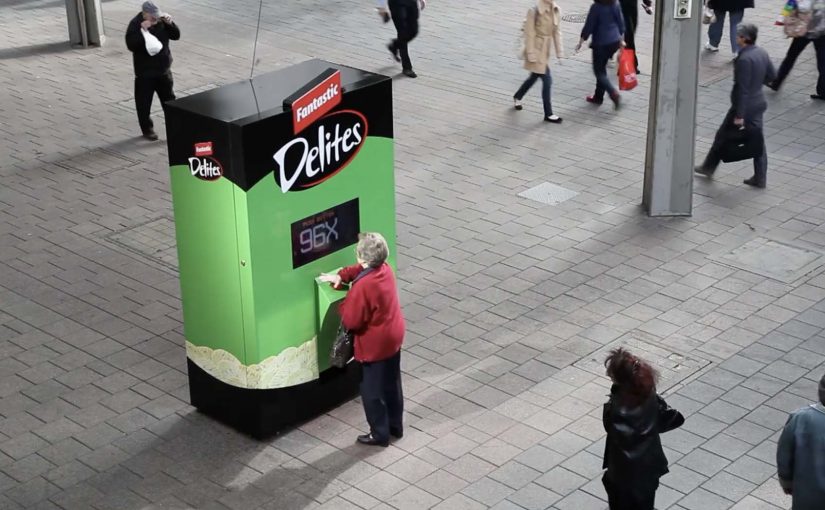
In this latest example, ad agency Clemenger BBDO Adelaide set out to see how far people will go for a free pack of Fantastic Delites.

So a machine dubbed the “Delite-O-Matic” was created that gave people a free pack of Fantastic Delites by means of pushing a button hundreds of times or performing challenges. It was then put out on the streets to prove that because Fantastic Delites taste so good, people would go to incredible lengths to get them.

Sampling that people choose to earn

Interactive vending machines are a great way to get consumer participation and engagement on the ground. There are tons of examples out there, of which some have been covered here.

The mechanic that makes it watchable

The mechanism is effort-based reward. The machine sets an instruction, the participant complies, and the prize is dispensed only after the effort is visible. The escalating “work” becomes the entertainment, and the entertainment becomes the message.

In FMCG sampling and retail activations, interactive vending machines are a repeatable way to exchange effort for product trial.

That structure works because visible effort gives the crowd a simple story to follow before the product appears.

Why it lands

This works because it turns sampling into a story people can instantly judge. The point is not only “free snack”. The real question is what kind of visible effort makes a simple product feel worth watching and worth wanting. Each extra button press or challenge makes the product feel more desirable, and the crowd becomes a built-in audience.

Extractable takeaway: When you make the cost of entry visible, you turn a giveaway into a social moment. That moment carries the brand further than a silent handout ever could.

What to steal from Delite-O-Matic

  • Make the exchange legible: people should understand the rule in one glance, and the effort should be obvious on camera.
  • Escalate, then release: tension comes from “will they do it”. Satisfaction comes from the dispense moment.
  • Keep the prize simple: the product is the hero. The machine is the stage.
  • Design for bystanders: the best sampling stunts recruit a crowd even before the first pack comes out.
  • Let participation become proof: the more people comply, the stronger the implicit claim becomes.

A few fast answers before you act

What is the Delite-O-Matic?

It is an interactive vending machine activation that dispenses a free pack of Fantastic Delites after people complete button-mashing or challenge-style tasks.

Why use effort instead of a simple giveaway?

Effort creates a story. It increases attention, pulls in bystanders, and makes the reward moment feel earned, which boosts recall and sharing.

What’s the key behavioral trick?

Visible commitment. When people publicly invest effort, the product feels more “worth it”, and the scene becomes entertainment for everyone around.

Where does this work outside snacks?

Anywhere trial is the goal and the product is easy to dispense or unlock. Beauty samples, quick-service food, entertainment promos, and event activations.

What’s the main risk?

If the tasks feel humiliating or unfair, the tone can flip. The sweet spot is playful challenge with a clear, quick payoff.