
Share a Coke

Share a Coke

Despite healthy brand tracking data, 50% of the teens and young adults in Australia hadn’t enjoyed ‘Coke’ in the previous month alone. Here, “brand tracking” refers to awareness and preference metrics that can look healthy even when recent consumption is slipping.

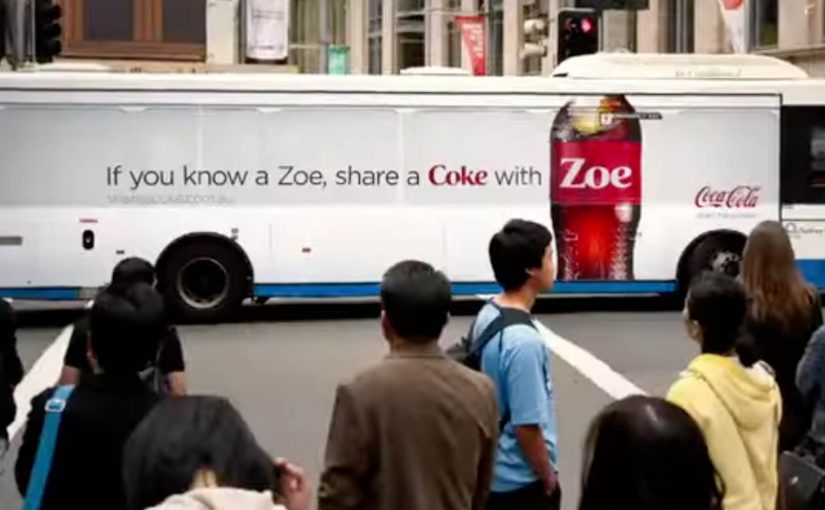
After 125 years of putting the same name on every bottle of ‘Coke’, they decided to do the unthinkable. They printed 150 of the most popular Australian first names on their bottles and then invited all Australians to ‘Share a Coke’ with one another.
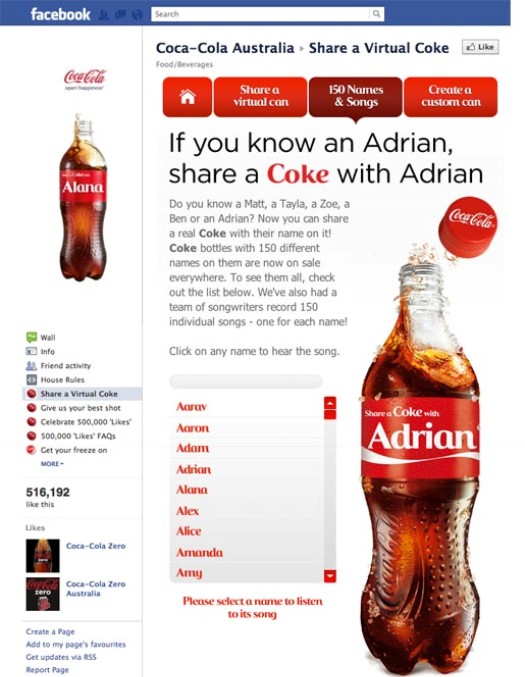
Facebook image showing Coca-Cola promoting the Share a Coke campaign.

The result…

Packaging becomes the conversation

What stands out here is the simplicity. A bottle stops being just a product and becomes a prompt. A name makes it personal. Personal makes it talkable. Talkable makes it shareable.

Because the name turns the pack into a prompt, it triggers talk and sharing without requiring people to learn a new action.

In consumer brands with mass distribution and fragmented media, the pack is one of the most consistent touchpoints, so a pack-level prompt can carry an integrated campaign.

In a world where brands are fighting for attention across channels, this is a reminder that the pack itself can be the media, if it gives people a reason to participate.

Why it works (and why it is more than a label change)

It works because it makes personal relevance visible at the exact moment of choice, and that relevance is what people naturally want to point out and pass along.

Extractable takeaway: If you can make the product itself the trigger for a social action, you reduce friction and get sharing that feels like a natural behaviour, not a forced message.

  • It lowers the barrier to engagement. You don’t need a new behaviour. You just need to spot your name, or someone else’s.
  • It turns purchase into a social act. The “share” is built into the product, not bolted on as a message.
  • It scales personal relevance. The idea is big, but the execution is local. It lives in the names people recognise.
  • It links offline and online naturally. When something feels personal in-store, people are more likely to talk about it beyond the store.

The real question is whether your product can create a social reason to talk at the moment of choice, instead of asking media to do all the persuasion.

When you can bake the “share” into the product experience, packaging-led participation is a more reliable lever than a channel-first campaign plan.

What to take from this for integrated campaigns

  1. Start with a human trigger. A real reason for someone to say: “This is for me”, or “This is for you”.
  2. Make the product do the work. If the core idea is physically present, the campaign holds together across channels.
  3. Design for sharing as a behaviour. Not as a slogan. The easiest shares are the ones that feel natural and immediate.
  4. Keep it legible in one glance. The best integrated ideas can be understood instantly, without explanation.

A few fast answers before you act

What is the “Share a Coke” idea?

It is a packaging-led campaign where Coca-Cola printed popular first names on bottles, then invited people to “Share a Coke” with someone else.

What problem was Coca-Cola trying to solve in Australia?

Despite healthy brand tracking data, 50% of teens and young adults in Australia hadn’t enjoyed ‘Coke’ in the previous month, so the brand aimed to reignite consumption and relevance through conversation.

Why is printing names on bottles strategically interesting?

It makes the product feel personally relevant at the moment of choice. That personal relevance can trigger attention, talk, and sharing without needing complex mechanics.

Is this a “digital campaign” or a “packaging campaign”?

It is both, but it starts with the pack. The packaging is the trigger that can naturally extend into social sharing and broader integrated storytelling.

What is the transferable lesson for other brands?

If you can embed participation into the product experience itself, you reduce friction and increase the odds that people will carry your message across channels for you.
The Creative Ransom: Domain Hijack Job Hunt

The Creative Ransom: Domain Hijack Job Hunt

In May 2010 an aspiring creative from the USA used Google to play upon the vanity of some top American creatives and land himself interviews and eventually a job.

Then in July 2011 a Dutch creative team created “The Twitter Hustle” to land a job with a big agency in the Netherlands.

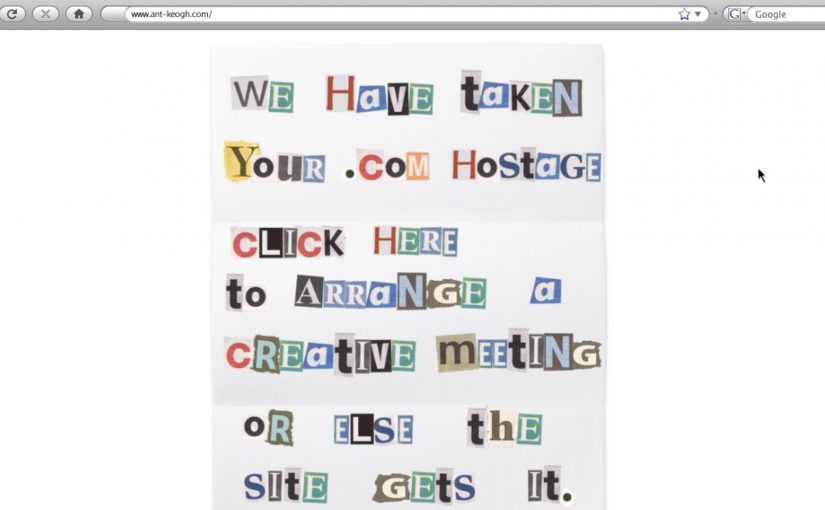
Now an Aussie creative team consisting of Andrew Grinter and Lee Spencer-Michaelsen take the job hunt to the next level. Their approach is to stand out from the crowd by buying domain names matching top creative directors in Melbourne, then sending ransom notes that point each target to their “hostage” URL.

The daring move gets them interviews. They are reported to have worn ski masks to those interviews, and still managed to get hired. The duo are also reportedly working for DTDigital, a division of Ogilvy Melbourne.

Ransom as a résumé

The mechanism is engineered interruption. First, choose a tiny list of people who can actually say “yes”. Next, buy the unclaimed name domains that would naturally belong to them. Then send a physical ransom note that forces a single action. Type the URL. When they land, the “ransom page” is really a portfolio pitch, personalised through the director’s own name.

In creative industry hiring markets where inbox outreach gets ignored, targeted disruption works when it is unmistakably personal and immediately resolves into craft.

Why it gets meetings

This is high-wire theatre with a simple psychological hook. You cannot half-notice your own name on a domain. The note creates curiosity and a tiny sense of urgency, and the landing page converts that spike of attention into proof of creative thinking.

Extractable takeaway: If you need decision-maker attention, design a one-to-one interruption that is impossible to confuse with spam, then make the first click deliver immediate evidence of your value.

The line between bold and dumb

There is a reason this one divides opinion. “Ransom” framing and identity-adjacent tactics can feel aggressive, even if the domains were available to buy. The stunt works as a story because it is extreme. That also makes it easy to copy badly.

The real question is whether the stunt creates enough admiration for the thinking before the intimidation becomes the headline.

What to steal without copying the threat

  • Steal the targeting. Make a short list of the only people who matter, and design for them.
  • Steal the personalisation. Use a bespoke hook that cannot be forwarded without losing its power.
  • Steal the proof-on-click. The first interaction should instantly demonstrate craft, not promise it.
  • Drop the menace. Keep the theatre, remove the coercion. Surprise beats intimidation.

A few fast answers before you act

What is “The Creative Ransom”?

A self-promotion job hunt where a Melbourne creative duo buys domain names matching senior creative directors, then uses ransom-style notes and landing pages to force a portfolio view and secure interviews.

What is the core mechanism?

Highly targeted interruption plus extreme personalisation. The target’s own name becomes the channel, and the landing page becomes the pitch.

Why does it work as a piece of communication?

It compresses a full narrative into one action. Open note. Type URL. See personalised page. The story is instantly retellable.

What should I copy from this, safely?

Copy the focus on a tiny list, the one-to-one hook, and the immediate proof of ability. Avoid coercive framing and anything that could be read as a threat.

What is a modern equivalent?

A personalised experience that appears exactly where a decision-maker already looks, then delivers unmistakable proof in seconds. Think bespoke microsites, tailored prototypes, or targeted creative drops, without the intimidation layer.

IKEA Manland

IKEA Manland

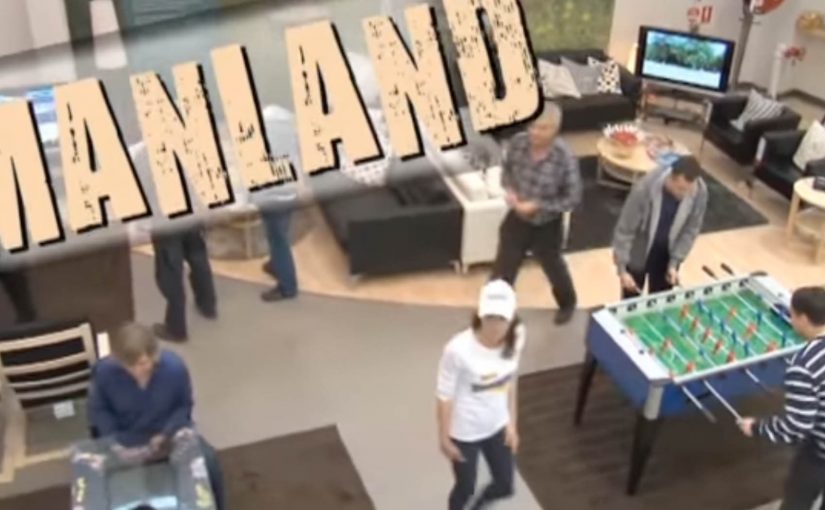
Last month IKEA in Sydney, Australia ran a four-day trial of Manland. They created a dedicated area in the store which men with short retail attention spans could use to escape the pains of weekend shopping at IKEA. In simple words, it was day-care for husbands and boyfriends who wanted to take a break from the shopping.

The store offered free hot dogs, Xbox consoles, pinball machines and nonstop sports action on TV. IKEA even handed out buzzers so women would get reminded to come back and pick up their men after a short session.

Turning “waiting time” into a branded service

Manland works because it is not pretending men suddenly love shopping. It acknowledges the reality. Some people will be there for the relationship, not the retail. So IKEA reframes the pain point as a service, the same way Småland turns “kids are restless” into a solved problem.

The mechanism is deliberately low-effort. You do not need an app, a QR code, or an explanation. You just drop in, decompress, and rejoin the trip with less friction and fewer arguments.

In big-box retail, weekend shopping is often a couple activity, and boredom is a conversion killer for the accompanying partner.

Why this becomes press, not just a gimmick

It is instantly legible. A “day-care for men” is a headline. The imagery does the distribution work. Consoles, sports, hot dogs, and a buzzer are all recognisable symbols, so the concept travels across cultures even if you have never been to an IKEA.

Extractable takeaway: If you want earned media from an in-store experience, design one idea that reads in a single photo and a single sentence.

It is also slightly provocative, which helps. People argue about whether it is funny, patronising, or brilliant. That debate is oxygen for earned media.

The business intent: protect dwell time and reduce walk-outs

The practical goal is simple. Keep groups in-store longer, reduce the urge for someone to storm out, and make the trip feel easier, especially on peak weekend traffic. The PR upside is a bonus. But the operational benefit is the real value.

The real question is whether you can remove that boredom without turning the idea into a stereotype.

If your store relies on group shopping, design for the bored companion as deliberately as you design for the primary buyer.

Steal the companion-lounge playbook

  • Solve a real friction. If it does not remove pain, it will not spread.
  • Make the rules obvious. The best retail ideas need zero onboarding.
  • Build a “photo truth”. If the experience photographs well, it earns its own distribution.
  • Use time limits to keep it fair. A short session keeps it accessible and stops it becoming a hangout that blocks capacity.

A few fast answers before you act

What was IKEA Manland?

Manland was a short trial inside an IKEA store in Sydney. It offered a staffed, game-and-sports lounge where men could take a break while their partners shopped.

Why did the buzzer matter?

The buzzer turned “come back later” into a simple timing system. It made pickup predictable and helped manage capacity without complicated queueing.

Is this primarily an ad idea or an operations idea?

Both. It is an operations idea that creates PR. The experience removes friction inside the store, then the simplicity of the concept turns it into a shareable story.

What makes this kind of activation risky?

Stereotypes. If the tone feels insulting or dated, the press flips from amused to critical. The safest version is to frame it as optional decompression, not a judgment.

What should you measure if you do something similar?

Dwell time, drop-off rates, and satisfaction in exit feedback. For comms, track earned pickup and social sharing, but only after the in-store metrics look healthy.