
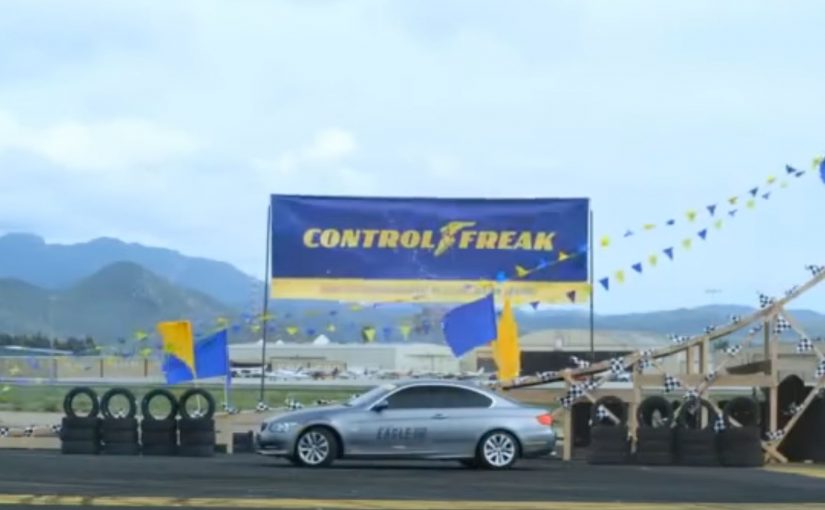
Goodyear Eagle F1 Test Drive

Goodyear Eagle F1 Test Drive

Goodyear does not try to “tell” you that a tire grips better. They stage a test drive that makes you feel it.

A customer walks into a Goodyear retail store expecting the usual sales conversation. Instead, a salesperson offers a test drive. The customer gets into a performance car with what looks like a normal driver. Then the drive turns into a controlled, choreographed, Hollywood-grade demonstration. The driver is a disguised stunt professional. The “test route” includes conditions that exaggerate what traction and control actually mean when things get unpredictable.

That single choice is the unlock. The product story is no longer a brochure. It is an experience.

Goodyear describes this execution as entertainment built around retail-store proof for its Eagle F1 Asymmetric All-Season line, often referred to as “Control Freak”. The point is not the stunt. The point is that grip becomes a felt outcome, not a claim.

The core move

Goodyear turns a retail test drive into entertainment that proves performance.

The real question is: how do you turn an “invisible” performance claim into belief at the moment intent is forming.

How the proof is staged

The stunt is engineered as a sequence of “proof moments” that escalate. The customer starts in a familiar retail context, then the driver introduces controlled chaos where traction and handling show up as outcomes you can feel. Because the demo is structured around cause and effect, the viewer does not need tire expertise to understand what is being proven.

In enterprise marketing organizations where retail, brand, and performance teams operate in different rhythms, retail-first proof content is one of the fastest ways to shorten the distance between awareness and intent.

Why this works so well

Most tire marketing struggles with the same problem. Performance is hard to visualize until you are already in a situation where you need it. “Better grip” sounds like every other claim until something slips.

Extractable takeaway: When a benefit is hard to evaluate in everyday life, do not buy more media to repeat the claim. Engineer one credible moment where the benefit becomes undeniable, then scale that moment through video.

This activation removes that abstraction by doing three things at once. Here, “activation” means a real-world, point-of-sale experience designed to prove one product claim with live human reaction and camera-ready structure.

  1. It makes proof visible.
    The story is designed around moments where traction and handling show up as a physical result. You do not need to understand tread compounds to understand what you just felt.
  2. It creates real human reaction.
    A staged product demo can feel like a stunt. A real customer reaction makes it believable, and shareable, at the same time.
  3. It anchors the brand in the point of sale.
    This is not a distant TV spot. The narrative starts inside the tire store. The purchase context is baked into the content, so the jump from awareness to intent is shorter.

The “retail first” storytelling pattern

A lot of experiential marketing starts with spectacle, then tries to connect it back to the product.

This one starts with the most ordinary commercial moment. A customer is about to buy tires. Then the experience expands outward. That sequencing keeps the brand motive clear. This is not adrenaline for its own sake. It is a dramatic way to demonstrate a benefit that is otherwise invisible.

If your category is dominated by price and familiarity, you win by making functional proof unignorable. You do not win by shouting “better” louder.

The deeper point

This is a category where functional proof usually loses to price promotions and familiarity. Goodyear flips that by turning functional proof into an event.

It is a reminder that “performance marketing” does not always mean dashboards and retargeting. Sometimes it means engineering a moment where the product benefit cannot be unseen.

What to borrow if you run marketing or commerce

  • Design for “proof moments,” not messages. Write down the one thing a customer must believe for your product to win. Then define the single moment they would need to see, feel, or experience for that belief to become non-negotiable.
  • Build the experience around the buying context. Placing the opening scene in a retail outlet removes friction. The story is already where the decision happens. For many categories, that is the most underrated advantage.
  • Treat the camera as a distribution strategy. The activation is designed to be filmed. Multiple angles. Real people. A sequence that escalates. In practice, the video becomes the scalable media layer on top of a physical stunt.
  • Make the customer the hero, not the brand. The most memorable part is not a feature list. It is the reaction. The brand earns attention by giving the customer an experience worth talking about.

A few fast answers before you act

What is the campaign actually demonstrating?

It demonstrates traction and handling by forcing controlled situations where grip and stability show up as physical outcomes, not claims.

Why stage it in a retail store instead of a track?

Because the purchase decision lives in retail. The story starts where intent is highest, so the proof is already in the buying context.

What makes this feel credible instead of gimmicky?

Real customer reactions plus a clear cause-and-effect link between the stunts and the product promise. The entertainment serves the proof.

What is the repeatable lesson for other categories?

Find your “invisible benefit,” create a safe way to make it visible through one engineered proof moment, then film it so it scales beyond the physical experience.

When does this approach fail?

When the experience is spectacle with no causal link to a product benefit. If you cannot explain what is being proven in one sentence, you are buying attention, not belief.
Mercedes-Benz: Golf Ball Catch World Record

Mercedes-Benz: Golf Ball Catch World Record

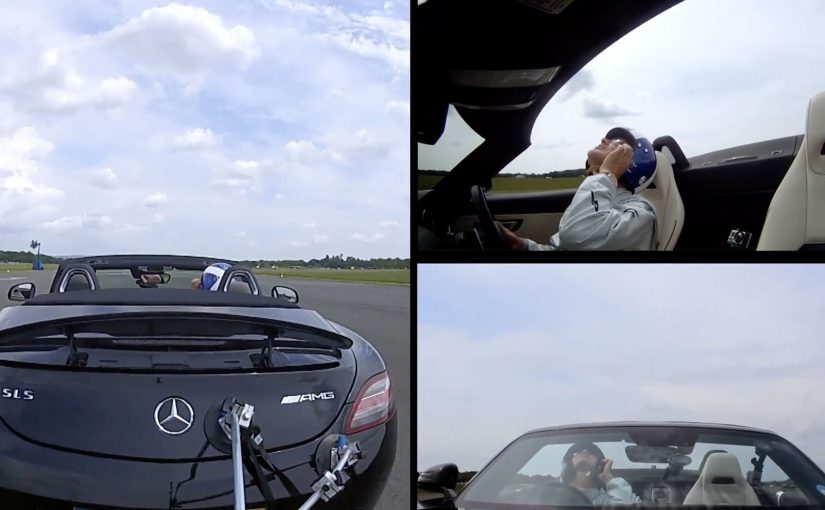
Mercedes-Benz recently uploaded a video of former Formula 1 driver David Coulthard and pro-golfer Jake Shepherd setting a Guinness World Record with a Mercedes-Benz SLS AMG Roadster.

To set the record, Coulthard caught a golf ball hit by Shepherd while driving. The ball was traveling at 178mph and was caught 275 metres from the tee, setting the record for the farthest golf shot caught in a moving car. At the time of posting, the video had already crossed the one-million-view mark within days.

A record attempt built on timing and trust

The mechanism is clean and measurable: a golfer launches a high-speed drive down a runway, a driver accelerates to meet its trajectory, and the open cockpit becomes the “catcher’s mitt”. If the car, speed, and timing are even slightly off, the attempt fails in a very visible way.

In performance-led automotive marketing, certified stunts turn engineering credibility into a piece of entertainment people want to pass on.

The real question is whether your proof is visible enough that the audience can judge it without trusting your narration.

Because you can clearly see whether it worked, the performance claim feels earned rather than explained.

Why it lands

It turns abstract performance into a single, replayable challenge with clear stakes, and then lets Guinness define what “success” means.

Extractable takeaway: World-record style stunts work as marketing when the measurement is simple, the failure mode is obvious, and third-party verification turns spectacle into credible proof.

It makes performance legible. Horsepower and handling are abstract until you attach them to a task with consequences. A moving catch at extreme speed is instantly understood.

It borrows external validation. The Guinness framing gives the clip a built-in reason to exist beyond “brand content”. It signals that this is not just a cool shot, it is a verified attempt with a defined outcome.

It is engineered for replay. The audience watches once for disbelief, then again for mechanics: speed, distance, and the exact moment the ball drops into the car.

Borrowable moves from the record attempt

  • Anchor the story to a number. Distance, speed, and a named record create instant stakes.
  • Make the “proof moment” unmissable. The catch is the single frame people share, and the decisive proof that the claim happened.
  • Use experts as the interface. Specialist talent makes the impossible feel attempted rather than faked.
  • Build the edit around clarity. Viewers should understand what success looks like before it happens.

A few fast answers before you act

What record did Mercedes-Benz, Coulthard, and Shepherd set?

The farthest golf shot caught in a moving car, using a Mercedes-Benz SLS AMG Roadster.

What were the headline numbers?

The drive was clocked at 178mph and was caught 275 metres from the tee.

Why does Guinness World Records matter here?

It provides an external definition of “success” and a trusted validation layer that separates a stunt from a simple brand claim.

What is the business intent behind a stunt like this?

To make vehicle performance feel tangible and memorable, while generating earned reach through a shareable “did you see that?” moment.

What is the most transferable lesson?

If you want proof to travel, wrap it in a single measurable challenge, show the decisive moment clearly, and keep the explanation simple enough to repeat.

smart: eBall interactive ping pong duel

smart: eBall interactive ping pong duel

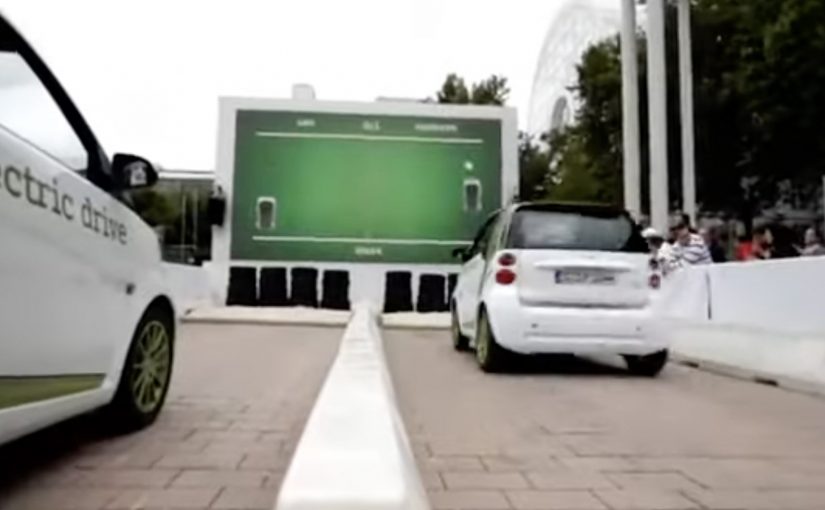
At the Frankfurt Motor Show (IAA) in 2011, Daimler promoted the third generation smart fortwo electric drive with a special interactive game event. Berlin-based Proximity BBDO designed a game called eBall that translates the joy of a highly responsive car into something visitors can play.

Visitors sign up with their driver’s license, get quick instructions on forward and reverse, and then step into a live ping pong duel. Instead of a controller, they use the car itself. Driving forward and back moves the “paddle,” with measurement technology tracking the rally on a large display.

When “responsive” becomes the gameplay

Electric drive messaging often struggles because it is full of abstractions. Efficiency, torque, responsiveness. eBall makes one of those claims physical. The faster and more precisely you control forward and reverse, the better you play. That is a rare alignment. The product behaviour is the mechanic.

Extractable takeaway: If your product promise is about control, speed, or precision, build an experience where performance is visible to a crowd and felt by the participant in under a minute.

In European automotive launches, live interaction works best when it turns a technical attribute into a simple skill people can feel and repeat.

The real question is whether your interaction turns the claim into a repeatable skill, not a slogan.

The tech trick is invisible on purpose

As described in coverage of the installation, the paddles on the LED wall are controlled by two real smart fortwo electric drive cars using laser measurement and transmission technology. The important detail is not the hardware. It is the immediacy. When the wall responds instantly, the player trusts the cause-and-effect and stays in the duel.

Why the driver’s license step matters

The license check does two jobs. It manages safety and liability, and it creates a small “this is real” threshold. You are not playing a simulator. You are operating a vehicle in a branded arena. That seriousness increases attention, and it makes the win feel earned.

What smart is really selling here

eBall does not try to convince you with specs. It frames the car as a fun, responsive object that behaves like a sports device in the hands of the driver. The subtext is clear. If it can play ping pong with precision, it will feel effortless in tight city driving too.

Moves worth copying in event mechanics

  • Translate one attribute into one action. “Responsive” becomes “hit the ball back.” No extra storytelling required.
  • Design for spectators. The LED wall makes the game readable from distance, so the crowd becomes the amplifier.
  • Keep the control model binary. Forward and reverse is legible, teachable, and low-cognitive-load.
  • Make the feedback immediate. Interactivity only feels truthful when response is fast.
  • Engineer the queue. A duel format naturally builds anticipation and repeat attempts.

A few fast answers before you act

What is smart eBall?

It is a live event game where visitors play a ping pong style duel by driving a smart fortwo electric drive forward and backward to control a digital paddle on a large screen.

Why does ping pong fit an electric city car story?

Because it is a precision game. It makes responsiveness and control visible in a way a brochure cannot, and it fits the “small, agile, quick” associations smart wants to own.

What makes this different from a normal driving simulator?

The controller is the vehicle, and the outcome is public. That changes the psychology from private play to performance, which increases energy, memorability, and word of mouth.

What is the biggest operational risk with this kind of activation?

Latency, safety, and throughput. If the system lags, people stop trusting the interaction. If safety or queue management fails, the experience becomes stressful instead of fun.

What should brands measure in a “playable product demo” like this?

Participation rate, average dwell time, repeat plays, audience size over time, and how many people capture and share the experience, plus any downstream test-drive or lead signals.