BMW Christmas Safety Card

To wish customers a new year of safe driving, BMW, together with ad agency AIR and electronics company Selectron, creates a Christmas card meant to be hung in the car.

A micro-sensor is built into the card to measure driving behaviour and react with a spoken message, “Ho! Ho! Hooo! Just like Santa!”, when the car is driven unsafely. The sensor measures G-forces and reacts when the car accelerates too much, or when it brakes or drives too quickly through bends. Here, “G-forces” are used as a proxy for sudden changes in speed and direction.

In performance-focused automotive communities, safety messaging lands best when it shows up inside the driving moment rather than after the fact.

A Christmas card that behaves like a safety co-driver

This is not a decorative greeting. The card acts like a lightweight in-car safety layer. It listens for aggressive driving signals, then interrupts with a playful warning that is hard to ignore. Because the feedback triggers during the manoeuvre, it is harder to dismiss than a post-drive message.

The real question is how you make safer behaviour feel like part of the performance identity, not a constraint imposed from outside.

Behaviour change beats awareness here. A small “nudge” is simply a timely prompt that makes the next decision easier, and this one does it without turning the experience into a lecture.

Why this fits the BMW M League audience

These limited-edition cards are sent to members of the BMW M League who recently buy their car and participate in the BMW Track Days. For that audience, performance driving is part of the identity. This card nudges safer habits without lecturing, because it speaks in a tone that feels seasonal and disarming.

Extractable takeaway: If your audience prizes performance, frame safety as a co-driver that protects the fun, and deliver the correction in their own tone at the moment it matters.

The pattern to steal

  • Measure the behaviour directly. Choose one behaviour you want to influence and measure it directly.
  • Put the intervention where it lives. Embed the intervention into a physical object people will actually place in the environment.
  • Correct in the moment. Trigger feedback at the exact moment of behaviour, not later in an email or app.
  • Make correction socially acceptable. Use a tone that makes the correction acceptable, so people do not reject it on instinct.

A few fast answers before you act

What is the BMW Christmas Safety Card?

A Christmas card designed to hang in a car, with a built-in micro-sensor that detects unsafe driving and plays a Santa-style voice warning.

What does the sensor measure?

G-forces. It reacts to strong acceleration, hard braking, and taking bends too quickly.

Who receives these cards?

Members of the BMW M League who recently buy their car and participate in the BMW Track Days.

What is the core idea?

Turn a seasonal greeting into an in-car behavioural nudge that activates in the moment.
Herta Knacki FootBall: The Football Machine

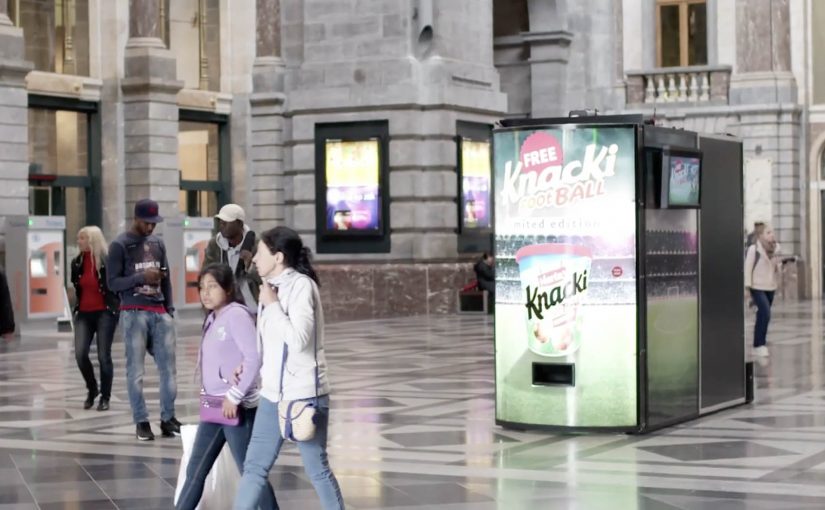
Herta, described as a Nestlé brand in Belgium, launched Knacki FootBall. Small meatballs designed to look like footballs. Instead of relying on standard sampling, the brand and BBDO Brussels turned a train-station moment into a game people could not ignore.

At Antwerp Central Station, a vending machine offered the product for free. Then came the twist. Press the button and the machine opened into a miniature football pitch, with Belgian football legend Leo Van Der Elst waiting inside. To walk away with the snack, you had to score.

Free is easy. Earning it is memorable.

The mechanic is deliberately unfair in the right way. People approach expecting a quick handout. The reveal forces a choice. Walk away, or step in and play. That decision point creates tension, and tension creates attention. In high-traffic commuter environments, the best sampling ideas turn “free” into a short challenge with a story-worthy payoff. The real question is whether your sampling moment earns attention before it earns a bite.

Extractable takeaway: Sampling gets retold when it includes a moment of risk or effort. The product becomes a trophy, not a giveaway.

A vending machine that behaves like a stadium

The physical design does most of the communication. The moment the door opens, everyone nearby understands what is happening. It becomes a spectator event, which is crucial in a station setting where most people do not want to stop unless something is already happening.

Why the celebrity opponent matters

Leo Van Der Elst is not a generic “host.” He is the difficulty setting. His presence turns the activation into a genuine duel, and that makes the outcome feel earned whether you win or lose. It also gives the content a built-in headline when the story travels online.

What the brand is really reinforcing

Knacki FootBall is a novelty product, so the job is not deep education. It is instant association. Football. Fun. A quick bite. The machine makes those associations physical, then anchors them to a specific place and moment people remember.

How to copy The Football Machine

  • Build a single, obvious action. Press the button. The rest happens to you.
  • Make the reveal legible from 10 meters away. If bystanders cannot decode it fast, you lose the crowd effect.
  • Turn sampling into a challenge. Effort increases perceived value and shareability.
  • Use a real “difficulty signal.” A credible opponent or constraint makes the game feel legitimate.
  • Design the exit. Winning should end with a clear reward and a clean photo moment.

A few fast answers before you act

What is Herta Knacki FootBall “The Football Machine”?

It is a vending machine activation where commuters expecting a free sample discover a miniature football pitch inside, and must score a goal to win Knacki FootBall.

Where did the activation run?

It is described as being installed at Antwerp Central Station in Belgium.

Why use a vending machine for a food launch?

Because it creates a familiar expectation. Then you can subvert it. That contrast generates surprise, crowd attention, and strong word of mouth while still delivering the product sample.

What makes this work in a train station specifically?

Stations are full of people who are time-poor. A reveal that is instantly understandable, plus a short game loop, one attempt that takes seconds, can stop people without requiring explanation.

What is the biggest operational risk with this kind of live activation?

Throughput and safety. If the game takes too long, queues become friction. If the experience feels unsafe or embarrassing, people avoid participation and the crowd effect collapses.

Thomas Cook: Surprise Wedding on a Plane

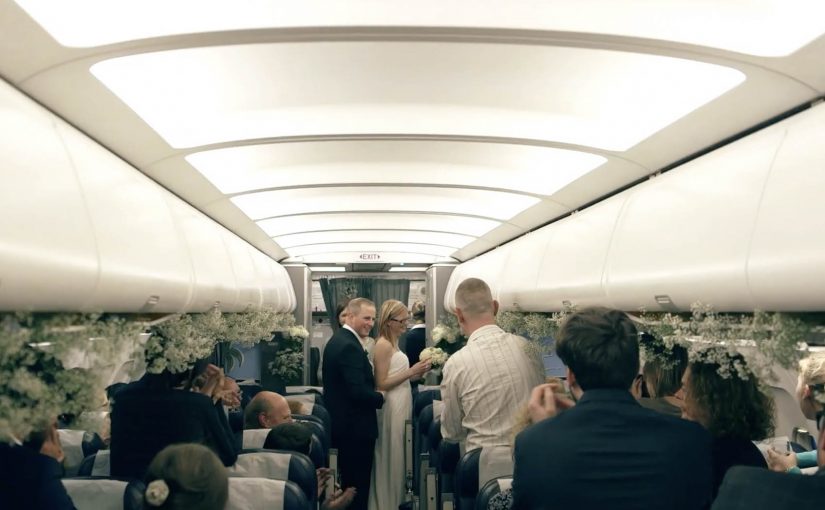
The secret to epic video marketing is to start with the smile of your audience, and then work back from there. In this stunt, Thomas Cook Travel Belgium does exactly that.

Thomas Cook asked fans on Facebook: if given the chance, would you marry your love on a plane. From the replies, one lucky fan was chosen and a surprise wedding was planned at cruising altitude, described as around 35,000 feet. The stunt was described as being funded by Thomas Cook, with the airline and family helping make it all come together. Here is the six-and-a-half minute video of how it unfolded.

How the story is engineered

The mechanism is a social prompt, meaning a simple public invitation for people to opt into the story, turned into a real-world payoff. A simple question creates a pool of willing participants. Selection creates stakes. Then a tightly planned surprise turns an ordinary flight into a once-in-a-lifetime moment. The camera simply follows the reveal, because the reveal is the content.

In travel marketing, surprise-led experiences that turn customers into protagonists can convert brand awareness into emotional preference.

The real question is how a simple social interaction becomes a moment people want to retell. This is smart brand storytelling because the experience is the ad, not a wrapper around it.

Why it lands

This works because it gives people a clean emotional arc in one sitting. A romantic setup. A public reveal. Genuine reactions. Then a resolution that feels earned because the participant initiated the story by saying “yes” in the first place.

Extractable takeaway: When you start with a simple audience prompt and pay it off with a real experience, you do not just “tell” a brand story. You manufacture a memory that participants and viewers will retell accurately.

What travel brands can borrow

  • Start with a low-friction question: make it easy for people to opt into the story with a simple response.
  • Design a single, clear payoff: one big moment beats five smaller surprises.
  • Let real reactions do the work: authenticity is the differentiator, not production polish.
  • Build in collaborators early: crew, family, and logistics must be part of the plan, not a last-minute add-on.
  • Keep the edit tight: preserve the emotional arc so the viewer gets the full journey without filler.

A few fast answers before you act

What is #FlightYes14?

It is Thomas Cook Belgium’s campaign framing for a surprise wedding staged on a flight, built from a fan prompt and captured as a shareable video story.

Why does a wedding work as travel marketing?

Because travel brands sell anticipation, emotion, and “big life moments”. A wedding is a concentrated version of that promise, and it creates instant viewer empathy.

What is the core mechanism behind the stunt?

A social prompt creates participation, a selection creates stakes, and a real-world surprise creates the payoff. The filming turns the payoff into distribution.

What makes this feel authentic rather than like an ad?

The participant’s reaction and the presence of real constraints. A plane is a real environment with real logistics, which makes the moment feel less like a set.

What is the main risk with this format?

Logistics and consent. If the surprise feels intrusive, staged, or poorly coordinated, the tone flips quickly. The planning has to protect the participant’s comfort and safety.