
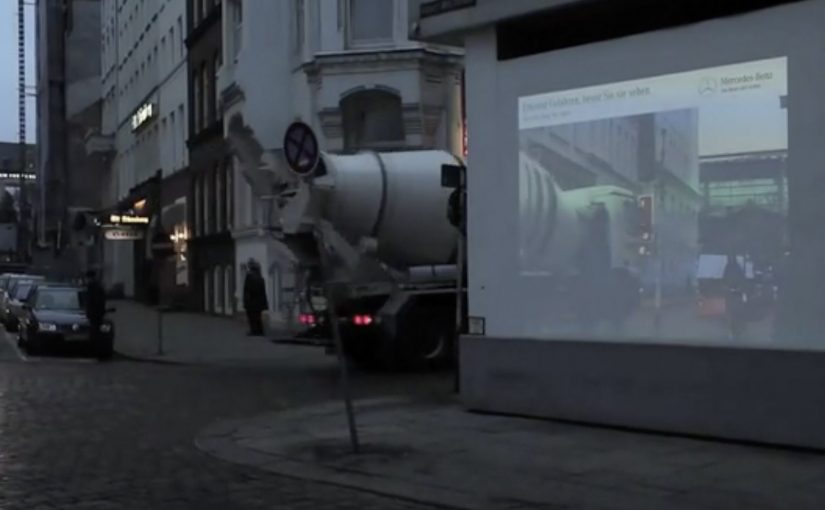
Mercedes-Benz: Transparent Walls for PRE-SAFE

For the PRE-SAFE® precrash system from Mercedes-Benz, ad agency Jung von Matt in Germany set out to make chaotic traffic intersections safer.

The idea was to let everyone “look around the corner” as if walls were transparent. In this execution, “transparent walls” means projecting a live camera view onto the building edge so the blind spot becomes visible. A camera filmed what was happening out of sight around the corner, and the live images were projected onto an 18/1-format billboard mounted on the building edge for approaching traffic to see.

When out-of-home becomes a live safety interface

This is not an awareness poster. It behaves like infrastructure. The corner. The blind spot. The moment of uncertainty. All become the media placement and the message at the same time.

The real question is whether your safety story behaves like a tool at the decision point, not a slogan people ignore.

How the mechanism creates “transparent walls”

  • Capture. A camera records the street view that drivers cannot see until they commit to the turn.
  • Project. A large-format display on the building corner shows that view in real time.
  • Anticipate. People approaching the intersection get a few extra seconds to recognise a cyclist, car, or hazard.

In urban mobility and automotive safety communications, making risk visible in the moment can change behaviour faster than warning copy.

Why it lands

Safety messages often fail because they arrive as abstract advice. This one arrives as immediate utility. It gives people a concrete, legible advantage at the precise point where bad outcomes happen. Because the live projection turns hidden risk into visible information, the benefit is believed without asking anyone to trust a claim. Safety-led brand work should earn attention through utility, not admonition. The result feels less like advertising and more like “someone fixed a problem.”

Extractable takeaway: The most persuasive safety communication is not a claim. It is a demonstrable reduction of uncertainty, delivered at the exact moment people need it.

What the brand intent looks like underneath

The stunt does double duty. It dramatizes what PRE-SAFE® is for without explaining sensors, thresholds, or system logic. It also signals a brand posture. Mercedes-Benz is not only selling performance. It is selling anticipation.

Steal this pattern: make uncertainty visible

  • Build the message out of the environment. Pick a real-world constraint your audience feels, then solve it visibly.
  • Make the proof self-evident. If people can understand the benefit in one glance, the idea scales.
  • Reduce uncertainty, not fear. Practical clarity outperforms shock in public safety-adjacent work.
  • Choose the right “moment.” Place the intervention where decisions are made, not where people are merely passing through.
  • Design for all road users. Intersections are shared systems. Make the benefit readable for drivers, cyclists, and pedestrians.

A few fast answers before you act

What is “Transparent Walls” in one sentence?

It is a digital out-of-home installation that shows live footage from around a blind corner on a building-edge billboard, so approaching traffic can spot hazards earlier.

How does this connect to PRE-SAFE®?

It demonstrates the value of anticipation. Seeing danger earlier is the human equivalent of what precrash systems aim to deliver technologically.

Why use a live camera feed instead of a scripted film?

Because real-time content makes the utility undeniable. People trust what they can see unfolding right now.

What are the main execution risks?

Latency, visibility in different lighting conditions, weather robustness, and ensuring the display informs rather than distracts drivers.

How would you measure success?

Observed speed adjustments, braking behaviour changes, near-miss reduction at the intersection, dwell/attention metrics, and sentiment around perceived usefulness.

Royal Copenhagen: Hand painted billboard

A giant porcelain plate appears on a billboard, completely blank. Then, over the course of the day, painters slowly build the familiar Royal Copenhagen decoration in public, stroke by stroke, until the finished pattern looks like it has come straight from the workshop.

That is the core move in this Royal Copenhagen work with Uncle Grey. If the product is handmade and unique, the advertising has to behave the same way. So the “ad” becomes a craft demonstration on an outdoor canvas.

The result is a simple proof mechanism, meaning the audience can verify “handmade and unique” just by watching the work happen. Mass-produced porcelain cannot do this. It cannot show its human hand in real time. This can.

A billboard that performs the brand promise

Most outdoor work is finished before you ever see it. This one unfolds in front of you. The billboard starts as an empty plate and ends as a completed piece, creating a living before-and-after story that pedestrians can witness at any point in the day.

In heritage premium brands, the fastest way to defend value is to make the making visible.

That pacing matters because it turns a static placement into a timed event, and it gives people a reason to look twice. The craft is not described. It is staged.

Why “unique” needs more than a tagline

When a category is full of cheaper alternatives, “quality” becomes a noisy claim. The smarter route is evidence. A hand-painted billboard is evidence because it is expensive, slow, and visibly human. Those traits map directly onto the message Royal Copenhagen wants to protect. Premium brands should default to observable proof over polished slogans. The real question is whether your premium claim can be witnessed, not merely asserted.

Extractable takeaway: If “craft” is part of your margin, design a proof people can watch unfold, not a line they have to trust.

What the business intent looks like in plain terms

The intent is to justify premium pricing without talking about price. By demonstrating labour and skill at scale, the campaign anchors the idea that the products are not interchangeable with mass-manufactured porcelain. Some coverage at the time described significant sales impact, including one report that framed results as a sharp uplift within 24 hours.

Stealable moves for a “craft” narrative

  • Turn a value claim into a process. If you say “handmade,” show the hand.
  • Use time as a creative device. Progression creates curiosity and repeat attention.
  • Make the proof uncheatable. The point is not novelty. The point is credibility.
  • Scale the detail. When a small craft becomes a large public act, people notice the effort.

A few fast answers before you act

What is the Royal Copenhagen hand-painted billboard?

It is an outdoor execution where a large “porcelain plate” billboard starts blank and is hand-painted live over time, mirroring how Royal Copenhagen porcelain decoration is applied by hand.

Why does painting it live make the message stronger?

Because it converts “handmade” from a statement into observable proof. People can see the labour, time, and human touch that cheaper mass production cannot replicate.

What is the key mechanism that makes it work?

Progression. The billboard changes throughout the day, so the ad becomes an event. That creates curiosity, repeat looks, and word-of-mouth.

What kind of brands benefit most from this approach?

Brands selling premium products where craft, tradition, and human skill are central to the value proposition. Especially when cheaper substitutes make category claims feel generic.

What is the main risk with “craft as advertising” ideas?

If the execution is not visibly authentic, it backfires. The audience needs to clearly see the human work, otherwise it reads like staged theatre without proof.

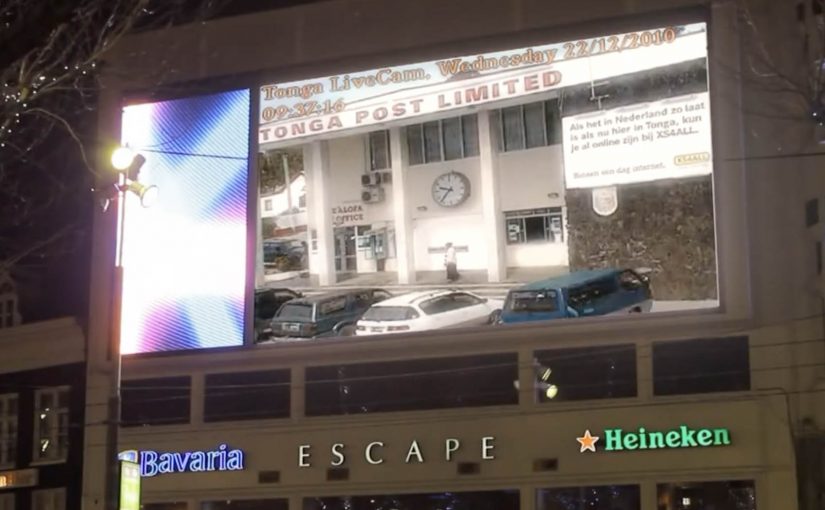
XS4ALL: Tonga Time

Switching internet providers in the Netherlands is often a time-consuming business, which is exactly why many people prefer not to switch at all.

XS4ALL sets out to change that with a promise that sounds almost like a hack. A connection in one day. The campaign idea is framed as “Tonga: Where Time Begins”. Order your connection at 11am Tonga time, and you can have it installed before it is 11am Netherlands time on the same day.

Putting “one day” on a clock

To make the promise tangible, Ogilvy Amsterdam erects a billboard on the Tonga post office. Alongside the billboard, a clock shows the local time in Tonga, described as being about 11 hours ahead of the Netherlands. The clock turns the claim into a visible countdown. Tonga is already “tomorrow”, so the installation can happen “today”.

The real question is not whether XS4ALL can claim speed, but whether it can make that claim feel believable before people experience the service. The strongest move here is turning service logistics into something viewers can verify in one glance.

In telecom markets where switching friction creates inertia, the fastest way to sell speed is to make the time advantage physically visible, not just verbally promised.

Why it lands

The idea works because it uses a real-world fact as the proof mechanism. Time zones are non-negotiable, so the promise borrows credibility from geography, not copywriting. The billboard and the clock also do something important. They take a service promise that feels abstract and make it photographable, retellable, and easy to understand in one glance.

Extractable takeaway: When your differentiator is speed, anchor it to a constraint the audience already trusts, then build a single physical artifact that turns the claim into a visible demonstration.

How to turn speed into visible proof

  • Make the promise measurable. A clock beats a tagline when the benefit is time.
  • Borrow credibility from a fixed reality. Geography, physics, rules, and infrastructure can outperform persuasion.
  • Create a shareable proof object. A single photo should communicate the idea without explanation.
  • Translate operations into a story. “Installed in one day” becomes a narrative people can repeat.

A few fast answers before you act

What is the core idea of “Tonga Time”?

Use Tonga’s head-start time zone to demonstrate that XS4ALL can deliver a new connection within a day, and make that promise tangible with a public clock and billboard.

Why choose Tonga for this message?

Because it is positioned as “where time begins”, so it provides a simple, memorable way to explain how the installation can happen before the Netherlands reaches the same clock time.

What does the clock add that a normal billboard cannot?

It turns a claim into a live reference. People can see the time difference and understand the “within one day” logic immediately.

What is the main risk of using time zones as proof?

If the exact time difference changes seasonally or is reported inconsistently, the concept still holds, but the numeric detail can be challenged.

When is this pattern most useful?

When you are selling speed or responsiveness, and you can tie the benefit to a trusted external constraint that makes the claim feel undeniable.