
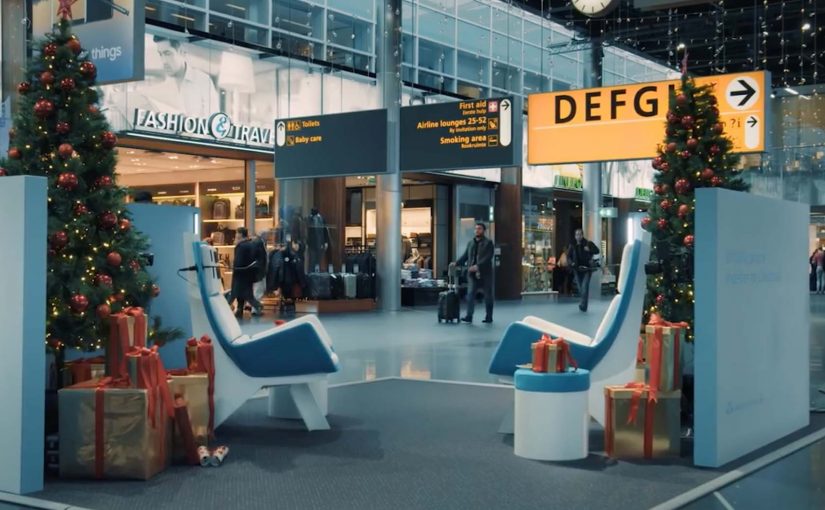
KLM Connecting Seats

KLM Connecting Seats

Airports are crowded with people from different backgrounds. This Christmas, KLM brings them together with Connecting Seats. Two seats that translate every language in real time, so people with different cultures, world views, and languages can understand each other.

The experience design move

KLM does not try to tell a holiday message. It creates a small, human interaction in a high-friction environment. You sit down. You speak normally. The barrier between strangers is reduced by the seat itself.

By turning translation into the interface, the seat makes the first move feel low-risk, which is why the interaction reads as human rather than branded.

The real question is how you turn a crowded, anonymous moment into a safe reason for two strangers to interact.

In global travel hubs, social friction, not language, is what keeps strangers from talking.

Why this works as a Christmas idea

Christmas campaigns often rely on film and sentiment. This one uses participation. Here, participation means travelers completing the message by talking with a stranger, not passively watching a story. That is a stronger holiday move than another sentimental film. It makes connection visible and gives the brand a role that feels practical rather than promotional.

Extractable takeaway: If you want a brand to stand for connection, design a micro-interaction that reduces first-move risk, and let participants create the meaning.

The pattern to steal

If you want to create brand meaning in public spaces, this is a strong structure:

  • Start with tension. Pick a real-world tension people already feel (crowded, anonymous, culturally mixed spaces).
  • Add a simple intervention. Introduce a small change that shifts behaviour in the moment.
  • Let interaction carry the message. Let the interaction do the work, not a slogan.

A few fast answers before you act

What are KLM Connecting Seats?

Two seats designed to translate language in real time, so strangers can understand each other.

Where does this idea make sense operationally?

In airports and other transient spaces where people from different backgrounds sit near each other but rarely interact.

What is the core brand outcome?

A memorable, lived proof of “bringing people together,” delivered through an experience rather than a claim.

What makes this different from a typical holiday film?

It shifts the message from storytelling to doing. The brand creates the conditions for connection, then travelers complete the meaning through the interaction.

How can a non-airline brand use the same structure?

Find a public setting where strangers share waiting time, introduce a simple prompt that lowers the first-move risk, and let the interaction carry the message.
KLM’s Bonding Buffet

KLM’s Bonding Buffet

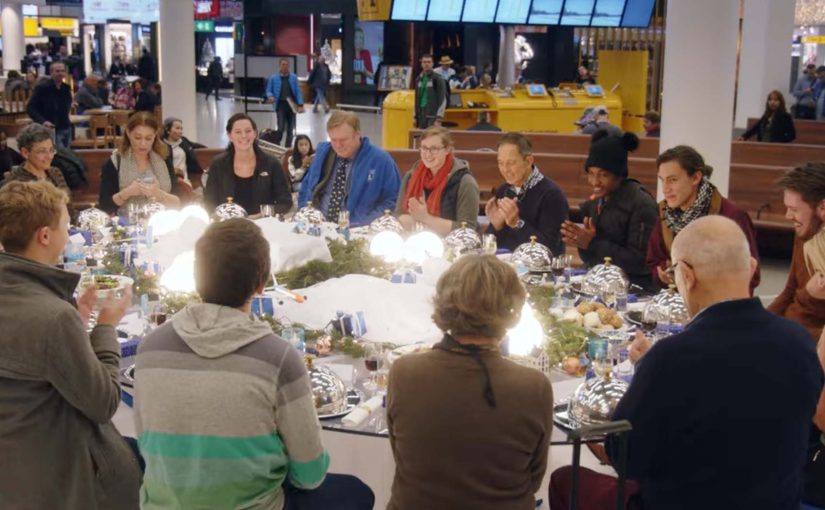
Airports can be lonely places, but Christmas is all about being together. So KLM sets up the Bonding Buffet at Amsterdam Airport Schiphol. A table with a full Christmas dinner sits 4.5 metres above the ground, clearly out of reach. The only way to bring it down is to cooperate.

The mechanic is beautifully simple. Travelers sit on the stools around the table. Each occupied seat lowers the table a little. When every seat is taken, the table is fully lowered and dinner can start. Here, “mechanic” means the rule that links each person sitting down to the table lowering.

In international airports, the fastest way to create togetherness is to make cooperation the only route to a shared reward.

As a result, people from over 20 different countries bond with each other, and the table injects some much-needed Christmas spirit into a busy airport.

The real question is how you design cooperation that feels natural in a place where everyone expects to keep to themselves.

Why this activation works so well

KLM does not “tell” people to connect. It designs a shared outcome that can only be achieved together, because the table only lowers when every seat is taken. The campaign turns a common airport truth. Waiting alone. Into a social moment with a clear reward. Engineered cooperation beats feel-good messaging every time.

Extractable takeaway: If you want strangers to connect, design a visible constraint that can only be resolved through cooperation, then reward the group immediately when they commit.

There are three tight design choices that make it land:

  • A visible constraint. The meal is there, but unreachable.
  • A cooperative mechanic. Everyone has a role. One seat at a time.
  • A shared payoff. The dinner only happens when the group commits.

The brand story is embedded in the experience

This is brand storytelling through behavior, not messaging. KLM positions itself as the airline that understands what travel feels like. Disconnected. Transitional. Sometimes lonely. Then it engineers a moment that flips the emotional state from isolation to togetherness.

The experience is also culturally portable. You do not need language to understand it. Sit down. Help lower the table. Eat together.

What to steal from this if you build live experiences

The transferable lesson is not “build a giant table.” The lesson is how to design bonding:

  • Make the goal obvious.
  • Make the mechanic collaborative, not competitive.
  • Make the payoff immediate and human.
  • Make it impossible to complete alone.

When those conditions are true, the social outcome becomes the content.


A few fast answers before you act

What is KLM’s Bonding Buffet?

It is a Christmas activation at Amsterdam Airport Schiphol where a dinner table starts 4.5 metres high and only lowers when travelers sit together on all seats.

How does the table come down?

Each person who sits on a stool lowers the table a bit. When every seat is taken, the table fully lowers and dinner begins.

Where does it take place?

KLM staged the Bonding Buffet at Amsterdam Airport Schiphol.

What human outcome is KLM designing for?

The activation is designed to help strangers bond, turning lonely transfer time into a shared Christmas moment.

Why is this a strong brand move?

KLM expresses its brand through an engineered experience that changes traveler behavior, not through slogans.

Volvo HoloLens Showroom: Virtual Dealership

Volvo HoloLens Showroom: Virtual Dealership

The showroom no longer needs cars

Car dealerships traditionally depend on physical inventory.

Space, logistics, and availability limit what customers can see, touch, and configure. That constraint disappears when Volvo introduces a showroom experience powered by Microsoft HoloLens.

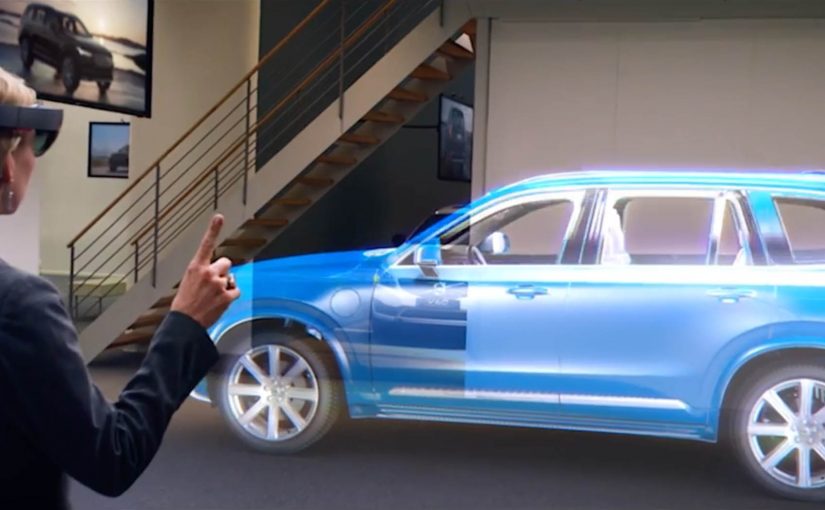
Instead of walking around parked cars, customers step into a virtual environment where full-size vehicles appear as holograms.

How the HoloLens showroom works

Using HoloLens, customers explore Volvo cars at real scale. This is mixed reality, digital objects anchored to the physical space around you.

They walk around the vehicle. Look inside. Inspect details. Colors, trims, and configurations change instantly. The experience feels physical, even though no car is present.

The showroom becomes software-driven. Inventory becomes optional.

In high-consideration retail, the job is helping people visualize options confidently before commitment, even when the product is not physically present.

Why this matters for automotive retail

This is not a gimmick. Virtual showrooms reduce the need for large floor space and allow dealerships to showcase the full portfolio, including models and options that are rarely stocked physically. Because customers can see the car at full scale and switch configurations instantly, they can compare options without relying on imagination, which makes commitment feel safer.

Extractable takeaway: If you can make options visible at real scale and changeable in seconds, you can sell preference, not availability, even when the product is not physically present.

For customers, the experience becomes calmer and more focused. There is less pressure. More exploration. Better understanding before committing.

Experience beats inventory

The deeper shift is about viewer control.

The real question is whether your showroom is designed for preference discovery or for stocking convenience.

Dealerships should treat mixed reality as a configuration layer that complements physical touchpoints, not as a tech demo.

Customers explore at their own pace. Sales staff guide rather than push. The conversation moves from availability to preference.

The dealership turns into a configuration studio, not a warehouse.

  • Make configuration the starting point. Let customers explore options first, then map the shortlist to what they can test and buy.
  • Keep staff in guide mode. Use people to frame trade-offs and confirm choices, not to gate access to information.
  • Design the experience like software. Treat the showroom as a repeatable configuration studio, not a one-off installation.

A few fast answers before you act

Is this replacing test drives?

No. A mixed reality showroom helps customers narrow configurations before a physical test drive.

What do customers actually do in the HoloLens showroom?

They walk around a life-size hologram, look inside, inspect details, and switch colors, trims, and configurations in real time.

What is the real business benefit?

Reduced reliance on physical inventory, clearer configuration conversations, and better use of showroom space.

Why does mixed reality fit automotive retail?

Cars are high-consideration purchases, so visualization can carry as much weight as specification.

What has to be true for this to feel real?

The hologram must stay aligned to the physical space, and configuration changes must respond instantly so customers trust what they are seeing.