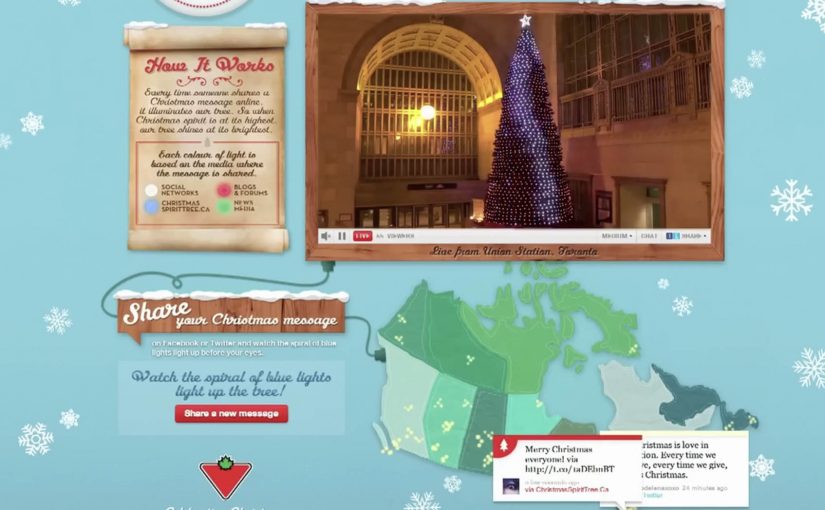
Canadian Tire wanted to re-energize Christmas spirit and reinforce its position as Canada’s leading Christmas store. So they built a public symbol of the season that behaves like a live dashboard for holiday cheer.
The result was a 30-foot Christmas tree wrapped with 3,000 individually programmed LED lights, powered by the nation’s collective online Christmas spirit. Social monitoring tools scanned blogs, forums, social networks, and news sites for Christmas keywords, then software translated that data into real-time light patterns on the tree.
Turning sentiment into a light show
The mechanic is a clean loop. Capture real-world language at scale. Reduce it to signals a system can interpret. Visualize those signals instantly as a physical experience people can gather around. That translation layer is the whole idea, because it makes something intangible, “spirit”, visible and shared. Here, the translation layer is the software bridge that converts online holiday language into visible light behavior.
In large-scale retail brands, public installations like this can turn social chatter into a measurable, collective ritual that reinforces seasonal ownership.
Why it lands
It gives people a role that feels meaningful without feeling like work. You do not have to download an app or learn a new behavior. You just post a message the way you already would, and the tree responds. That cause-and-effect is what makes the story travel, because the installation feels like it is listening, not just broadcasting.
Extractable takeaway: If you want “community” to feel real, build a visible feedback loop where everyday audience behavior directly changes a shared public object. Then make the transformation obvious enough that people can connect their action to the outcome.
What the campaign is really optimizing for
The objective is not only brand warmth. It is reclaiming seasonal leadership by creating a national-scale proof point that Canadian Tire can own, film, and redistribute. The real question is how to make seasonal sentiment visible in a way only Canadian Tire can own. The tree becomes a repeatable centerpiece for earned media, social sharing, and store association without having to lead with price.
What to steal for your own seasonal playbook
- Make the idea self-explanatory. “Messages make lights” is a one-sentence mechanic people can repeat.
- Turn digital into physical. Physical experiences feel more “real” than dashboards or microsites, even when the inputs are purely online.
- Design for spectators and participants. The best public work rewards both the person who posts and the person who just watches.
- Build a content engine. If the installation produces fresh patterns continuously, you get ongoing footage and reasons to talk about it.
A few fast answers before you act
What is the core idea of the Christmas Spirit Tree?
A large LED Christmas tree that lights up in response to holiday messages detected online, turning seasonal sentiment into a live public experience.
Why use social monitoring as the “power source”?
Because it makes the audience feel like the energy behind the display. The installation becomes a collective mirror, not a one-way broadcast.
What makes this more effective than a standard Christmas film?
The live feedback loop. People can influence the outcome, and that influence creates participation, talk value, and repeat attention.
Why does the physical tree matter more than a digital counter?
Because a public object turns online sentiment into something people can gather around, film, and talk about. The physical response makes the mechanism feel shared rather than abstract.
What is the biggest execution risk?
If the response feels delayed, random, or unconnected to real posts, the magic breaks. The system must feel immediate and believable.