

The Live Tile Experiment: Oslo Live Tiles

The Live Tile Experiment: Oslo Live Tiles

Microsoft has been heavily advertising the new Windows 8, Surface RT and Windows Phone 8 along with their respective features. In Norway, Microsoft partners with Norwegian electro rock band Datarock to bring the experience of Windows 8 and Windows Phone 8 Live Tile functionality to unsuspecting residents of downtown Oslo. Live Tiles are interface elements that surface changing, real-time information before you click.

A giant lit-up “tile” appears on the street outside a seemingly closed-off venue. When a passer-by steps onto it, the wall drops and the hidden party spills into the street, with Datarock performing live. The result is an evening to remember.

What the stunt makes you understand about Live Tiles

Live Tiles are designed to feel active, not static. They are not just shortcuts to apps. They are meant to show “something is happening” before you even click. This activation dramatizes that promise by making the tile itself the trigger for real-world content. Because the tile is both preview and trigger, the promise of “something is happening” becomes instantly believable.

In European city-center launches, the most effective experiential stunts translate a UI idea into a single physical action people can trigger without instructions.

Why the surprise mechanic works

The build-up is visible. You hear music, you see a barrier, you notice something glowing at your feet. Curiosity does the recruiting. The moment of commitment is tiny, just stepping onto the tile, but the payoff is oversized, because the environment changes instantly around you.

Extractable takeaway: If you want people to understand a product behavior fast, design a tiny, obvious trigger that unlocks an outsized change in the environment.

What Microsoft is really selling here

Specs are not the message. The message is a feeling: Windows looks alive. By turning a UI element into a street-level “switch” that unleashes a live experience, the campaign makes the feature memorable even for people who never touch the product that night.

The real question is whether your feature can be felt through a simple trigger before it is explained.

This kind of launch is the right move when you want the feature’s behavior to become the story people repeat.

Trigger-based patterns for feature marketing

  • Convert the feature into a trigger. If the benefit is “real-time,” make the audience activate something in real time.
  • Make the payoff disproportionate. A small action should unlock a big reveal.
  • Stage it for bystanders too. The crowd reaction is part of the content.
  • Keep the story tellable. “I stepped on a tile and a concert exploded” is easy to repeat.

A few fast answers before you act

What is “The Live Tile Experiment”?

It is a street stunt in Oslo that turns the Live Tile concept into a physical trigger. Step on a giant tile and a hidden Datarock performance is revealed as the wall drops.

What product feature does it communicate?

Live Tiles, the Windows 8 and Windows Phone 8 interface element designed to display changing, real-time information and content.

Why use a concert reveal instead of a traditional demo?

A live reveal creates an emotional memory tied to the feature idea. It shows “alive and dynamic” faster than any explanation.

What makes the activation easy for the public to participate in?

The required action is obvious and low effort. People only need to step onto the tile to trigger the outcome.

What is the key lesson for feature launches?

Do not describe the benefit. Stage a moment that behaves like the benefit, so people feel it immediately.
Aldo: Ring My Bell

Aldo: Ring My Bell

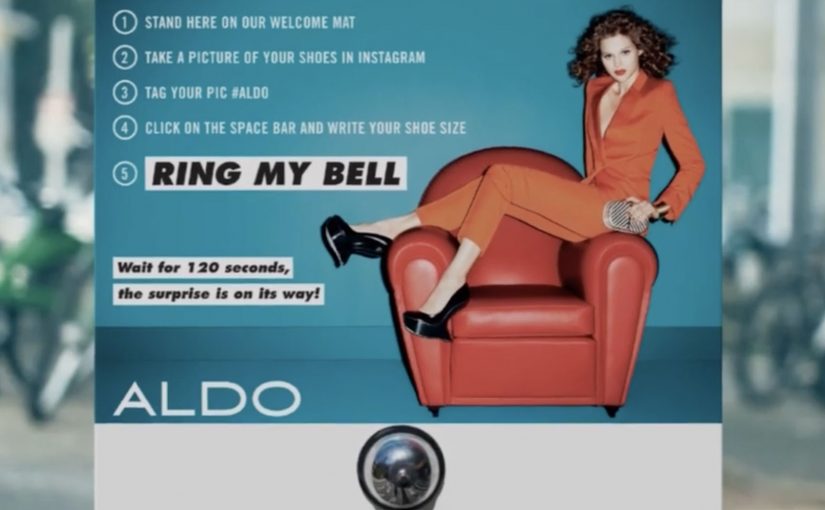
You stand on a welcome mat in the middle of the street, photograph your shoes, post to Instagram with #ALDO, add your shoe size, then ring a bell and wait 120 seconds. If you complete the steps, you get a surprise gift.

How the stunt turns a hashtag into a real-world trigger

The mechanism is a five-step participation script, a fixed sequence of actions that any passer-by can copy, that converts street curiosity into a trackable social action. The welcome mat marks the “stage”. The Instagram post captures proof and size data. The bell is the commitment moment. The 120-second wait creates tension. Then the brand pays off with a physical surprise delivered to the participant.

In high-footfall urban shopping streets where social posting is second nature, the fastest activations are the ones that turn a simple post into an immediate, tangible reward.

Why it lands

This works because it is friction-light and outcome-heavy. The instructions are short enough to follow at a glance, and the payoff happens quickly enough that the crowd stays to watch. The bell and countdown also make the moment public, which naturally pulls in the next participant.

Extractable takeaway: If you want social behaviour in the wild, write the participation flow like a street recipe. One clear prompt, one proof action, one suspense beat, one fast reward.

What the brand is really buying

The real question is not whether a hashtag can spread, but whether it can trigger a public action that proves the reward is real. This is less about reach in the abstract and more about engineered proof. By engineered proof, the brand makes the promised reward visible in real time so the next person believes it will work for them too. People do not just see a poster. They see someone trigger a reward in real time, which makes the campaign feel trustworthy and repeatable.

What to steal from a street-triggered reward loop

  • Make the call-to-action executable in under a minute. Anything slower loses passers-by.
  • Use a public commitment moment. A bell, button, or scan turns observers into a queue.
  • Time-box the suspense. The 120 seconds creates attention and crowd energy.
  • Design the payoff for spectators too. The best street rewards recruit the next person automatically.

A few fast answers before you act

What is “Ring My Bell”?

A street activation where pedestrians post a shoe photo to Instagram with #ALDO and their size, ring a bell, wait 120 seconds, then receive a surprise gift.

What is the core mechanism?

A simple participation script that links a social post to a physical reward, with a short countdown to keep attention on-site.

Why collect shoe size in the post?

So the reward can be prepared or matched quickly, and so the brand can fulfill immediately without follow-up friction.

What makes this work as OOH?

It turns signage into an interaction, and it makes the result visible to everyone nearby, which creates instant social proof on the street.

What is the safest reusable lesson?

Build an offline-to-online loop where the social action is the trigger, and the reward is fast enough to be witnessed in the moment.

Lux: Magic Shower Rooms

Lux: Magic Shower Rooms

Unilever samples the new Lux Magic Spell shower soap in ladies’ shower rooms across spas, clubs and gyms in Singapore. But instead of handing out a bottle and hoping for recall later, the sampling moment is engineered into the space itself.

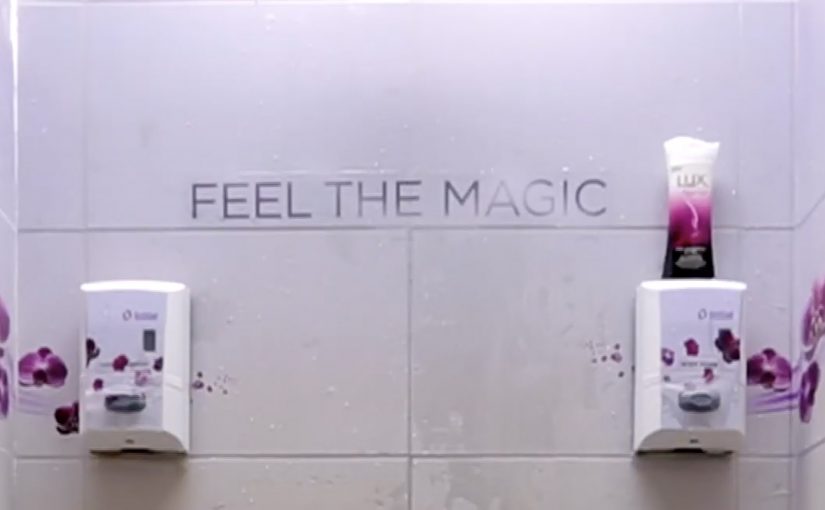
The walls and floors are covered with special stickers made using hydrochromic ink. Hydrochromic ink is a water-reactive coating that changes appearance when it gets wet. As soon as water hits the surface, the white layer disappears to reveal the message and beautiful trails of orchids, so the shower moment becomes a small piece of “magic” tied directly to the product experience.

When the environment becomes the sampler

The mechanism is water-activated reveal. The user does not need instructions, scanning, or a download. The shower triggers the transformation automatically, and the brand message arrives as part of the ritual.

In APAC beauty and personal-care sampling, the most efficient activations reduce the gap between trial and emotion by making the first-use moment feel special.

Why it lands

This works because it avoids the typical sampling failure mode. The product is tried, but nothing memorable happens. Here, the reveal creates a clear “before and after” moment, and that moment is inseparable from using water and being in the shower, which is exactly where the product belongs. In-space triggers beat a handout when the product is used in a fixed ritual and the trigger is unavoidable.

Extractable takeaway: If you want sampling to drive preference, attach the product trial to a sensory trigger in the same environment where the product is naturally used, and make the payoff immediate and unmistakable.

The real question is whether your sampling moment creates a memorable “before and after” that only happens in the product’s natural context.

Moves to borrow for your next ambient sampling activation

  • Make the trigger inevitable. Water is not optional in a shower room. So the reveal is guaranteed to happen.
  • Let the brand behave like a “feature” of the space. The message is not pasted on top. It is revealed by the environment.
  • Use beauty cues that match the promise. Orchids and floral trails visually echo fragrance and sensoriality without needing copy-heavy explanation.
  • Design for the first five seconds. The moment someone sees the reveal, they understand what changed and why it is interesting.

A few fast answers before you act

What is “Magic Shower Rooms” in one sentence?

A Lux sampling activation where shower-room stickers reveal orchids and messaging only when water hits them, turning product trial into a live, in-context surprise.

Why use hydrochromic ink here?

Because it converts water contact into a visible transformation, making the shower itself the interaction trigger.

What makes this stronger than a normal sampling handout?

It creates a memorable moment during first-use, in the exact environment where the product is meant to be experienced.

Where does this idea work best?

In environments where the trigger is unavoidable and the product ritual is already happening, so the reveal feels native instead of staged.

What is the main execution risk?

If the reveal is hard to notice, messy, or poorly maintained, the magic becomes confusion, and the brand association turns negative.