
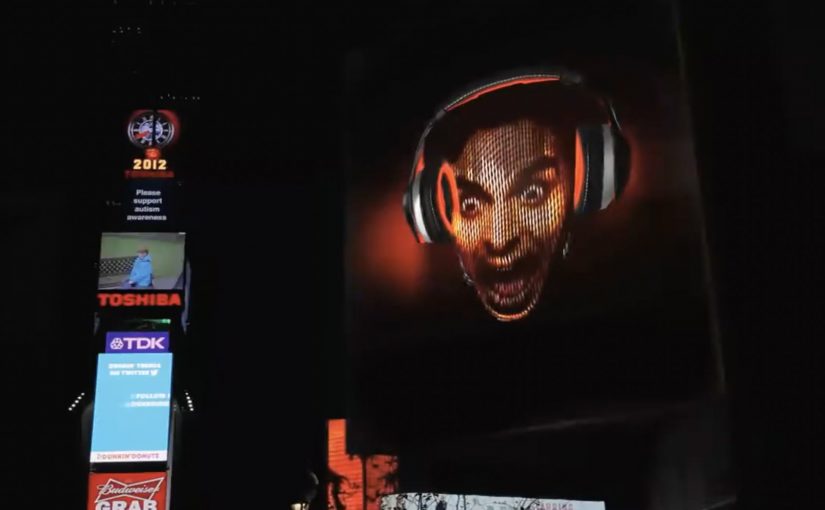
Denon VisYOUalizer: feel the music

Denon wants to bring to life the idea that with its line of lifestyle headphones you do not just hear the music, you feel it. So BBDO New York, described alongside Jam3 in production write-ups, creates an engaging experience for younger audiences who are not yet familiar with Denon’s long-running audio heritage.

A Denon VisYOUalizer app is created that lets people try on the headphones virtually and turn their faces into a dynamic, customized music visualizer.

How the VisYOUalizer turns “sound” into something you can see

The mechanic is simple. Your face becomes the canvas, the music becomes the driver. You line up to a camera, the headphones snap into place virtually, and the experience maps a moving visual layer to your expression and the track’s energy. Because the visual layer responds in real time to both the track and your expression, the “feel it” promise reads as proof rather than copy.

In consumer electronics and lifestyle brands, face-based interactivity works best when the visual payoff is immediate and the product benefit is embodied rather than explained.

Why it lands for a younger audience

Headphone marketing often leans on specs, heritage, or famous musicians. This goes the other way. It starts with play and self-expression, then backfills the brand story through the experience and its share value. The real question is whether you can make an intangible promise visible enough that people want to play with it before they care who you are. When awareness is the constraint, a participatory demo beats a spec-led pitch.

Extractable takeaway: If your benefit is sensory or emotional, make the user’s own face or movement the proof, and deliver the payoff before you ask for attention to the brand story.

That matters when awareness is the real problem. If people do not know Denon, a participatory demo can earn attention faster than a product film.

What the brand is really doing here

This is a virtual try-on wrapped around a music visualizer. The try-on makes the product tangible. The visualizer makes the “feel it” claim legible. And the combination gives Denon an interaction that people can show to friends without needing to explain anything.

Steal this for your next “feel it” product idea

  • Turn an abstract benefit into a visible response. If “feel” is the promise, show a reaction that moves with the input.
  • Make the first 10 seconds rewarding. The hook should work before anyone reads instructions.
  • Use virtual try-on as the entry point. It lowers friction because people already know what to do.
  • Let personalization do the marketing. When people see themselves in the output, they are more likely to share.

A few fast answers before you act

What is the Denon VisYOUalizer?

It is a face-based interactive experience that lets you virtually try on Denon lifestyle headphones and transforms your face into a music-driven visualizer.

What product message is it designed to prove?

It translates “you do not just hear the music, you feel it” into a visual reaction that changes in real time with the sound and the participant’s presence.

Why combine a visualizer with a virtual try-on?

The try-on makes the product concrete and recognizable on your face, while the visualizer supplies the emotional payoff that makes people stick around and share.

What do you measure to judge success?

Time spent, completion rate, share rate, repeat plays, and click-through to product pages are more meaningful than raw impressions for an experience like this.

What is the biggest failure mode for this format?

If the camera alignment is finicky or the output looks generic, people bounce fast. The experience needs instant feedback and obvious personalization.

Frijj: You LOL You Lose

Frijj, a UK-based milkshake brand, and Iris Worldwide developed a campaign to help people build their tolerance to the unexpected. The aim was to make Frijj’s new flavours, Honeycomb Choc Swirl, Jam Doughnut, and Sticky Toffee Pudding, feel like a challenge worth trying.

So they created an advergame, a branded game designed to promote a product through play. It pits you against friends from your social networks in a challenge of who can keep a straight face for the longest period of time while the web app serves up funny and weird YouTube videos.

A “don’t laugh” game that sells flavour confidence

The mechanic is straightforward. You start a session, the site throws escalating clips at you, and you try not to crack. The moment you smile, you lose. The format turns passive viewing into competitive viewing, which is exactly what makes it sticky. Here, “flavour confidence” means making unusual flavours feel safe and fun to try rather than risky or strange.

In FMCG launches, simple competitive mechanics are a reliable way to turn a product message into repeatable social behavior.

Why it lands

This works because it reframes product novelty as a playful test. Instead of saying “these flavours are bold”, it says “prove you can handle bold”. Social comparison does the rest. You want a better score than your friends, so you replay, you share, and you bring others into the same loop. The use of face tracking is also a smart constraint. If the system can “catch” a smile, the challenge feels fair and measurable rather than self-reported.

Extractable takeaway: If your product promise is “unexpected”, build a mechanic where the audience has to demonstrate composure or control. The brand benefit becomes the rule of the game, not the line of copy.

What Frijj is really buying with this advergame

This is a strong launch mechanic because it turns trial curiosity into repeatable social play at scale. The real question is whether the product promise can become a rule people want to test with friends. The game creates time spent, repeat visits, and a socially distributed invitation mechanic, all while keeping the brand message consistent. New flavours that might feel risky in a supermarket become a badge of fun online.

Design rules worth borrowing from Frijj

  • Make the rule binary. Smile equals lose. Simple rules travel.
  • Use content people already understand. YouTube “weird and funny” clips need no explanation.
  • Turn replay into the product benefit. Each retry reinforces “unexpected” as the brand’s territory.
  • Design social competition as the default. Friends, scores, and bragging rights beat generic “share this”.
  • If you use webcam detection, be explicit. Clear consent and clear on-screen feedback keep trust intact.

A few fast answers before you act

What is the core idea of “You LOL You Lose”?

A straight-face challenge where the “payment” is composure. You watch funny clips and try not to smile longer than your friends.

What is an advergame?

An advergame is a branded game designed to promote a product by turning the message into gameplay rather than traditional advertising.

How does the game know you “lost”?

It is described as using face tracking through your webcam to detect a smile. When you smile, the session ends.

Why is this a good fit for launching unusual flavours?

Because it converts “new and unexpected” into a playful challenge, which makes novelty feel fun instead of risky.

What should you measure if you run something similar?

Repeat plays per user, share and invite rate, average session duration, and any lift in branded search or retail trial during the launch window.