
IKEA: Paul “The Chair”

IKEA: Paul “The Chair”

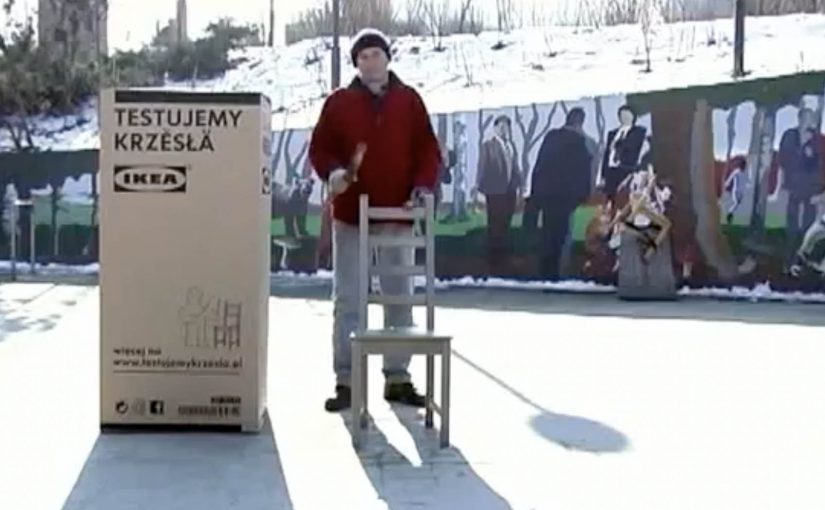
For years, a street performer has been playing on chairs outside Warsaw Central Station. Locals call him Paul “The Chair”.

JWT Warsaw turns that real-world detail into a simple social mechanic for IKEA. In practice, that means a repeatable audience action and brand response that people can join and watch unfold. Let the people who follow IKEA Warsaw decide which chairs Paul should test next, then publish the results back on the IKEA Poland Facebook page. The campaign claims the loop worked fast. Within seven days, IKEA Warsaw fans reportedly increased by 70%.

From street credibility to Facebook voting

The mechanic is a fan vote with a built-in payoff. The audience chooses the chair. Paul tests it. IKEA posts the result. That structure converts passive scrolling into a repeatable reason to come back, because every vote creates anticipation for the next video.

In social-led retail marketing, giving viewers control over what gets demonstrated turns content into participation rather than promotion.

Why it lands

This works because the “expert” is not a paid spokesperson archetype. It is a recognizable local character with a believable, slightly odd credential. Seven years of playing chairs in public. The voting layer also makes the brand feel less like it is broadcasting and more like it is hosting. People are not just watching furniture content. They are steering it, and that makes sharing and returning feel earned.

Extractable takeaway: If your product range is broad and hard to browse, create a recurring format where the audience picks the next item, and make the result public quickly so the loop trains repeat attention.

What IKEA is really buying

The real question is whether IKEA can turn chair browsing into a repeatable act of participation instead of another passive product feed.

The stronger play here is product familiarity through participation, not fan growth for its own sake. The immediate goal is fan growth and interaction, but the deeper goal is product familiarity. Repeated exposure to specific chair models. Subtle proof of sturdiness and usability. A social reason to talk about chairs without sounding like a catalogue.

What retail marketers can lift from this

  • Borrow a credible “tester”. Find a person whose real-life behavior makes them a believable evaluator of your category.
  • Let the audience choose. A simple vote is enough to create ownership and return visits.
  • Close the loop fast. The shorter the time between vote and result, the more the mechanic feels alive.
  • Make each post an episode. Recurrence beats one-off virality for retail ranges.

A few fast answers before you act

What is the core idea of “Paul The Chair”?

IKEA turns chair testing into a recurring social series by letting fans vote on which chairs a local performer, Paul “The Chair”, should test next.

Why does the audience vote matter?

Voting converts attention into commitment. People are more likely to return and share when they helped choose what happens next.

What does this teach about product-range marketing?

You do not need to explain the whole range. You need an ongoing format that makes individual items discoverable one at a time.

What is the key credibility lever here?

The tester’s story. A real person associated with chairs in public life makes the premise feel less like advertising and more like a local truth.

What is the biggest execution risk?

If the results content feels slow, repetitive, or over-produced, the vote becomes a gimmick and the loop stops rewarding repeat attention.
SAS: Up for Grabs on Facebook

SAS: Up for Grabs on Facebook

To promote a million-seat fare sale, Scandinavian Airlines (SAS) and Crispin Porter + Bogusky Stockholm ran a Facebook competition where fans could “grab” a free trip. The ask was visual and dead simple, and it turned participation into the media.

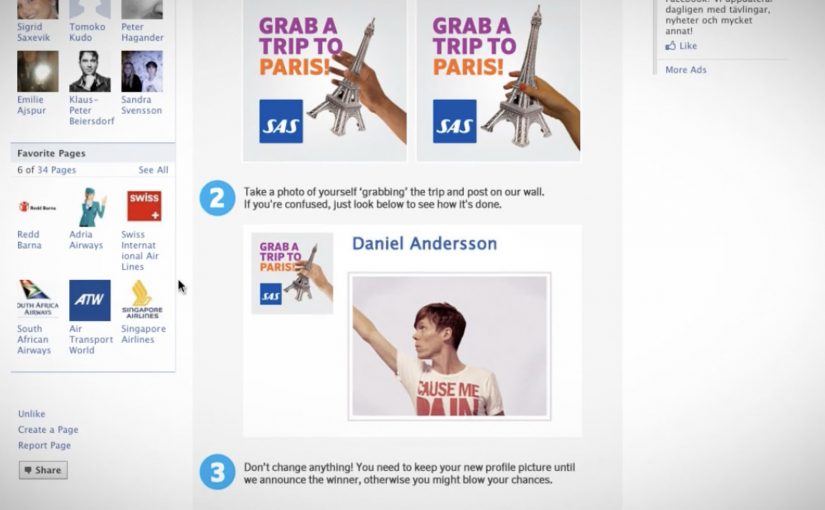
Fans changed their profile picture into a custom “Up For Grabs” image, then posted a matching photo on the SAS Facebook wall where they physically “grabbed” the trip. Every entry looked like an ad, and every ad looked like a friend.

The mechanic that turns fans into distribution

The campaign’s mechanism was a two-step loop. First, replace your profile image with a branded frame that signals you are “in”. Second, publish a playful photo on the brand wall that demonstrates the concept, grabbing the prize. That wall then becomes a live gallery of social proof, with each new post re-selling the fare sale in a more human way than a banner ever could.

In airline marketing, promotions that convert participation into shareable images can outperform price-only fare announcements.

Why it lands

It turns an abstract offer into a physical gesture. “Grab a trip” becomes something you can perform, photograph, and show. The profile-picture switch is a light commitment that broadcasts intent, and the wall post is a public performance that invites imitation. The momentum comes from visibility, because the more entries you see, the more “normal” it feels to join.

Extractable takeaway: When you need scale fast, design one participation artifact that doubles as an ad unit, and make the action easy enough that people will copy it without instructions.

What the shutdown reveals about the strategy

The campaign was reportedly against Facebook promotion terms, and it was shut down. That ending is part of the story, because it highlights the tightrope of social-first promotions. The creative is built on a behavior Facebook historically restricts for contest entry, asking people to publish specific content as a condition of participation, even if the idea is clever and the buzz is real.

The real question is whether the participation mechanic can spread the offer without depending on a platform behavior that can be switched off overnight.

The stronger strategic read is that the creative idea is right, but the distribution mechanic is too dependent on borrowed platform rules.

What to steal for your own launch

  • Make the entry format the message. If the entry itself demonstrates the offer, you get free repetition of the proposition.
  • Use a low-friction first step. Profile-picture frames and templates work because they are fast and socially legible.
  • Design a single visual trope. “Grabbing” is a trope anyone can reproduce, and that consistency creates a recognizable feed.
  • Build compliance in from day one. If the mechanic depends on prohibited platform behaviors, plan a compliant alternative before launch.

A few fast answers before you act

What is the core idea of Up for Grabs?

A Facebook contest where fans change their profile picture to a branded frame and post a “grabbing the trip” photo on the SAS wall to compete for a free flight.

Why does the profile-picture step matter?

It turns participation into persistent visibility. The frame signals “I am in”, and it spreads through everyday browsing without requiring an additional media buy.

What made the campaign travel beyond the SAS page?

Each entry was both participation and promotion. When fans changed their profile picture and posted a matching photo, the fare sale moved into personal networks instead of staying inside brand media.

Why was it shut down?

It was reportedly closed for violating Facebook promotion rules by conditioning entry on specific platform actions, such as posting photos on the wall.

How do you keep the upside without the platform risk?

Keep the visual template and the “grab” trope, but move the submission mechanic to a compliant entry flow, then allow optional sharing that is not required to participate.