Borders between media are blurring. Books are being swiped, magazines digitally scrolled and even in print one can today occasionally navigate. So it is no surprise when regular paper posters come to life on being combined with bluetooth, conductive ink, sensors and speakers.
Paper as an interface, not a surface
The mechanism is straightforward. Conductive ink turns parts of a poster into touch-sensitive zones. Sensors detect taps, knocks, or touch patterns. Bluetooth and small speakers, or a paired phone, provide the audio output. The poster stops being an image and starts behaving like a controller.
In public retail and event environments, touch-based posters only work when people feel safe and permitted to interact.
In consumer marketing and live environments, interactive print means print that senses touch and triggers a digital response. It is a way to turn passive out-of-home into a touchpoint that behaves like a device.
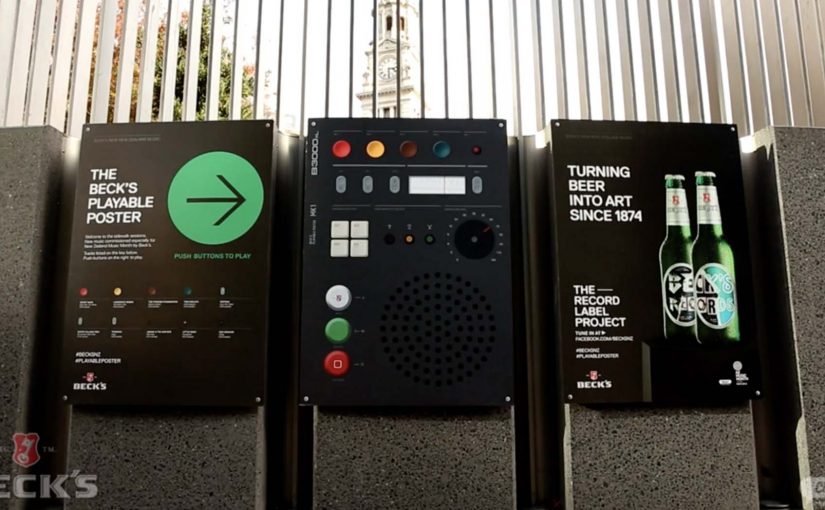
Beck’s Playable Poster
Looking for an innovative way to mark New Zealand’s Music Month, Beck’s partnered with Shine to design a playable poster. Using conductive ink and speakers the posters were made playable with a simple tap of the finger.
The Sound of Taste
Herb and spice brand Schwartz is all about flavour. So to dramatise flavour which was invisible and silent, they got print tech collective Novalia and ad agency Grey London to collaborate on an interactive poster. The poster used conductive ink to turn the surface area of the paper into an interactive interface that also connected to the viewers smartphone to deliver a richer experience.
Change the tune
Agency Republic from UK created a poster with an embedded sensor which when knocked changed the song being played on the agencies shared sound system.
Why these work: the demo happens in your hands
Each example keeps the interaction legible. Tap to trigger sound. Touch to explore flavour as audio. Knock to skip a track. The poster does not ask people to learn a new behavior. It hijacks an existing one, touching a surface, and rewards it instantly.
Extractable takeaway: When you want print to feel alive, make one obvious gesture trigger one immediate reward, and let the brand message ride on that moment of viewer control.
The real question is whether the interaction earns enough memorability to justify the added production. If the payoff is not instant and on-message, do not build it. Because the audience causes the outcome with a simple touch, the message sticks.
Practical patterns for interactive print
- One interaction, one reward. Do not overload the surface with too many modes.
- Make the “how” obvious. A tap zone, a knock cue, a simple instruction. Then deliver instantly.
- Use phones as infrastructure. If pairing adds depth, let the phone do what paper cannot, audio, saving, sharing.
- Design for public confidence. People will only touch a poster if it feels safe, clean, and socially acceptable.
A few fast answers before you act
What is “conductive ink” doing in these posters?
It creates touch-sensitive paths on paper, so taps or touches can be detected and mapped to actions like playing audio.
Do these posters need special printing like QR codes?
They still require specialist production, but the interaction can be integrated invisibly into the design. The poster itself becomes the control surface rather than carrying visible codes.
Why add Bluetooth to print?
Bluetooth allows paper to trigger sound through a phone or external speaker, which is essential when the content is audio or when you want richer layers than print can carry.
What makes an interactive poster feel “worth it” to a passer-by?
Immediate payoff and low friction. If the result is instant and satisfying, people will try it. If setup or pairing is slow, they walk past.
Where does this format fit best?
In environments where people have dwell time and curiosity, festivals, transit hubs, retail windows, office interiors, and brand experiences where interaction is socially normal.