The European Football Championship is going to kick off in a few months, and brands are already getting ready with their advertising pitch. However the brands are not the only ones who want to grab people’s attention.
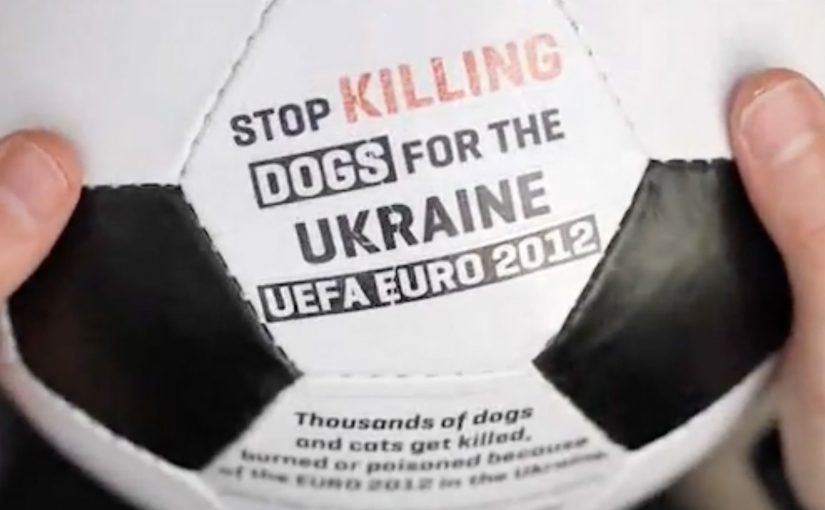
In Ukraine there are street dogs and cats that are reported to be being killed to make the country cleaner and ready to welcome thousands of football tourists. So pan-European animal charity ETN has conceived an attention grabbing ambient campaign in Hamburg to get people involved in its animal protection program.
A football that stops being fun for a second
The execution borrows the most universal gesture around the tournament. A casual kick. Then it interrupts that habit with a jolt that does not belong on a pitch, pulling a distant issue into the middle of the street.
How the mechanism works
The campaign is built around a physical football installation placed in public space. When someone kicks it, the “game” produces an unexpected emotional cue, and the surrounding prompts push you toward a simple next step to support ETN’s protection work. The route to action is designed to be immediate, not research-heavy.
In European cause marketing, the fastest way to mobilize help is to turn a distant issue into a local, physical moment that asks for one simple response.
Why it lands
Football creates permission. People approach without suspicion, because the object feels familiar and playful. The switch from play to discomfort is what makes the message stick. The moment re-frames “preparation for a tournament” as something with consequences, then it uses that heightened attention window to ask for help while the feeling is still fresh.
Extractable takeaway: If you can hijack a familiar public behavior and replace its expected feedback with a values signal, you get instant comprehension and a much higher chance of follow-through than a poster ever delivers.
What ETN is really trying to achieve
This is not awareness for awareness’ sake. The real question is whether a street encounter can convert concern into immediate support before attention fades. It is a conversion play, meaning the point is to turn attention into donations or sign-ups. Make the issue legible in ten seconds, then make support doable in the next ten. The ambient moment is the top of funnel. The donation and sign-up paths are the business end.
What to steal from ETN’s street intervention
- Use a culturally loaded object. Football already carries meaning during a tournament build-up.
- Change the feedback, not the instruction. The surprise does the teaching.
- Design the “next step” to be instant. If action requires effort, the moment evaporates.
- Keep the story single-threaded. One cause, one emotion, one ask.
- Place it where the behavior naturally happens. Public space is the medium and the distribution.
A few fast answers before you act
What is “The Howling Football”?
An ambient street installation that uses a football-triggered moment to spotlight a reported animal-welfare issue and direct people to support an animal protection program.
Why tie an animal charity message to a football tournament?
Because the tournament creates attention and shared behavior. The campaign uses that attention to make a neglected topic visible to people who otherwise would not seek it out.
What makes this different from a normal charity poster?
It interrupts a real action in real space. That interruption creates emotional salience, then it immediately offers a next step while attention is still high.
What is the biggest execution risk with shock-based ambient?
If the moment feels gimmicky or unclear, people disengage. The cue has to be instantly interpretable, and the path to help has to be frictionless.
How do you measure success for a campaign like this?
Track conversions first. Donations, sign-ups, and cost per action. Then look at earned reach and press as secondary amplification.