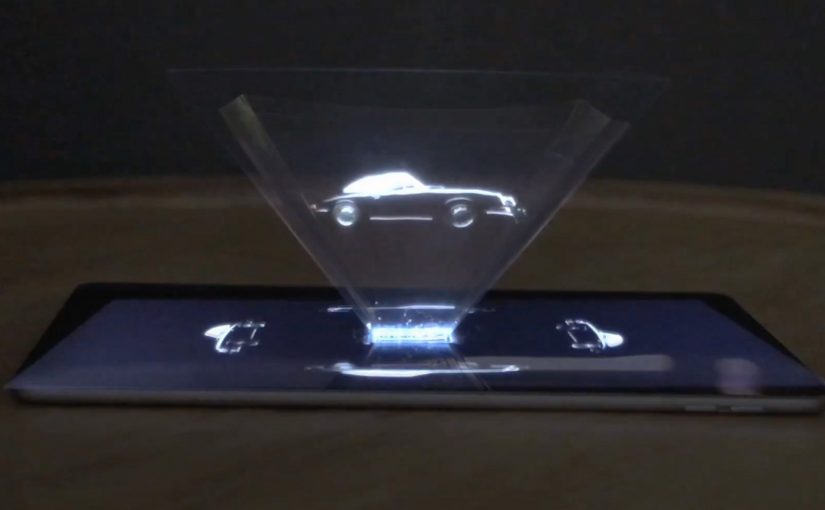
To launch its latest 911, Porsche created a print ad that behaves like a device. Working with agency Cramer-Krasselt, Porsche placed a small acetate sheet into Fast Company’s April issue, turning a magazine spread into a build-it-yourself prism and an interactive “hologram” experience. In this context, “hologram” refers to a prism illusion created from tablet-screen content.
The execution ran as a four-page spread inserted into around 50,000 copies, complete with assembly directions. Porsche billed it as the world’s first interactive hologram print ad.
When a magazine page turns into a viewing tool
The mechanic is the whole point. You fold the acetate into a small prism, place it on top of a tablet, then use the screen content to create the floating 3D-style illusion inside the prism. Print does not “show” the car. Print enables the car to appear.
That shift matters. Instead of asking a reader to imagine innovation, the ad makes them assemble it, which turns curiosity into action.
In premium automotive marketing, making print behave like a device is a fast way to earn attention from audiences who think they have seen every format.
Why the prism matters more than the hologram
The hologram effect is a spectacle, but the prism is the message. It signals precision, engineering, and fascination through the act of building. It also gives the reader a reason to keep the insert, show someone else, and replay the experience, which is exactly what print needs when attention is scarce. The real question is whether the build step makes “innovation” feel earned rather than claimed.
Extractable takeaway: If you want a print unit to signal modernity, make it an enabling tool the viewer assembles, so the interaction itself becomes the proof.
What Porsche is really buying
The business intent is to make a high-end model launch feel as advanced as the product story. A conventional print page can carry features and beauty. This format carries a proof point. Porsche can credibly say, “We pushed the medium,” and that halo transfers to “we pushed the car.”
This is a smart launch move because it turns medium innovation into a product halo without adding more copy.
Steal this print-as-device pattern
- Make the reader do one small action. Folding beats scanning when you want ritual, not convenience.
- Let print enable the experience. The page becomes the trigger, not the canvas.
- Keep the rules idiot-proof. If assembly fails, the entire idea fails.
- Use scarcity and selectivity. A targeted drop can feel more premium than mass coverage.
A few fast answers before you act
What is an “interactive hologram print ad”?
It is a print ad that includes a physical component, in this case an acetate prism, that turns a tablet screen into a hologram-style viewing effect. The print unit is the enabling tool.
How does the prism create the hologram effect?
The prism reflects and refracts imagery from the screen into a floating illusion. The viewer sees the content “inside” the prism rather than flat on the tablet.
Why put this in a business magazine like Fast Company?
Because the audience expects innovation and is more likely to try a format experiment. It also gives the stunt credibility as “design and tech”, not just “advertising.”
What is the biggest execution risk?
Friction. If instructions are unclear, materials are flimsy, or setup takes too long, people drop the experience before the payoff.
What should you measure for a print-to-device activation?
Completion rate of the build, repeat views, sharing behavior, and brand recall lift versus a standard print placement. The real KPI is whether the mechanic gets retold accurately.