
Hemoba and Vitória FC: My Blood Is Red and Black

The state of Bahia was experiencing a shortage of blood. To raise awareness of this problem and increase the blood reserves, Hemoba Foundation (Blood Foundation) in Brazil partnered with Bahia football club Esporte Clube Vitória to run a unique blood donation drive.

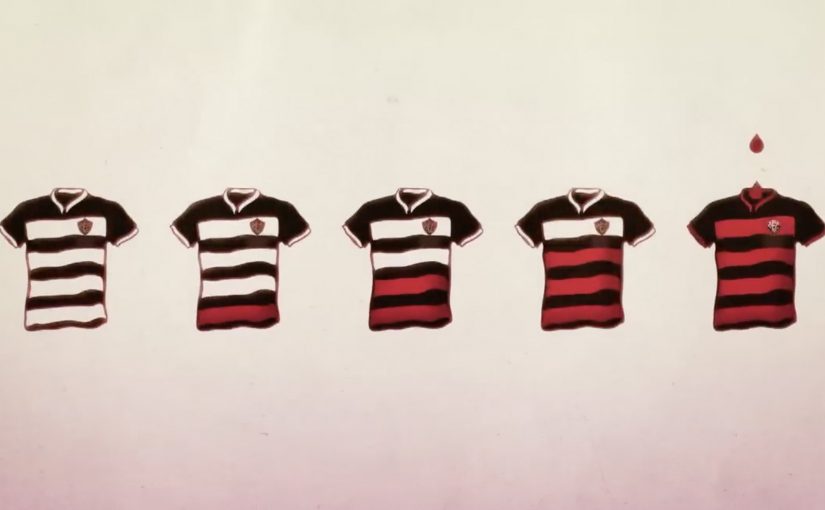
For the campaign, the football club changed the stripes of their iconic jersey from red to white. Then over the course of the season as the blood reserves rose, the team slowly changed the white stripes back to the original red.

As a result, the promotion is reported to have helped raise blood donation by 46%.

A club kit that doubles as a public scoreboard

This is a blood drive that refuses to stay in the background. Instead of asking people to donate “because it is important”, it turns the most visible symbol of the club into a live indicator of how the state is doing. This is a stronger behavior-change design than a standard awareness appeal, because the public scoreboard sits inside club identity.

How the stripe mechanic works

The mechanism is one clean promise. Remove the red from Vitória’s shirt, then bring it back only as blood reserves recover. Every step of progress becomes legible in the one place fans naturally look, the team’s colors.

In sports-led community campaigns, changing a core identity asset works because it creates a shared metric that everyone can track without explanation.

Why this lands beyond typical charity messaging

Most donation drives rely on abstract need. This one makes need visible and slightly uncomfortable, because fans are confronted with “missing red” every match week until they act. It also flips motivation from guilt to pride, because the act of donating becomes a way to restore the club’s full identity.

Extractable takeaway: If you need sustained participation, attach the cause to a symbol your audience already protects. Then turn progress into a public, binary signal that updates over time.

What the partnership is really doing

The campaign aligns incentives. The real question is how to turn a one-time act of goodwill into a shared public ritual that people keep joining. Hemoba gets reach and urgency without buying attention in the usual media sense. The club earns meaning and publicity by making its platform materially costly, because it “gives up” part of its kit until the community responds.

What to steal for your next behavior-change campaign

  • Make the metric visible. People act more when they can see progress, not just hear appeals.
  • Use a symbol with real emotional ownership. Identity assets beat posters, because people notice when they change.
  • Turn donation into restoration. “Bring something back” is often more motivating than “add something new”.
  • Design for weeks, not a day. A season-long mechanic sustains attention and creates multiple decision moments.

A few fast answers before you act

What is “My Blood Is Red and Black”?

It is a blood donation campaign in Bahia, Brazil, where Hemoba partnered with Esporte Clube Vitória and used the team jersey’s red stripes as a visible indicator tied to blood reserves.

How did changing the jersey drive donations?

By removing the red stripes and gradually restoring them as reserves improved, the campaign turned blood supply into a public signal that fans could track across the season.

Why does sports identity work for public health?

Because club colors, rituals, and match-week attention are already shared and emotionally charged. The campaign borrows that energy and redirects it into a concrete action.

Why is this stronger than a standard awareness appeal?

Because it does not ask people to care in the abstract. It makes the shortage visible through a symbol fans already watch, defend, and want restored.

What is the transferable principle here?

Make progress tangible. Link participation to restoring a valued symbol, and keep the feedback loop running long enough for people to join when they are ready.
Fiat 500 America: TwitBid Twitter Auction

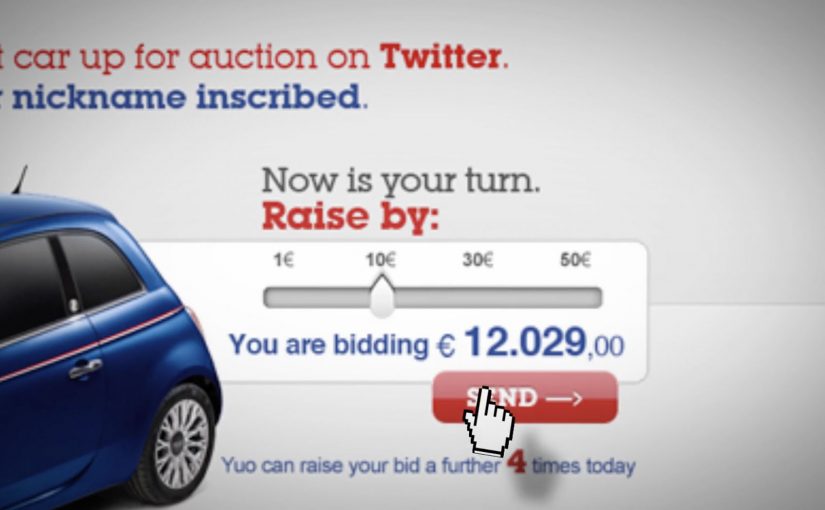
Fiat unveiled an exclusive limited edition run of 500 cars inspired by U.S. style at the Geneva Motor Show. Then, through a Twitter based auction, they made it possible to win the “number one” car (distinguished by a badge on the external pillar bearing the serial number 1/500 and the winner’s Twitter nickname) starting from a bid of €1.

To win the Fiat, participants were directed to follow @fiatontheweb on Twitter and then place a bid at www.500America.fiat500.com using their Twitter account. As a result, Fiat received 700 bids from 293 users, across 11 countries. A Twitter follower with a bid of €15,165 was declared the winner of the limited edition Fiat 500 America.

TwitBid turns a car launch into a public scoreboard

TwitBid is a Twitter-linked auction mechanic where each bid is tied to a visible handle. The smartest part is not the auction itself. It is the visibility layer. A bid is not a private transaction step. It becomes a social signal tied to an identity, which encourages escalation and turns the bidding ladder into content other people can watch unfold.

In brand launches with collector energy, mechanics that let fans compete in public create more momentum than mechanics that keep participation hidden.

What the mechanism is really doing

  • Make entry frictionless. The opening bid starts at €1, which makes “having a go” feel low risk.
  • Use identity as fuel. Bids are placed via Twitter, so the participant’s handle becomes part of the story.
  • Turn the object into proof. The “number one” car carries a visible 1/500 marker and the winner’s nickname, which makes the win feel permanent and collectible.

In global consumer launches where scarcity is real, a public scoreboard can turn a product drop into shared entertainment.

Why it lands

The real question is whether your launch mechanic turns every participant move into something other people can see. Most automotive launches ask people to admire. This one asks people to compete. The auction format creates scarcity pressure, and the Twitter layer adds social proof. Even if you do not bid, you can still follow the narrative of who is winning and how high it goes.

Extractable takeaway: If you want real participation, attach identity to action and make progress public. People engage longer when their move is visible, comparable, and tied to status.

What Fiat is really buying with this

The obvious outcome is a high price for the first car. The deeper outcome is attention that behaves like earned media. Each bid acts like a micro-broadcast, and the “number one” badge ties the online moment back to a physical artifact. That is a clean bridge between social platforms and product storytelling.

Launch moves to copy from TwitBid

  • Pick one scarce artifact. A single “first off the line” item is easier to explain than multiple prizes.
  • Make the ladder visible. Competition needs a scoreboard, not a form.
  • Build identity into the reward. A name, handle, or serialisation marker increases perceived ownership value.
  • Engineer the minimum increment. Small step sizes keep the contest active and make it feel winnable.

A few fast answers before you act

What is TwitBid in plain terms?

It is a Twitter-linked online auction where people place bids using their Twitter account to compete for a specific limited-edition item.

Why tie bidding to Twitter instead of a normal auction site?

Because every bid is tied to an identity and can become visible in the social stream, which increases reach and reinforces the competition dynamic.

What makes the “number one” car feel more valuable than the other 499?

It is positioned as the first unit off the line and visibly marked with serial number 1/500 plus the winner’s nickname, which makes it a one-off collectible.

What is the biggest risk with social auctions?

Friction and trust. If sign-in, bidding, or confirmation steps are unclear, participation drops. If rules feel opaque, the brand takes reputational damage.

What should you measure if you run a similar mechanic?

Unique bidders, bids per bidder, bid velocity over time, conversion from followers to registrants, and how much incremental reach the bidding activity creates versus paid media.

Sprint: Unlimited Love Billboard in Times Square

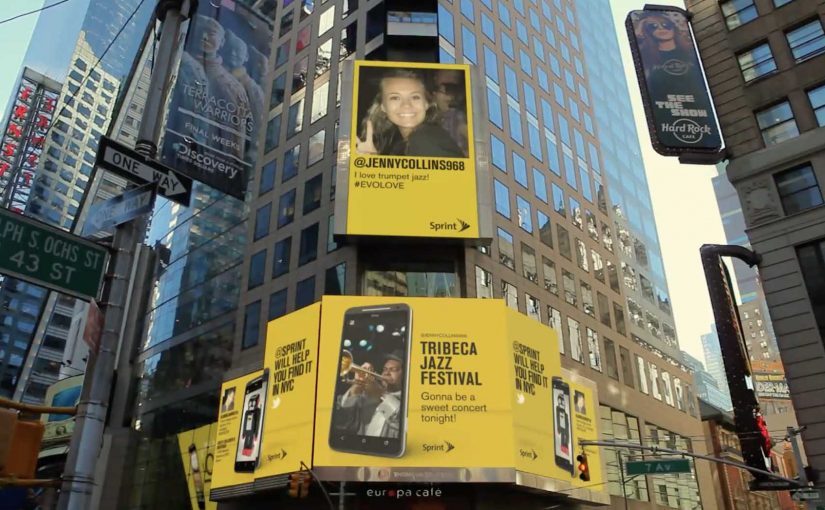
You are in Times Square and a billboard asks a simple question. What do you love. You tweet your answer with #EVOLOVE to @sprint, and the screen answers back with places in New York City where you can find it.

Sprint in the USA created an integrated advertising campaign for the launch of the HTC EVO 4G LTE phone on their network. To launch EVO in New York City they set up an interactive billboard in Times Square that encouraged visitors to tweet things they love with #EVOLOVE to @sprint. Then, with the help of local experts, the billboard re-tweeted locations of where these things of love could be discovered in New York City.

Why the mechanic works

The mechanism is a clean exchange. You give the brand a public signal. A tweet about something you love. The brand gives you an immediate, useful response. A location you can act on right now. That “reply with value” is what turns a hashtag prompt into participation.

Extractable takeaway: Interactive OOH works best when the public input reliably triggers a fast, specific reply that helps someone decide what to do next.

It also creates a visible social proof layer. The billboard is not only showing Sprint’s message. It is showing other people’s messages, which makes the campaign feel alive and current while you are standing there.

In consumer technology launches and telco marketing, a social-to-DOOH loop, where a social post immediately changes what the screen shows, turns a landmark screen into a real-time recommendation engine that people can influence from their own phones.

What Sprint is really buying

This is a launch tactic that behaves like service. It positions the EVO as a device you use to discover the city, not just a phone with specs. At the same time, it lets Sprint demonstrate “unlimited” as a lived experience. Always on, always connected, always responding in real time.

The real question is whether you can keep the reply layer fast, relevant, and brand-safe in public.

If you cannot operationalize that reliably, a simpler DOOH idea will outperform an “interactive” one that feels slow or generic.

Steal this reply-with-value billboard pattern

  • Make the input obvious. One hashtag. One handle. One sentence prompt.
  • Return something concrete. Maps, directions, a nearby place, a clear next action.
  • Curate the response layer. “Local expert” guidance beats generic automation for relevance and trust.
  • Design for the crowd and the clip. The street moment should be fun to watch. The video should still work without being there.

A few fast answers before you act

What is the Sprint #EVOLOVE Times Square billboard?

A digital billboard that invites people to tweet what they love with #EVOLOVE to @sprint, then responds by showing where in New York City they can find that thing.

Why connect Twitter to a billboard instead of running a normal DOOH spot?

Because participation becomes the content. The screen stays fresh, people feel seen, and the interaction creates a public spectacle that attracts more participants.

What is the “value exchange” in this campaign?

The user provides a public message and attention. The brand provides a timely, useful recommendation and makes the user visible on a high-profile screen.

What makes this different from simply displaying tweets on a screen?

The reply layer. The billboard does not only mirror tweets. It answers them with specific places and directions, which turns social chatter into utility.

What is the biggest execution risk?

If the responses feel slow, generic, or off-topic, people stop playing. The campaign only works when the replies feel genuinely relevant in the moment.