
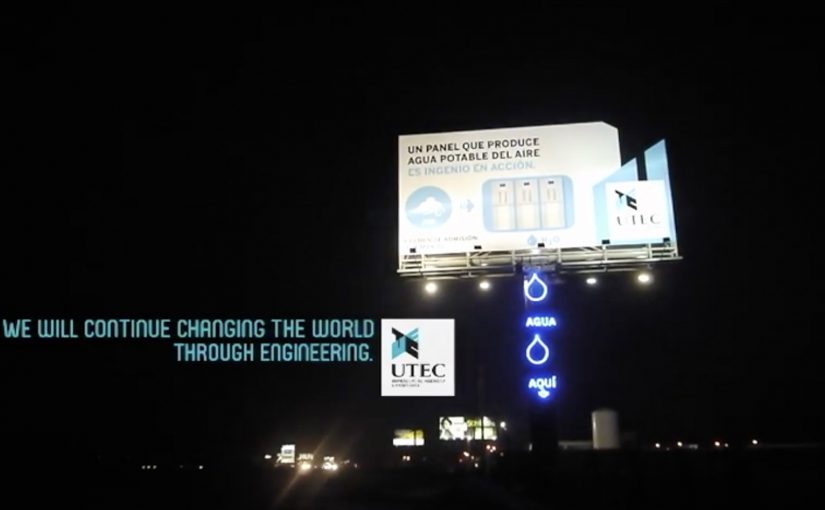
UTEC: Potable Water Generator

A billboard in Lima does not just advertise. It dispenses drinking water.

UTEC, the University of Engineering and Technology in Peru, believes engineering can change the world. To make that belief tangible and to attract future applicants, it tackles a local constraint. Lima is often described as a major capital city set on desert conditions, where rainfall is minimal, but atmospheric humidity can be extremely high. UTEC uses that humidity to build a billboard that is described as producing potable water out of air.

Definition tightening: This is atmospheric water generation. Moist air is captured, condensed into liquid, then treated so it can be dispensed as drinking water.

A recruitment message you can literally use

The mechanism is a public proof. Turn an engineering principle into civic micro-infrastructure, then let the infrastructure demonstrate the promise of the institution. You do not need to argue that engineering matters. You show it working on the street.

In urban Latin American contexts where infrastructure gaps are visible in daily life, recruitment marketing becomes more believable when the brand contributes something functional before it asks for attention.

Why it lands

It works because the outcome is immediate and legible. People understand “clean water from a billboard” faster than they understand any tagline about innovation. The board also flips the usual direction of advertising. Instead of taking attention, it gives utility, and that trade feels fair.

Extractable takeaway: If you want trust fast, build a single, real-world demonstration where your capability produces a public benefit, then make the benefit the headline.

What UTEC is really positioning

This is engineering as an identity. The university is not selling courses first. It is selling a worldview. Engineers notice constraints. Engineers build systems. Engineers improve the lived environment. The billboard makes that identity concrete, and the recruiting message follows naturally.

The real question is whether you can prove a capability in public before you ask people to believe the story around it.

What to borrow from UTEC’s water billboard

  • Pick one local constraint people feel. Water access is not theoretical. It is daily.
  • Make the demonstration self-explanatory. No app. No instructions. Just a visible result.
  • Let utility replace persuasion. If the object helps, the story spreads on its own.
  • Design the “proof moment”. A tap and a container beat any infographic.

A few fast answers before you act

What is “Potable Water Generator”?

It is a UTEC outdoor activation in Peru where a billboard is described as producing drinkable water from atmospheric humidity, turning engineering into a visible public service.

What is the core mechanism?

Capture humid air. Condense it into water. Treat it for safe consumption. Dispense it from the billboard so the benefit is immediate and observable.

Why is this also recruitment marketing?

Because it demonstrates the kind of engineering UTEC wants to be known for. Practical, applied, and aimed at solving local problems, not just talking about them.

What makes this more memorable than a standard awareness billboard?

The outcome is functional. People can use it, which turns the campaign into an experience and a story, not just a message.

What is the most reusable lesson?

When your brand promise is capability, prove it with one tangible demonstration that improves the environment people are standing in.
Turismo de Portugal: Cobblestone QR Codes

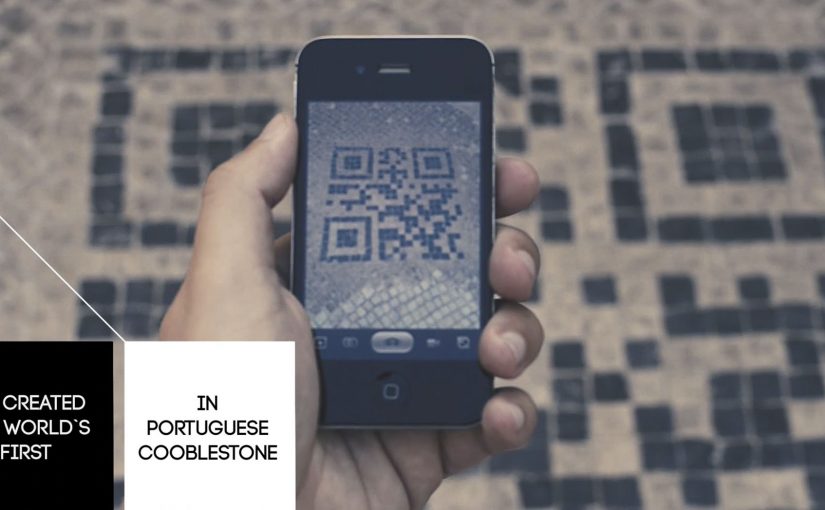
To get into the minds of tourists, Turismo de Portugal decides to fuse QR code technology with Portugal’s historical cobblestone tradition. The result is described as the first QR code made from Portuguese cobblestones.

The first QR code is embedded into the city ground in Lisbon, followed by an installation in Barcelona. Reported write-ups describe the campaign as successful enough to spark plans for similar cobblestone QR codes in other cities such as Berlin, Paris, Tokyo, New York, Vienna, Goa, Lima, and Oslo.

When street craft becomes the interface

The mechanism is simple. A familiar tourist behavior, looking down at the street and looking for cues, is turned into a scan trigger. The QR code is physically “native” to the place because it is built using the same black-and-white stone patterns people already associate with Portuguese streets, especially in historic areas like Chiado.

In destination marketing and city tourism promotion, bridging physical street culture to mobile content is a reliable way to convert foot traffic into deeper engagement. Destination brands should treat the street as the interface, not just the backdrop.

In European destination marketing, the most scalable activations turn street-level cues into a clear mobile doorway.

Why this lands with visitors

It does two jobs at once. It signals “authentic Lisbon” through material and craft, and it gives the tourist an immediate next step through their phone. The real question is how you turn a place’s own cues into a frictionless next step without making it feel like advertising. Unlike a poster or a billboard, the code is part of the ground people are already walking on, so discovery feels like finding something, not being targeted.

Extractable takeaway: If you want mobile interaction in public space, embed the call-to-action into something the place already owns. Local texture first, technology second. The scan should feel inevitable, not imported.

What to steal for your own place-based activations

  • Make the trigger belong to the environment. Use local materials, patterns, or rituals so the interaction feels contextual.
  • Design for tourist attention spans. The best street interactions reward a 5-second decision, not a long explanation.
  • Use “discovery” as the media buy. When people feel they found it, they are more likely to scan, share, and talk about it.
  • Plan for maintenance and legibility. Outdoor codes live or die based on wear, lighting, contrast, and camera-readability.

A few fast answers before you act

What is the Cobblestone QR idea in one sentence?

A QR code built into the street using Portuguese cobblestones, so tourists can scan a piece of the city itself to access content.

Why does making a QR code “physical” matter?

Because it turns a generic tech behavior into a place-specific experience. The scan feels like interacting with Lisbon, not with a random sign.

What makes this different from putting a QR code on a poster?

Placement and meaning. A poster is rented space. A street pattern is owned space. The medium carries authenticity before the message even loads.

What should the QR code open to?

A fast-loading mobile page that confirms you are in the right place and offers one clear next step. If the page feels generic or slow, the “found it” magic disappears.

What is the biggest execution risk?

If the code is hard to scan or the content behind it is weak, the novelty collapses. The physical build earns attention. The mobile experience must repay it.

Coca-Cola: Wallet of Happiness Honesty Test

An honesty test on a crowded Lima street

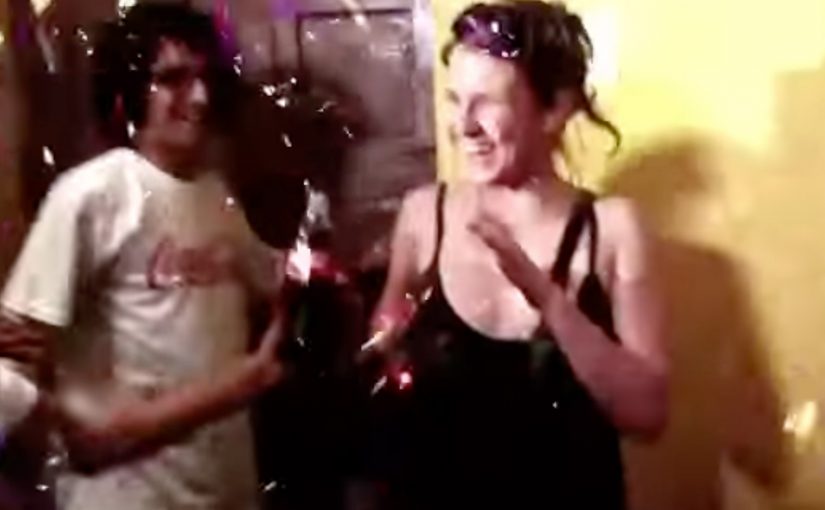
As part of an experiment in a very crowded Lima district in Peru, Coca-Cola with their agency McCann Erickson deliberately left a wallet containing $100 on the street. With it they tested people’s honesty.

A $100 question, asked in public

The brilliance is how quickly the situation reads. Find the wallet. Notice the money. Decide what kind of person you want to be, with nobody asking you anything.

In social experiment storytelling, a simple moral trigger creates instant comprehension and invites viewers to project themselves into the decision. Here, a moral trigger means a moment that forces a right-versus-wrong choice without explanation.

In global FMCG brand storytelling, street-level honesty tests like this travel because they turn a private value into a public, watchable moment.

Why you keep watching

You are not just judging strangers. You are quietly measuring yourself against what you hope you would do. The real question is what you do when the right choice is clear, but no one is holding you accountable. That internal comparison is the engine of the film. Because the choice is legible and unprompted, viewers can run the same decision in their own head, which keeps them watching.

Extractable takeaway: If your mechanic makes viewers instantly ask “what would I do,” the story carries itself without narration.

What the experiment is trying to reveal

People’s honesty, observed in a real public setting through a simple, high-stakes trigger.

What to borrow from a public honesty test

  • Choose a mechanic that is universal and legible without narration. In this context, “mechanic” means the simple rule that generates the behavior you want to capture.
  • Keep production minimal so human reaction stays central.
  • Let the audience do the interpreting. A good social test creates its own debate.

A few fast answers before you act

What did Coca-Cola do in Lima?

They left a wallet containing $100 on the street in a crowded district to test people’s honesty.

Where did this take place?

In a crowded district of Lima, Peru.

Who created the campaign?

The post credits Coca-Cola and McCann Erickson.

Why does the film hook people so fast?

Because the dilemma is instantly legible: you see the wallet, notice the money, and immediately imagine what you would do.

What was the point of the experiment?

To observe how people would react when they found a wallet with money in a real-world public setting.