
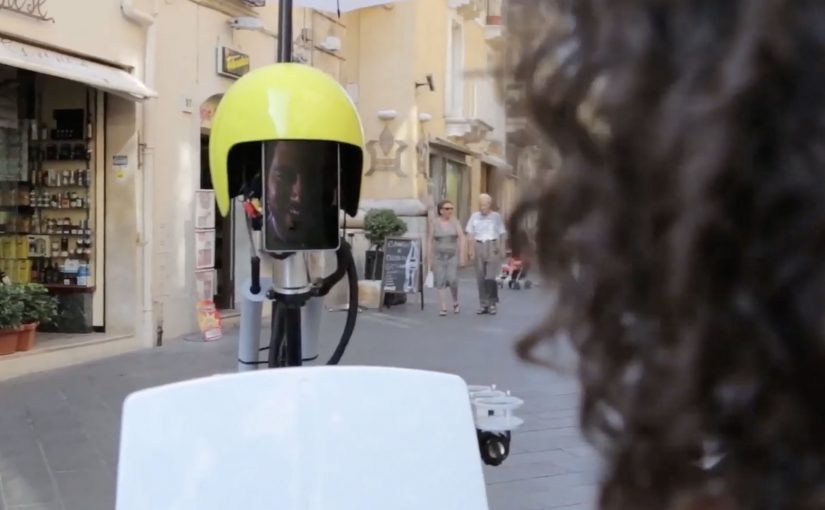
Social Robots: San Pellegrino and Coca-Cola

In 2011, Andes Beer in Argentina used robots in their campaign to enable people to virtually experience a real-life event. Fast forward to 2013 and social robots show up again, this time in campaigns from Italy and Israel. Here, “social robots” means telepresence robots used as remote-controlled avatars at live events.

When “social” becomes physical

The mechanism in both examples is telepresence. A robot with a webcam and microphone acts as a movable avatar in a real location. People at home control where it goes, what it looks at, and who it talks to, turning a distant event into something they can actively explore rather than passively watch.

In experiential marketing, telepresence robots let brands scale a place-bound moment to remote audiences without reducing it to a simple livestream.

Why the robot format lands

This works because it restores a missing ingredient of remote content. Presence. You are not only consuming footage. You are choosing what to look at, moving through the environment, and having real-time interactions that feel personal. Because telepresence combines viewer control with two-way contact, it turns remote viewing into participation. Telepresence is worth the operational hassle only when “being there” is the product. The real question is whether your remote audience needs presence, not just access.

Extractable takeaway: If your brand moment is tied to a physical place, give remote audiences viewer control over a live viewpoint. Even small control makes the experience feel earned, and earned experiences get talked about.

Three minutes in Italy

San Pellegrino invited Facebook fans to discover the Sicilian village of Taormina and explore its cobblestone streets via a webcam and microphone enabled robot controlled from their own computer.

Coca-Cola Summer Love 2013

Coca-Cola Summer Love is the annual summer event for Israeli teenagers. Not everyone can join in person, so Coca-Cola created robots that allowed teens to be part of the camp without leaving their homes. The robots carried webcams and microphones and were controlled by users who could not physically be there.

Users could navigate around the campus, talk with friends, watch shows, participate in competitions, and be part of the experience. The robots were welcomed, danced with, and treated like real attendees, becoming the “stars” and a natural media magnet inside the event.

Practical steals for telepresence events

  • Make control the feature. Remote access becomes meaningful when people can choose what happens next.
  • Keep interactions human-scale. Let remote users talk to real people, not just watch a feed.
  • Time-box the experience. Constraints like “three minutes” create urgency and reduce operational load.
  • Design for friendliness. The robot should invite social acceptance in the space, not disrupt it.

A few fast answers before you act

What is a “social robot” in these campaigns?

A telepresence robot that carries a live camera and microphone, letting a remote person control movement and interact with people on-site in real time.

Why is telepresence more compelling than a normal livestream?

Because it adds viewer control and two-way interaction. Control makes the experience feel personal, and two-way contact makes it feel like participation rather than content consumption.

What is the main operational risk?

Latency, connectivity, and crowd behavior. If the robot is hard to control or gets blocked, the magic disappears quickly.

Where does this pattern fit best?

Events, tourism, launches, and experiences where the value is being “there,” and where remote audiences have strong motivation but limited ability to attend physically.

How do you keep the robot from becoming a distraction?

Set simple on-site rules, give the robot a friendly presence, and design short, guided interactions so crowds do not block or hijack it.

Budweiser: Poolball, football on a pool table

Coming to a Buenos Aires pub near you is the newly minted sport of Poolball, created by Ogilvy Argentina for Budweiser.

Two teams meet on a giant 7×3 meter pool table. Fifteen soccer balls are reskinned to look like pool balls. The competitors use their feet instead of cues to score.

A new bar sport with a brand stitched into it

Poolball takes two things that already belong in the same evening. Football and beer. Then it adds a third. The “I could play that” simplicity of pool. The result feels less like a stunt and more like a playable product.

Extractable takeaway: Poolball is a brand activation that fuses two familiar games into one instantly understandable format, so people stop watching and start participating without needing instructions.

The mechanic: one rulebook, two rituals

The mechanic is the entire idea. A pool table scaled up to human size. Pool-ball visuals on footballs. Pool rules translated into foot play. When the mechanic is this legible, the content is self-explaining and the crowd becomes the amplification layer.

BTL is often used as shorthand for below-the-line activity. In practice, it means a brand experience designed to be felt in the real world, then shared because it is worth retelling.

In busy city bars and event spaces, the formats that spread fastest are the ones everyone can read at a glance.

Why it works in a pub

Bar-friendly activations win when they create quick status moments. You either played it, you watched someone nail a shot, or you filmed the chaos. Poolball naturally creates all three, because every “pocket” attempt is a mini highlight.

It also lowers the risk of participation. You are not learning a new sport. You are remixing two you already know, with rules you can copy by watching one play.

The intent behind the fun

The real question is whether your activation is a game people still want to play when the camera is off.

Budweiser is not selling a feature here. It is selling association. Big-game energy. Competitive banter. Social proof that the brand belongs in the centre of group nights out.

When the game is branded but not fragile, the brand becomes the host of the experience rather than the interruption inside it.

Poolball patterns worth stealing

  • Fuse, don’t invent. Combine two known behaviours so the audience understands the format instantly.
  • Make the object the media. A giant playable artefact beats a screen when your goal is participation.
  • Design for highlights. Build in repeatable “shot” moments people want to film and replay.
  • Keep rules visible. If someone can learn it by watching one round, you have the right complexity level.
  • Let branding be structural. Brand the experience itself, not every surface area with logos.

A few fast answers before you act

What is Poolball?

Poolball is a branded game format that combines football and pool. Players kick footballs designed like pool balls on a giant pool table and score using pool-style goals.

Why does this kind of activation travel well across venues?

Because it is easy to understand, easy to spectate, and it produces repeatable highlight moments. Venues like it because it creates crowd energy. Brands like it because the crowd documents it.

What makes the mechanic “shareable” without forcing sharing?

The visual contrast does the work. A human-scale pool table and “pool ball” footballs create an immediate “what is that” reaction, so filming feels natural rather than incentivised.

How do you keep a branded game from feeling like a gimmick?

Make it genuinely playable. Simple rules. Clear scoring. Quick rounds. If the experience is fun without the brand name, the brand credit comes for free.

What’s the minimum viable version of this idea?

A single hybrid rule, one striking physical cue, and one repeatable scoring moment. If people can explain it in one sentence, you have the right foundation.