
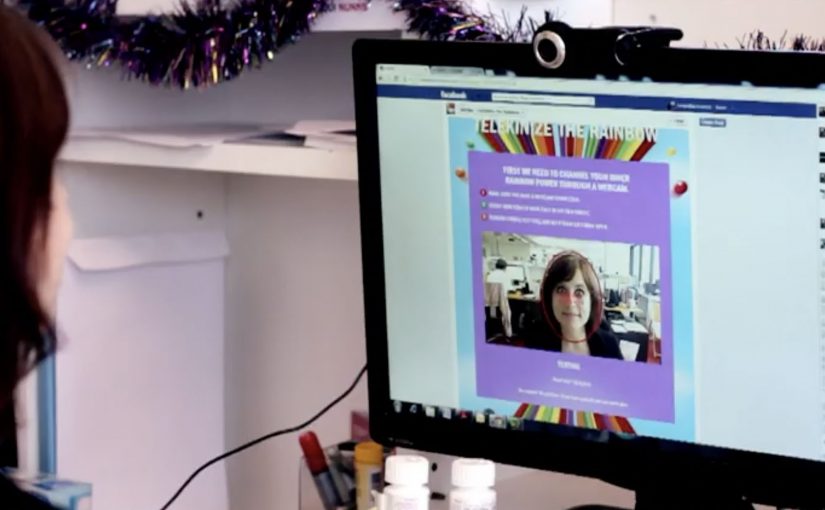
Skittles: Telekinize the Rainbow

You look at a single Skittle on a white surface, and it starts to move. The moment plays like telekinesis, the illusion that your mind can move an object. It is not a visual trick on a screen. It is a live feed of real Skittles being nudged around in the real world.

Skittles Australia and Clemenger BBDO build this as a Facebook experience because, as the case frames it, only a small minority of fans engage with a brand’s page after liking it. The goal is to make “like” feel like a superpower, not a dead end.

The trick is not mind control. It is eye control

The mechanism is webcam tracking plus a physical rig. Your eye movements, captured via webcam, are translated into commands sent to Wi-Fi-controlled robots attached to Skittles, so the candy moves in response to where you look.

In global consumer brands on social platforms, “engagement” only scales when interaction feels immediate and personal.

The real question is whether your activation turns a passive like into an active loop in under ten seconds.

In social platforms, turning passive likes into active participation usually comes down to one thing. Give people an interaction loop that feels immediate, personal, and worth showing to someone else.

Why it lands

It creates a clean “I need to try this” reaction in seconds. The live camera feed removes skepticism, and the physical motion makes the experience feel bigger than a typical Facebook app. It also bakes in a share-worthy narrative: the fan is not consuming content. The fan is controlling a real object.

Extractable takeaway: If you want engagement rather than reach, stop asking for attention and start granting control. A tiny moment of viewer control, tied to a brand asset, can outperform bigger content drops because the audience feels like the protagonist.

Campaign write-ups report that users spent an average of around four minutes interacting with the experience, and that page growth and app ranking spiked during the run.

What to steal for your next social activation

  • Make the mechanic visible. Live proof beats claims. If the audience can see it is real, they trust it faster.
  • Turn the brand into the interface. Here the “UI” is literally the product. That keeps the experience on-brand without extra messaging.
  • Design for one-person amazement and second-person sharing. The first user is impressed. The second user wants to replicate it.
  • Keep the loop short. Look. Move. React. Repeat. The faster the feedback, the longer people stay.

A few fast answers before you act

What is Telekinize the Rainbow?

A Facebook experience that lets people move real Skittles through eye movements captured by a webcam, with the motion executed by Wi-Fi-controlled robotics.

Is it actually mind control?

No. The “telekinesis” framing is the story. The control signal is eye movement, translated by software into physical movement.

Why is the live webcam feed important?

It proves the effect is happening in real space, which makes the experience feel more magical and more credible than a purely on-screen interaction.

Do you need eye tracking to borrow the pattern?

No. The transferable pattern is a tight input-to-output loop where the audience action clearly changes what they see, fast enough to feel like “power,” not a UI.

What is the main risk in copying this approach?

If setup friction is high or latency is noticeable, the illusion collapses. Experiences built on “power” need instant response to feel real.
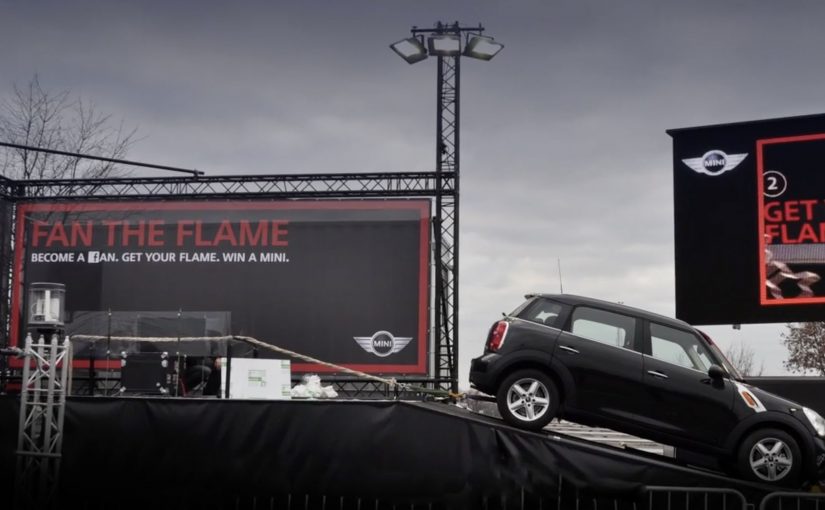
MINI: Fan the Flame

MINI, together with TBWA\Agency.com, creates a social spectacle to grow the fan base for its newly launched Facebook page in Belgium and Luxembourg.

The setup is as physical as it gets. A MINI Countryman is attached to a thick rope in the parking lot of the Brussels Motor Show, with a burner placed beneath the rope. Facebook fans are encouraged to remotely trigger the burner and shoot flames at the rope. A webcam broadcasts the scene 24×7, and the fan whose flame ultimately breaks the rope wins the MINI Countryman.

Why this is a “like” campaign people actually talk about

Most fan-growth ideas are transactional: click like, get content. This one makes the click feel consequential. Each interaction is a tiny act of sabotage against a real-world object, with a visible scoreboard outcome. The page is not just where the brand posts. It is the control panel for the event. This is the better pattern when you need fast fan growth without training people to expect freebies.

Extractable takeaway: If you want people to talk, make the social action change a visible system, then let the audience verify progress live.

The mechanism: remote control plus live proof

Mechanically, the campaign combines three ingredients: a simple trigger (fan action), a physical system (rope and flame), and continuous proof (the live webcam). The webcam is crucial because it converts a remote interaction into trust. People can see that something is actually happening, continuously, with no editing.

In European automotive social campaigns, linking digital participation to a live physical outcome is one of the fastest ways to create earned attention, meaning people talk and share without paid amplification, beyond the fan base itself.

What the prize is really doing

The real question is whether your social channel is just a feed, or a place where the audience can change something that matters in real time.

The MINI Countryman is not only incentive. It is also the symbol. The closer the rope gets to breaking, the more the prize feels “reachable”, which keeps people checking back and telling friends to join. The prize turns time into tension.

What to copy for your next live activation

  • Make the interaction visible. Live video proof makes remote participation feel real.
  • Use a simple mechanic with cumulative progress. People return when they believe their action contributes to a final outcome.
  • Put the brand in the role of facilitator. The page becomes the place where something is happening, not just the place where posts appear.
  • Design for suspense. A slow-burn system creates anticipation and repeat visits.

A few fast answers before you act

What is “MINI Fan the Flame” in one line?

A live contest where Facebook fans remotely trigger flames to burn through a rope holding a MINI Countryman, with the fan who breaks it winning the car.

Why does the webcam matter?

It provides continuous proof that the event is real and progressing, which sustains trust and repeat engagement.

What behavior is this campaign optimizing for?

Fan acquisition plus repeat visits. The tension mechanic encourages people to return and recruit others.

What is the transferable lesson for other brands?

If you want scale, connect digital actions to a visible physical outcome and design the system so progress builds suspense over time.

What is the minimum viable version of this mechanic?

Combine one clear trigger, one physical system that visibly changes, and one always-on proof stream so participants can verify progress without edits.