
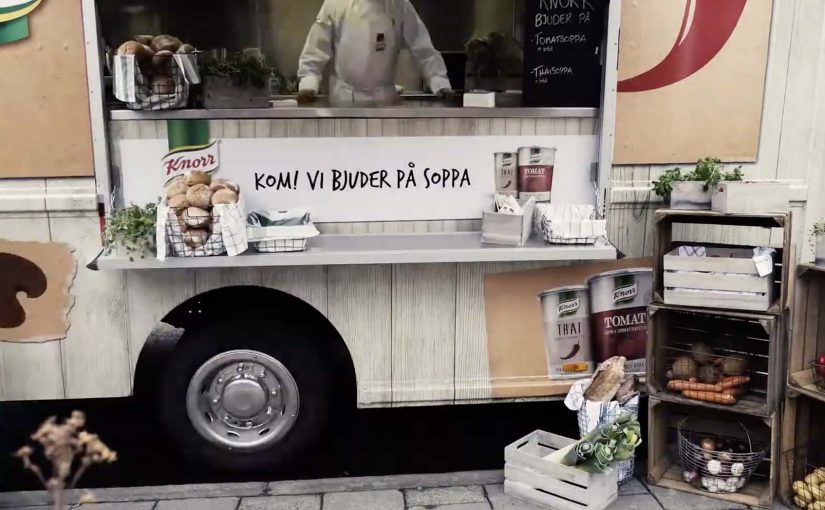
Knorr physical retargeting: iBeacon soup truck

In November, a Knorr food truck in chilly Stockholm offers free warm samples of the brand’s tomato and Thai soups. Visitors can eat it on the spot or take home the samples.

To ensure visitors can also be retargeted through relevant mobile ads, Knorr equips the truck and the sampling team with battery-powered iBeacons. Through these beacons, visitors who already have the Swedish newspaper Aftonbladet app installed are registered as having been there. Instead of pushing a coupon immediately, the campaign waits until the next time the user opens the Aftonbladet app, then serves the offer as a mobile ad on the start screen.

In FMCG sampling, delayed retargeting works best when the message arrives in a natural “open app” moment, not as an intrusive push at the street corner.

Physical retargeting is the practice of using a real-world visit as the trigger for a later digital message, so the follow-up feels connected to what the person actually did offline.

Why the timing choice matters more than the beacon

The iBeacons are the plumbing, but the experience design is the restraint. The campaign avoids interrupting the sampling moment and instead chooses a later point of attention when the person is already browsing content. That shift makes the offer feel more like a relevant reminder than a forced conversion attempt.

What the campaign proves, beyond “we can target”

Sampling often struggles with attribution. This approach creates a cleaner bridge between the street interaction and a measurable mobile impression, without requiring a QR scan or a form fill at the truck.

What to steal for your own offline-to-mobile loop

  • Separate experience from conversion. Let the street moment stay human, then follow up later in a calmer context.
  • Use a trigger the user already understands. “When I open the app, I see it” is easier than “enable Bluetooth, accept three prompts”.
  • Keep the reward aligned. A soup sample followed by a soup coupon is a coherent loop.
  • Design for opt-in environments. The cleanest versions of this pattern run inside existing app ecosystems where ads are already expected.

A few fast answers before you act

What is Knorr “physical retargeting” in this example?

It is an offline-to-online marketing loop where visiting the soup truck becomes the trigger for receiving a relevant offer later inside a mobile app.

Why not show the coupon immediately at the truck?

Because immediate prompting can feel invasive and can disrupt the sampling experience. Waiting until the next app open delivers the offer in a more natural attention moment.

What role does the Aftonbladet app play?

It is the environment where the follow-up ad appears. People who already have the app installed can be recognized as having visited and later see the offer when they reopen the app.

What is the core benefit for the brand?

It links a real-world sampling touchpoint to a measurable, relevant mobile follow-up, improving recall and making conversion more likely.

What is the biggest failure mode for this tactic?

If the follow-up arrives too late or feels unrelated, it reads as generic targeting. The timing and message match are what make it feel earned.
Kellogg’s Tweet Shop: Pay with a tweet

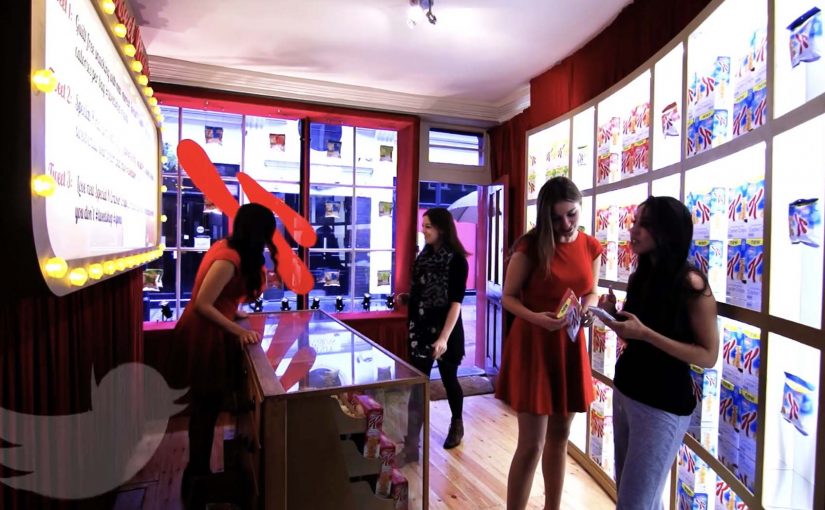
Last month in London, Kelloggs setup a pop up store where passers-by who walked in could try the low calorie snacks and then post a review on Twitter. “Special K girls” in red dresses who manned the store, checked each customer’s tweet before handing over a packet of Special K Cracker crisps.

How the Tweet Shop turns sampling into distribution

The mechanic is deliberately lightweight. Walk in, try the product, then publish a short reaction on Twitter before you leave. Staff verify the tweet on the spot, then you get a pack to take away.

A “pay with a tweet” activation is a pop-up retail format where the transaction is a public social post rather than money, converting product sampling into earned reach and searchable social proof.

In global FMCG marketing, this kind of social-to-sample loop works when the “payment” is fast, public, and directly tied to a tangible reward.

Why it lands: the tweet is both receipt and recommendation

Most sampling disappears into a bag with no trace. Here, the brand creates a visible record of trial. Each tweet acts like a receipt that confirms participation, and a micro-endorsement that other people can stumble on later.

The red-dress staffing is not just costume. It makes the interaction unmistakably “Special K” in photos, which helps the moment travel beyond the store.

What Kellogg’s is buying with “social currency”

  • Frictionless trial. People try a new product with zero financial risk.
  • Instant word of mouth. Reactions publish in real time, while the experience is still fresh.
  • Searchable proof. A hashtag-based trail can cluster impressions and sentiment in one place.
  • High street theatre. A pop-up adds “I was there” energy that a standard promo rarely achieves.

What to steal for your next “pay with a post” idea

  • Make the ask specific. Tell people exactly what to post and keep it short enough to do without thinking.
  • Verify fast. The handover moment should feel immediate, or it stops being fun.
  • Reward honesty. If you only want praise, people feel manipulated. If you invite real reactions, the format feels fair.
  • Design the store for photos. If the space is not camera-ready, you waste the free distribution you just created.

A few fast answers before you act

What is the “Tweet Shop” concept in simple terms?

It is a pop-up shop where people receive a product after posting a tweet about their experience, with staff checking the post before the handover.

Why would a brand accept tweets instead of money?

Because a public post can create awareness and credibility at scale, while the product cost stays predictable and controlled.

What makes this different from a normal free sample?

The sample creates a visible social trace. Each person who tries it leaves behind a shareable review that others can discover.

What is the biggest risk with “pay with a tweet” activations?

If the ask feels forced or takes too long, people opt out. If the experience is not worth sharing, the format collapses into awkward bribery.

How do you judge whether this worked?

Track trial volume, unique posts, sentiment, and whether conversation continues after the pop-up closes, not just during the event.

Xerud the lover’s fortuneteller

The sales of Durex Taiwan were on the decline. To increase condom purchases they needed to remind their young audience of the risks of unprotected sex. This was effectively done in other markets via sampling. Given the cultural taboos in Taiwan, regular promoters in the streets were not being able to achieve the daily contact goals.

OgilvyAction was given the challenge to find a new and more effective way to get the Durex products into the consumers hands and start a conversation. The insight Ogilvy had was that all Taiwanese frequently consult fortune-tellers to know their fate in wealth, health and especially love. With a very limited budget they created an unbranded fortune-teller machine called “Xerud” and placed it in bars, nightclubs and karaoke bars.

“Xerud” handed out predictions related to one’s sexual life and relationships together with a sample condom based on the forecast and the product benefits. The sample pack also contained educational tips about safe sex.

On an average a street promoter hands out 23 samples an hour. “Xerud” handed out an average of 77!