
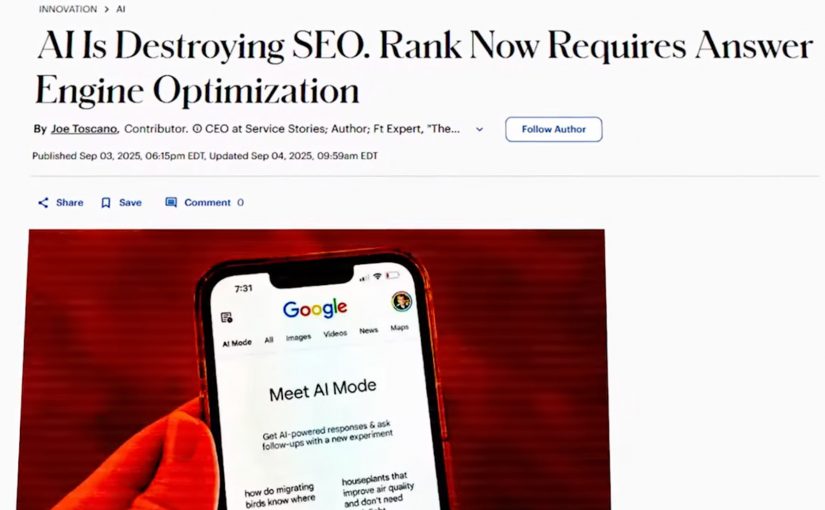
How to Rank #1 with Answer Engine Optimization

SEO is becoming AEO. From clicks to citations

Answer Engine Optimization (AEO) is the practice of structuring content so AI-powered search experiences can extract, summarize, and cite it as the best answer to a user’s question. Traditional SEO optimizes for blue-link rankings and click-through. AEO optimizes for inclusion and citation inside the answer itself.

That is the practical difference. Traditional SEO is built to win rankings and clicks. AEO is built to win inclusion in the answer itself by making your content easy to parse, easy to trust, and worth citing inside Google AI Overviews and AI-driven search experiences.

If you want to “rank #1” in the AI era, stop treating search as a list of links and start treating it as an answer ecosystem. Publish content that is easy to extract, unambiguous in structure, and defensible with evidence. Evidence means primary sources, concrete numbers, named examples, and claims you can back up with reputable third-party references. Then reinforce it with authority signals beyond your site, because answer engines learn trust from repeated third-party validation.

The video above breaks down a practical 6-step AEO framework any brand can implement immediately. The objective is simple. Earn the citation, not just the click.

A 6-step AEO framework brands can implement now

  1. Target long-tail conversational questions
  2. Prioritize low-competition AEO opportunities
  3. Match informational intent, then design a conversion path that fits
  4. Optimize for multi-feature SERP visibility, not one placement
  5. Build brand authority through third-party mentions and citations
  6. Run an AEO gap analysis to find where competitors are cited and you are not

The winners will be the brands whose pages are consistently extractable and consistently corroborated. They become the sources AI systems cite when summarizing a category, problem, or decision. The losers will be the ones still optimizing only for yesterday’s SERP.

As AI summaries appear more frequently across search results, the competitive battleground shifts upward. Visibility concentrates inside the generated answer. The winning strategy becomes “earn the citation,” not just “earn the click.”


A few fast answers before you act

What is Answer Engine Optimization (AEO)?

Answer Engine Optimization is the practice of structuring content so it can be directly extracted and used as an answer by AI systems and modern search interfaces. The goal is to be the cited, summarized, or recommended response when the interface returns answers instead of links.

How is AEO different from SEO?

SEO primarily optimizes for ranking in a list of results and earning clicks. AEO optimizes for being included in the generated answer itself. SEO still matters, but AEO focuses more on extractability, clarity, and trusted corroboration.

What is the fastest way to make a page “answerable”?

Use clear headings that match real questions, then answer each question in one concise paragraph before expanding. Define terms explicitly. Use short lists where helpful. Remove ambiguity so an AI can quote or summarize accurately.

What page structures tend to perform best for AEO?

Pages with a strong, focused topic; clear H2 and H3 hierarchy; direct definitions; step-by-step guidance where relevant; and tightly written Q&A near the end. The structure should make it easy to extract the most important claims without reading the full article.

What types of questions should you include?

Include definitional questions (what is), comparison questions (what’s the difference), decision questions (how to choose), and action questions (what to do next). These map to how people search and how answer systems assemble responses.

How do you improve your chances of being included in AI answers?

Make your entity and topic signals consistent across your site. Use the same names for products, concepts, and frameworks. Support claims with specifics. And ensure the page aligns to one primary intent so the system can confidently select it.

What should you measure if clicks decline but visibility increases?

Track inclusion. Monitor whether your brand or page is referenced in AI answers for your key topics. Combine that with classic metrics like impressions, branded search lift, and downstream conversions, because the click is no longer the only proof of impact.

What is a practical starting playbook for AEO?

Pick 10 to 20 pages that already perform well or match your core topics. Add a clean question-based heading structure. Write crisp answers first, then detail. Ensure internal linking reinforces the same entity and topic cluster. Iterate based on query themes and inclusion signals.
Why #1 on Google Might Be Worthless in 2026

The uncomfortable truth about “ranking #1”

My view is simple. A #1 Google ranking can still be useful, but it is no longer the finish line. As AI-driven search experiences answer questions directly, the click is no longer guaranteed. In many queries, the “winner” is the brand that gets mentioned inside the generated answer, not the page that sits at the top of the classic results.

Traditional SEO has been optimized for blue links. The new battleground is whether an answer engine chooses to reference your brand at all, and whether it trusts your brand enough to recommend you in context.

Why AI can ignore your best ranking

When the interface becomes an answer, rankings become a weaker proxy for visibility. You can rank first and still lose the moment the user’s intent is satisfied before they ever scroll. That changes what “value” means. The value shifts from traffic capture to brand inclusion, brand recall, and being presented as the default option inside the recommendation layer.

There is a second shift that matters even more. AI systems do not just retrieve pages. They form a view of the world using entities and relationships. If your brand is not clearly understood as an entity, or not strongly connected to the right categories, problems, and alternatives, you can lose the mention even when you “win” the ranking.

In modern discovery journeys, being cited by answer engines increasingly functions as the new top-of-funnel, even when classic rankings remain strong.

GEO is the new layer on top of SEO

Generative Engine Optimization (GEO) is how you improve your probability of being included in AI answers and AI recommendations. The lever is not only keywords and backlinks. The lever is entity clarity and entity corroboration.

Think of GEO as building a machine-readable and human-validated identity for your brand, product, people, and category. Then reinforcing it with consistent signals across the web so an AI system can confidently connect the dots.

A practical example. When entity strength beats ranking strength

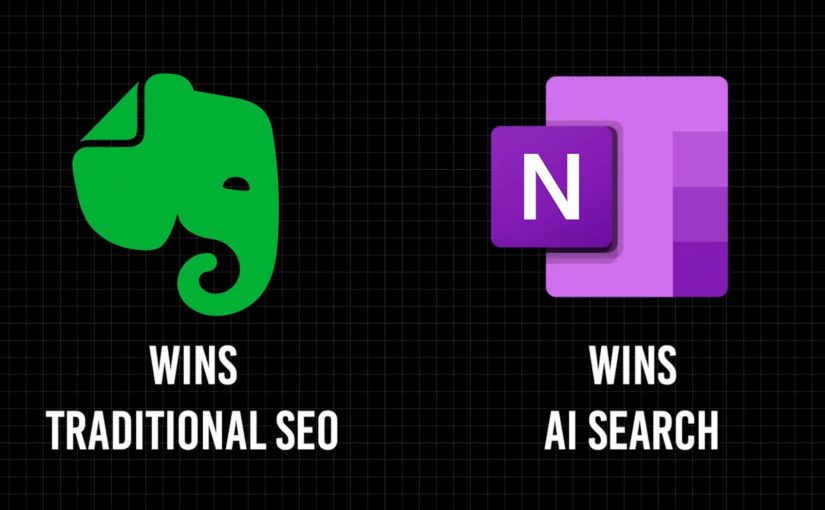
The video illustrates the shift with a simple scenario. An AI-driven recommendation can favor Microsoft OneNote over Evernote, even if Evernote looks stronger in classic Google results for certain queries. The implication is uncomfortable but actionable. The recommendation layer is not a pure reflection of rankings. It reflects how confidently the system can identify entities, connect them to the category, and justify a suggestion.

The video also highlights another reality that reduces classic SEO control. Google can rewrite meta descriptions, which means your carefully crafted SERP message can be replaced by what Google believes best matches the query. That makes “ranking” an even less reliable lever for narrative control.

The new tactics. Build and clarify entities

If GEO is the goal, the playbook changes from “optimize pages” to “optimize understanding”.

  1. Treat your brand as an entity system, not a website
    Define the entities you want AI systems to recognize: your brand, your flagship products, your category terms, your spokespeople, your differentiators, and your comparison set. Then ensure you use consistent naming and consistent descriptions across your owned properties.
  2. Make your content extractable and unambiguous
    Write so answers can be lifted cleanly. Use clear headings, crisp definitions, scannable lists, and explicit statements that do not require interpretation. This is where SEO structure and AEO structure become practical GEO enablers.
  3. Corroborate your identity across the web
    GEO rewards real-world confirmation. Genuine mentions, real customer conversations, and durable multi-channel presence matter because they create distributed, consistent signals. Those signals strengthen entity credibility and relationships over time.
  4. Align metadata with how people actually ask
    If Google rewrites descriptions, you still want your page to provide the best candidate text. Align titles, headings, and on-page summaries with the question patterns your audience uses. That increases the probability that your message survives the rewrite layer and remains coherent in snippets and summaries.
  5. Measure inclusion, not only traffic
    In 2026, a meaningful KPI is whether you are included in AI answers and recommendations for your category, and how often. Rankings and clicks still matter, but they no longer explain the full picture of visibility.

The takeaway for brand leaders

If your strategy still treats #1 ranking as the ultimate outcome, you are optimizing for a shrinking slice of visibility. The stronger strategy is to earn inclusion. Make your brand easier to identify, easier to connect, and easier to justify as an answer. That is what keeps you visible when the interface stops being a list of links and starts behaving like a decision engine.


A few fast answers before you act

Can ranking number one on Google still matter?

Yes. It can still drive clicks. But it does not guarantee inclusion in AI answers, summaries, or shopping and assistant experiences that bypass click-through.

Why can an AI answer ignore the top result?

Because answer engines prioritize synthesis, entity credibility, and cross-source consistency. They may select sources that are clearer, more attributable, or better structured for citation.

What is GEO in plain terms?

Generative Engine Optimization is the practice of making your brand and content easy to reference, quote, and cite in AI-generated answers. It builds on SEO but targets “mentionability” and attribution.

What is the most practical GEO move?

Strengthen entities and definitions. Make key claims easy to extract. Use clear naming, consistent terminology, and standalone paragraphs that answer common questions directly.

What should leaders measure if clicks decline?

Track visibility in answer engines, share of voice in citations, branded search lift, and downstream conversion quality. Treat “being cited” as a measurable distribution channel.

Volkswagen: Image Search SEO as an “Organic Ad”

When the “ad” is the search results page

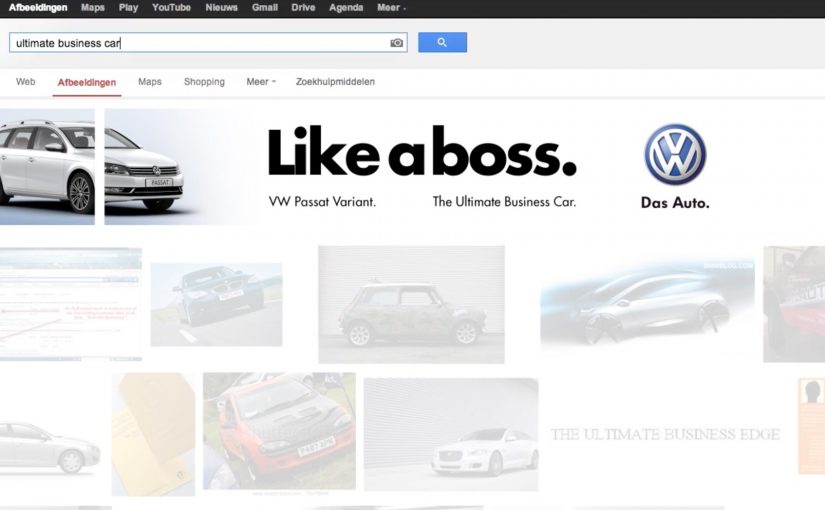
Everyday millions of people are searching for products and brands on Google. So in this latest example of search optimisation, SEA Team from UK created a search engine advertising campaign for Volkswagen which positioned the car in a unique “organic ad” created by optimising the first five individual URLs of a Google Image Search.

The campaign does feel realistic but when I searched for “ultimate business car”, I got only images from people posting about the campaign.

The hack: assemble a creative out of ranked tiles

The idea is essentially compositional SEO. You do not buy a placement. You engineer multiple image results so the grid itself becomes one coherent “ad.” The medium is the interface people already trust.

Why it is both clever and fragile

It feels native because it lives inside an everyday behavior. searching. But the moment the campaign becomes the story, the query gets polluted. Your “proof” starts returning meta-content about the stunt, not a stable, normal-looking result set.

What this is really trying to achieve

Borrow the credibility of organic results while delivering the impact of a designed creative. A brand moment that lives exactly where intent lives.

What to steal. And what to watch out for

  • Use interface-level creativity. Sometimes the container is the canvas.
  • If you rely on organic authenticity, plan for contamination once the stunt spreads.
  • Pick queries and mechanics where the effect can survive time, press, and copycats.

A few fast answers before you act

What was the Volkswagen “organic ad” concept?

A campaign that optimized the first five source URLs in a Google Image Search so the image grid formed a single Volkswagen creative.

Who created it?

The post credits SEA Team from the UK.

Why does it feel realistic at first?

Because it appears inside an organic search behavior and uses the familiar image-results interface as the placement.

What problem did the post observe when trying it later?

Searching for “ultimate business car” returned mostly images of people posting about the campaign, rather than a clean, normal-looking result set.