
Air China “Facebook Check Ins”

Air China “Facebook Check Ins”

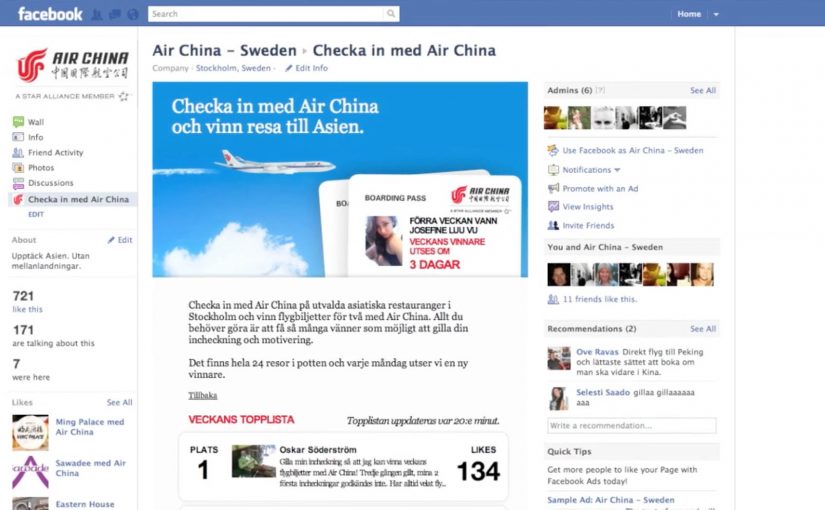
You visit a popular Asian restaurant in Sweden, check in with Air China on Facebook, and instantly become part of a live leaderboard. The more you check in, the higher you climb. Each week, the top check-in users earn two complimentary tickets to Asia.

Air China flies not only to China but also throughout Asia. The challenge is how Air China raises Swedish consumers’ awareness about this fact. In response, their ad agency Rodolfo creates a Facebook check-ins campaign.

How the campaign works in the real world

A select number of popular Asian restaurants in Sweden are transformed into ambassadors for Air China. At the restaurants, guests are encouraged to check in with Air China on Facebook.

What makes it competitive and shareable

The check-ins are aggregated on the Air China Facebook page, and a complete leader board of the highest number of check-ins and the most popular restaurants is displayed. Each week, the users with the highest number of check-ins are awarded two complimentary tickets to Asia.

In market categories where route awareness is broader than one destination, brands need a way to move from static claims to lived proof in everyday settings.

Why this format fits airline awareness

The activation connects everyday behaviour to a clear brand message. Because the action happens in Asian restaurants and the leaderboard makes repeat visits visible, the idea of “Asia access”, meaning one airline that can take you to multiple destinations across Asia, feels immediate, social, and measurable without needing a hard sell in the moment.

Extractable takeaway: When a brand promise is broader than what people currently remember, attach it to a repeatable action in a context that already signals the message.

The real question is whether the brand can turn ordinary social behaviour into repeated proof of a broader route network. The business intent is to expand Air China’s mental availability beyond China and into Asia as a travel network. This is a smart awareness play because the reward, venue, and social mechanic all reinforce the same message.

What to steal from this airline check-in mechanic

  • Use context as your media: Turn partner venues into “brand ambassadors” when the venue naturally signals your message, here Asian restaurants reinforcing broader Asia access.
  • Design for 10-second participation: Use a repeatable, low-friction action, check-in, that people can do in seconds, in a context where sharing already feels normal.
  • Add a progress mechanic: Include a visible scoreboard, leaderboard, so the behaviour has a reason to repeat, not just a reason to start.
  • Run on a clear cadence: Weekly winners keep urgency high and create multiple chances to participate without complexity.
  • Make the reward reinforce the promise: Align incentives tightly to the brand claim, tickets to Asia, so every mention strengthens recall.

A few fast answers before you act

What is the core idea of this campaign?

Turn physical venues into social triggers. Restaurants prompt people to check in with Air China, and the accumulated check-ins become the campaign scoreboard.

Why use restaurants as campaign ambassadors?

They are culturally relevant touchpoints for Asia in Sweden, with built-in footfall and a natural reason for people to share where they are.

What role does the leaderboard play?

It creates a simple competition loop. People see progress, compare against others, and repeat the behaviour to climb. That repetition drives reach and recall.

What is the incentive design lesson here?

Make the reward perfectly aligned with the promise. Tickets to Asia are a direct reinforcement of Air China’s broader Asian network, not a generic prize.

What should a brand copy first from this format?

Start with the triad, not the platform: a relevant venue, a low-friction repeat action, and a reward that proves the brand promise. That is the reusable structure.
FRANK Oslo: Giuliani 9/11 Tweets

FRANK Oslo: Giuliani 9/11 Tweets

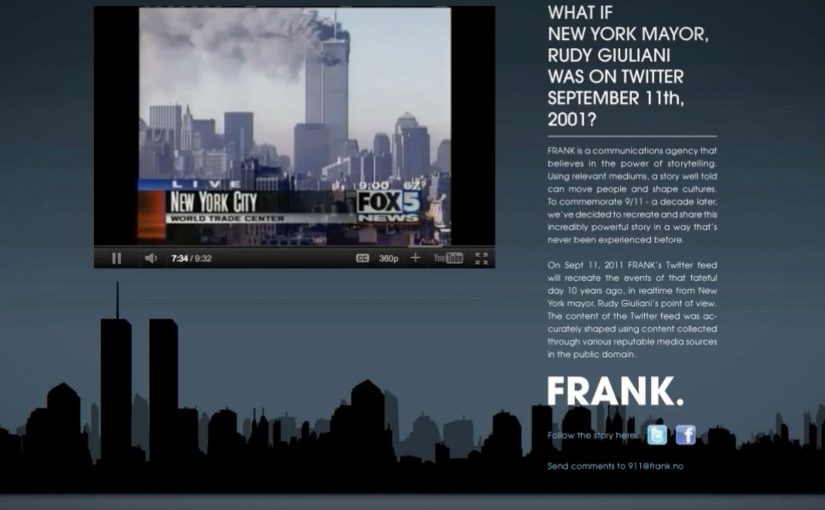
You follow a Twitter feed as if it is happening now. Updates arrive minute by minute, building confusion into urgency, then urgency into shock. The feed is written from New York mayor Rudy Giuliani’s point of view, and it recreates September 11, 2001 in real time.

FRANK is a communications agency from Oslo that wants to demonstrate the power of storytelling through the right medium. To commemorate 9/11 a decade later, they recreate and share the day as a live social stream experience.

On September 11, 2011, FRANK’s Twitter feed recreated the events of that day ten years earlier in real time from Giuliani’s point of view. The feed is described as being shaped using content collected from reputable public-domain media sources.

Real-time remembrance as a platform-native documentary

The mechanism is simple and specific. A single account publishes a paced sequence of posts that map to the original timeline, written in a constrained perspective, so the audience experiences the narrative in the same format they use for breaking news.

Here, platform-native means the story is built for the feed itself, not merely promoted through it.

In crisis and remembrance communications, real-time formats can make historical events feel immediate without changing the facts.

Why it lands

The power is in the temporal constraint. Real-time pacing prevents the viewer from jumping to the ending, which recreates uncertainty and heightens attention. The Giuliani viewpoint acts as a narrative spine, giving the stream a human decision-maker and a consistent voice, rather than a collage of headlines. It is a reminder that storytelling is not only what you tell, but also how you sequence it and where you let people experience it.

Extractable takeaway: If you want audiences to feel the weight of a known story, constrain the format. Pick one viewpoint, match the original timeline, and let pacing do what exposition cannot.

What the campaign is really doing

This is a proof of medium choice. The real question is whether the medium can carry remembrance with the same urgency as the original news cycle. Twitter is not used as a promotion channel. It is used as the container for the story. The campaign demonstrates that a platform-native structure can increase empathy and attention for complex events, while staying grounded in documented reporting.

What to steal from this real-time storytelling pattern

  • Choose one perspective. A single viewpoint makes large events navigable and coherent.
  • Use timing as a creative constraint. Real-time sequencing creates tension and attention without additional production.
  • Build credibility into the sourcing. If you rely on archival material, describe your source discipline clearly.
  • Match story to medium. The most persuasive channel is sometimes the format people already trust for “live” information.

A few fast answers before you act

What is FRANK Oslo’s “Giuliani 9/11” idea?

A real-time Twitter reconstruction of September 11, 2001 from Rudy Giuliani’s viewpoint, published ten years later to let audiences experience the timeline through a live-feed format.

Why use Twitter instead of a film or article?

Because the platform format is the point. A feed is how people experience unfolding events, so the campaign uses that native behavior to recreate pacing and uncertainty.

How does the single viewpoint help?

It creates narrative continuity. Viewers follow one decision-making perspective rather than switching between fragmented sources.

What is the main credibility requirement for this pattern?

Source discipline. If you claim accuracy, you need a clear method for selecting, verifying, and sequencing archival material.

When should you use real-time reconstruction?

When the goal is remembrance, education, or empathy, and when pacing and sequence are essential to understanding the human experience of the event.

Turkcell: #Turkcelltweet Live Unboxing

Turkcell: #Turkcelltweet Live Unboxing

Turkcell was launching new smartphones bundled with mobile internet and wanted to build awareness among heavy internet users. So Turkcell’s agency, Rabarba from Istanbul, created a live Twitter competition designed to pull exactly those people in.

A Twitter game that literally unwraps the prize

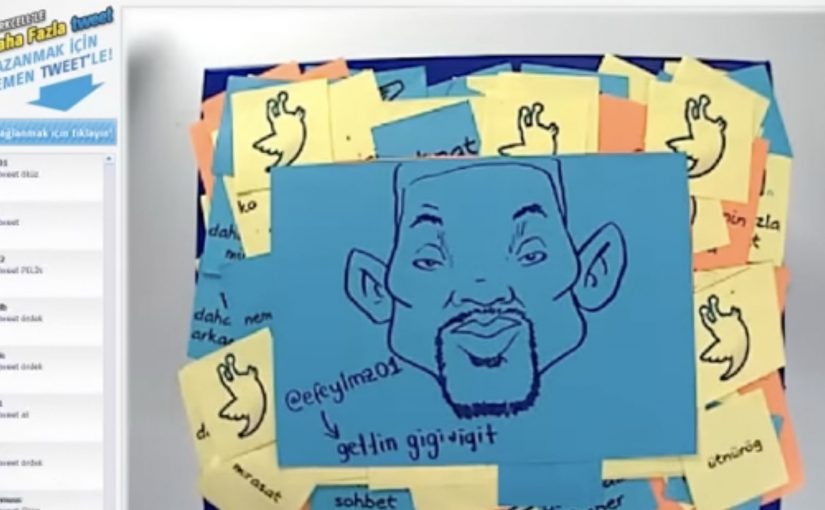
The smartphone was packed in gift boxes and covered with Post-it notes. Players had to tweet what was written on the Post-its to “unwrap” the boxes, using the hashtag #Turkcelltweet. Along the way, contestants joined quick games that won them free minutes and mobile data. The final challenge was to get a celebrity to retweet the message, which won the successful Twitter user a smartphone.

In mobile-first consumer markets, live social mechanics can turn a product launch into a participatory event that spreads through existing networks.

Why it lands

This works because it converts passive watching into a simple, fast action. Read. Tweet. Progress. It also creates a public scoreboard effect. Everyone can see the stream, feel the speed pressure, and understand why a specific player is moving closer to the prize.

Extractable takeaway: When you need attention from people who tune out advertising, design a live loop where participation creates visible progress and the reward feels plausibly “earned” in public. By “live loop” I mean a repeatable action-reward cycle that updates in real time.

What the brand is really buying

The real question is whether you are buying a one-off spike or a repeatable participation habit you can trigger again.

On the surface, it is a giveaway. Underneath, it is audience training. The campaign teaches people to watch Turkcell’s channel closely, to act quickly, and to associate the bundle with active internet culture rather than with standard telecom promotion.

If you cannot guarantee fair rules and real-time moderation, do not run a live social competition like this.

Steal this live unboxing loop

  • Build a single clear verb. “Tweet this to unwrap” is easier than any multi-step entry mechanic.
  • Make progress visible. The crowd should be able to understand what is happening in seconds.
  • Use micro-rewards. Minutes and data keep non-winners engaged, not just the front-runner.
  • Reserve one high-status finish. A celebrity retweet creates a final boss moment that feels bigger than “random draw”.
  • Design for throughput. Live contests die if the pace slows or the rules feel inconsistent.

A few fast answers before you act

What is #Turkcelltweet in one sentence?

It is a live Twitter competition where people tweet Post-it clues to unwrap a boxed smartphone, win small rewards on the way, and compete for a phone as the final prize.

Why does “unwrapping in public” work as a mechanic?

Because it creates visible progress that spectators can follow, and it turns every participant action into content the network can see.

What role do the small prizes play?

They keep the wider crowd engaged. Even if you do not win the phone, you can still gain minutes or data and feel the game is worth playing.

What is the biggest risk with live social competitions?

Fairness and reliability. If timing, moderation, or rule enforcement looks inconsistent, sentiment can flip fast.

What should you measure beyond hashtag volume?

Unique participants, repeat participation, completion rates across stages, sentiment, and whether the campaign lifts bundle consideration and store inquiries in the launch window.