
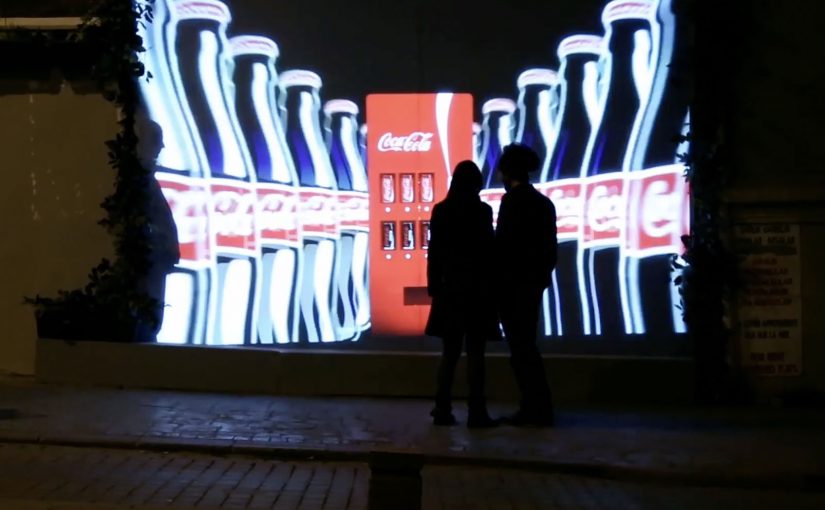
Coca-Cola Turkey: Invisible Vending Machine

Coca-Cola Turkey: Invisible Vending Machine

Since the time I started writing this blog, I have come across many innovative vending machines. Some I featured right here on Ramble.

Now to add to this collection, here is an invisible vending machine from Coca-Cola Turkey that becomes visible only when couples walk by. The machine was created specially for Valentine’s Day (last week) and was installed in Istanbul to spread happiness Coca-Cola style.

A vending machine you cannot see until the right moment

The trick is the reveal. What looks like a normal stretch of wall becomes a vending interface only when two people approach together. That instant transformation creates a micro-scene, and the micro-scene pulls in everyone nearby.

In consumer brand activations, public installations work best when the interaction is obvious, fast, and shareable without instruction.

How the interaction is described to play out

  • Invisible by default. The unit blends into the wall and does not present itself as a machine.
  • Couples trigger the reveal. When two people pass together, the interface lights up and becomes visible.
  • Personal moment, not just a dispense. In coverage at the time, the machine asks for names and then produces two personalised cans.

Why it lands

This is not “another vending machine story”. It is a street-level surprise that creates a small, romantic spotlight for a couple, and a quick bit of theatre for everyone else. The invisibility is not a gimmick. It is a pacing device that makes the reveal feel like a reward. The real question is whether the experience creates a transformation that bystanders can explain in one sentence.

Extractable takeaway: If you want people to stop, watch, and retell an activation, build a visible transformation into the experience. A before-and-after moment is easier to share than a static stunt.

What Coca-Cola gets out of the Valentine framing

Valentine’s Day provides the social permission for public sweetness, names, and sentiment. For the brand, it is a clean link back to togetherness and “sharing happiness”, while turning a sample into a story people can repeat without being prompted.

Retail theatre patterns worth borrowing

By “retail theatre” I mean designing a retail moment as a small piece of live, shareable experience, not just a dispense or transaction.

  • Hide the interface until it matters. Visibility can be part of the reward, not just a prerequisite.
  • Keep the trigger legible. People should understand why it happened in one glance, or they will not mimic it.
  • Design for bystanders. The couple is the participant. The crowd is the media channel.
  • Personalise lightly. Names, messages, or small custom outputs feel intimate without needing heavy data.

A few fast answers before you act

What is the “invisible vending machine” concept?

A vending machine that stays hidden until a couple approaches, then reveals itself and delivers a Valentine-themed Coca-Cola moment.

Why make the machine “invisible” at all?

It creates a sharp reveal, and that reveal is the shareable payload. People remember transformations more than static installations.

What is the simplest way to replicate the effect?

Use a clear proximity trigger plus lighting and screen content that turns on instantly, and ensure the “why it appeared” is immediately understandable.

What is the biggest execution risk?

If the trigger is inconsistent or unclear, people will not repeat the behaviour and the crowd will not form. Reliability matters more than complexity.

What should you measure beyond views?

Dwell time, participation rate per hour, bystander clustering, social mentions generated on site, and any lift in nearby sales during the activation window.
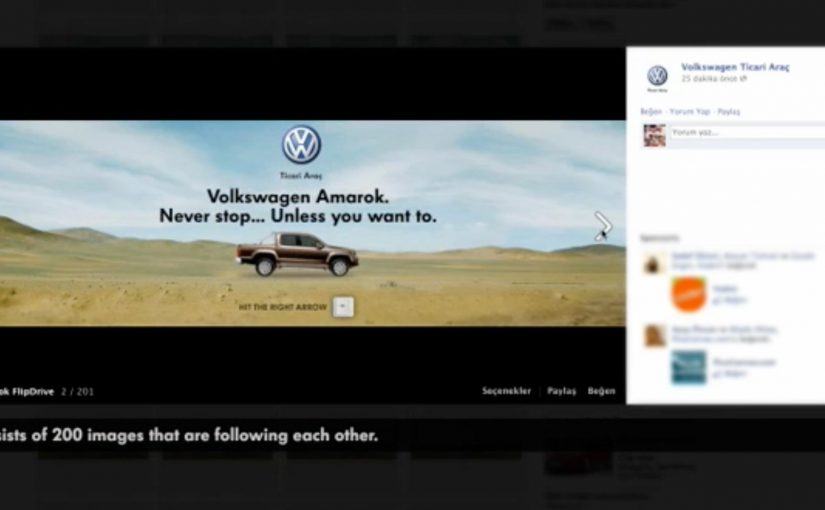
Volkswagen Facebook Flipbook

Volkswagen Facebook Flipbook

You open a Facebook photo gallery called Amarok FlipDrive, click the first image, and keep the right arrow button pressed. The photos flip fast enough to feel like a running movie. A flipbook, built out of a Facebook album.

The reference point. A “commercial” powered by a Twitter feed

In April, Mercedes Smart in Argentina created the first of its kind Tweet Commercial using its Twitter stream. Here, “Tweet Commercial” means the Twitter feed is the engine behind the spot. Now Volkswagen Amarok in Turkey has created the Facebook alternative.

The idea. An all-terrain truck that can even “drive” on Facebook

The Volkswagen Amarok is positioned as an ultimate all terrain vehicle. It can go everywhere. From the city to sand to water. With some creativity from McCann Erickson Istanbul, it can even go on Facebook.

This is the kind of platform-native execution worth copying because it treats navigation as the media layer, not just a way to browse.

How it works. 201 images in sequence

201 images that follow each other in sequence are uploaded to the Amarok FlipDrive Facebook photo gallery. Opening the first photo and keeping the right arrow button pressed makes the photos flip by fast and gives the effect of a running movie.

In global brand marketing teams looking for attention inside social feeds, this is a reminder that interface behavior can be the format.

Why it lands. Viewer control becomes playback

Because the user can hold one familiar key to control speed, the sequence feels like motion without needing a video player. The real question is whether your idea can be expressed as a repeatable gesture the platform already trains people to do.

Extractable takeaway: If a platform has a predictable navigation gesture, you can sequence stills so the gesture becomes playback and the user becomes the “play button”.

The reality check. Caching changes the experience

The flipbook experience is very jerky the first time, but once all the photos are cached (loaded locally after the first pass), it plays as seen in the video below.

What to borrow from Amarok FlipDrive

  • Turn one navigation action into “play”. Upload frames in strict sequence, then let holding the right arrow key act as the playback control.
  • Design for the first-run experience. Expect jerkiness until images are cached, and make sure the idea still reads even when playback is imperfect.
  • Use native mechanics as the “player”. Streams, galleries, and navigation keys can carry a social commercial without introducing a separate media layer.

A few fast answers before you act

What is the Volkswagen Facebook Flipbook?

It is a Facebook photo gallery that behaves like a flipbook-style animation when you move quickly through sequential images by holding the right arrow key.

How many images does it use?

201 images, uploaded in sequence.

What does the user do to “play” it?

Open the first photo in the album and keep the right arrow key pressed to flip through the sequence fast enough to feel like motion.

Why is the first run jerky?

Because the images are not yet cached. Once the browser has loaded them once, playback becomes smoother.

What is the broader pattern?

Using native platform mechanics, such as streams, galleries, and navigation keys, as the media layer for a social commercial.

Coca-Cola: The Future Room Exhibition

Coca-Cola: The Future Room Exhibition

A museum-scale brand moment for a milestone anniversary

In brand experience work, the strongest anniversary executions do not look like commemorations. They look like a reason to step inside the brand world. Coca-Cola’s “Future Room” is a clean example of that approach.

For Coca-Cola’s 125th Anniversary, Istanbul’s creative agency Antilop created a “Future Room” concept, made specifically for the Turkish modern-art museum Santralistanbul. They transformed a section of the gallery into an impressive 90 square meter, 270-degree projection mapping installation.

How the Future Room worked as an immersive installation

The mechanism was spatial immersion. Here, that means using the room itself as the storytelling surface, so viewers are surrounded rather than watching a single screen.

That choice changed the viewing behavior. People did not just watch a piece of content. They entered it, and the room itself became the interface.

In global consumer brands, milestone experiences land best when the venue and the format give people a reason to physically show up.

Why it landed in a modern-art setting

In a museum context, attention is earned through presence, scale, and craft. Projection mapping fits because it turns a physical space into a living canvas.

Extractable takeaway: In cultural venues, design the environment first, then let the brand meaning ride on the craft people can feel in the room.

By committing 90 square meters of gallery to one experience, the work signaled seriousness. It also made the activation feel like an exhibit, not an ad, which is exactly the psychological shift a heritage brand wants during an anniversary moment.

The business intent behind the exhibition format

The intent was to elevate the partnership between brand and venue, and to position Coca-Cola as culturally fluent rather than purely commercial.

The real question is how you make a milestone feel current without turning it into a retrospective.

An anniversary is a credibility play, meaning a chance to reaffirm relevance in the present. The exhibition format helped translate “125 years” into something contemporary, sensory, and shareable, without relying on nostalgia alone.

Design cues for your next immersive brand experience

  • Choose a format that matches the venue. In cultural spaces, experience and craft beat messaging density.
  • Use scale as a signal. Large physical commitment communicates importance before anyone reads a word.
  • Turn the room into the medium. Immersion works when the environment does the storytelling, not just the screen.
  • Make milestones feel current. Anniversary work lands when it shows relevance, not only history.

A few fast answers before you act

What was Coca-Cola’s “Future Room”?

An immersive, exhibition-style installation that used large-scale projection mapping to wrap visitors in a future-facing brand environment.

Where did it appear?

It was created for Santralistanbul, a Turkish modern-art museum in Istanbul, as part of Coca-Cola’s 125th anniversary moment.

What was the mechanism?

The room became the medium. A wraparound projection space made the environment itself the interface.

Why does this work in a museum context?

Museums reward presence, scale, and craft. An immersive installation can read as an exhibit, not an ad, which changes how people grant attention.

Why is this effective for anniversaries?

It makes the milestone feel current. It gives people a reason to attend now, not just a reason to remember then.

What should experience teams copy from it?

Match the format to the venue, commit physically to signal seriousness, and design for movement and dwell time instead of messaging density.