
Hemoba and Vitória FC: My Blood Is Red and Black

Hemoba and Vitória FC: My Blood Is Red and Black

The state of Bahia was experiencing a shortage of blood. To raise awareness of this problem and increase the blood reserves, Hemoba Foundation (Blood Foundation) in Brazil partnered with Bahia football club Esporte Clube Vitória to run a unique blood donation drive.

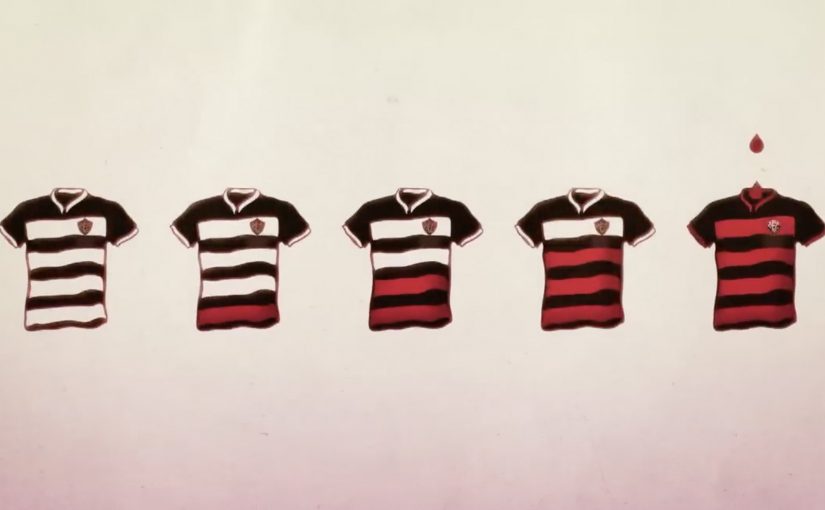
For the campaign, the football club changed the stripes of their iconic jersey from red to white. Then over the course of the season as the blood reserves rose, the team slowly changed the white stripes back to the original red.

As a result, the promotion is reported to have helped raise blood donation by 46%.

A club kit that doubles as a public scoreboard

This is a blood drive that refuses to stay in the background. Instead of asking people to donate “because it is important”, it turns the most visible symbol of the club into a live indicator of how the state is doing. This is a stronger behavior-change design than a standard awareness appeal, because the public scoreboard sits inside club identity.

How the stripe mechanic works

The mechanism is one clean promise. Remove the red from Vitória’s shirt, then bring it back only as blood reserves recover. Every step of progress becomes legible in the one place fans naturally look, the team’s colors.

In sports-led community campaigns, changing a core identity asset works because it creates a shared metric that everyone can track without explanation.

Why this lands beyond typical charity messaging

Most donation drives rely on abstract need. This one makes need visible and slightly uncomfortable, because fans are confronted with “missing red” every match week until they act. It also flips motivation from guilt to pride, because the act of donating becomes a way to restore the club’s full identity.

Extractable takeaway: If you need sustained participation, attach the cause to a symbol your audience already protects. Then turn progress into a public, binary signal that updates over time.

What the partnership is really doing

The campaign aligns incentives. The real question is how to turn a one-time act of goodwill into a shared public ritual that people keep joining. Hemoba gets reach and urgency without buying attention in the usual media sense. The club earns meaning and publicity by making its platform materially costly, because it “gives up” part of its kit until the community responds.

What to steal for your next behavior-change campaign

  • Make the metric visible. People act more when they can see progress, not just hear appeals.
  • Use a symbol with real emotional ownership. Identity assets beat posters, because people notice when they change.
  • Turn donation into restoration. “Bring something back” is often more motivating than “add something new”.
  • Design for weeks, not a day. A season-long mechanic sustains attention and creates multiple decision moments.

A few fast answers before you act

What is “My Blood Is Red and Black”?

It is a blood donation campaign in Bahia, Brazil, where Hemoba partnered with Esporte Clube Vitória and used the team jersey’s red stripes as a visible indicator tied to blood reserves.

How did changing the jersey drive donations?

By removing the red stripes and gradually restoring them as reserves improved, the campaign turned blood supply into a public signal that fans could track across the season.

Why does sports identity work for public health?

Because club colors, rituals, and match-week attention are already shared and emotionally charged. The campaign borrows that energy and redirects it into a concrete action.

Why is this stronger than a standard awareness appeal?

Because it does not ask people to care in the abstract. It makes the shortage visible through a symbol fans already watch, defend, and want restored.

What is the transferable principle here?

Make progress tangible. Link participation to restoring a valued symbol, and keep the feedback loop running long enough for people to join when they are ready.

Nike Golf: No Cup Is Safe

Nike Golf: No Cup Is Safe

Nike Golf has released a TV spot in which Tiger Woods and Rory McIlroy turn a practice session into a small competition on the golf course. The joke is simple. When two world-class players share a range, even the targets feel under threat.

A practice range that plays like a duel

The mechanism is a clean escalation. Start with casual shots. Introduce a visible target. Add one-upmanship. Then let the athletes do what they do best. Make the impossible look repeatable. The “no cup” line is the punchline because it turns accuracy into a kind of harmless menace. That works because a simple duel structure makes elite skill legible in seconds.

In performance-driven sports categories, the fastest brand wins are often built on demonstrations that feel like entertainment rather than instruction.

Why it lands

The spot works because it respects the viewer’s intelligence. No spec sheet. No product sermon. Just elite talent, a familiar rivalry energy, and a challenge you can understand in one second. It sells Nike Golf as the gear behind precision and confidence, without ever having to say those words.

Extractable takeaway: If your product promise is “performance”, design a proof that reads instantly. Use a simple rule, a clear target, and a visible outcome that makes the capability undeniable.

What Nike is really doing here

This is also roster storytelling, where the pairing itself signals what kind of competitive culture the brand owns. The real question is whether Nike can turn a practice-range stunt into a broader signal of competitive credibility.

Nike gets this right because pairing Woods with McIlroy frames the brand as the home of golf’s competitive edge across generations. The tone stays light, but the subtext is serious: these are the players you associate with winning, and they are wearing this swoosh while they do it.

How Nike turns proof into a brand asset

  • Turn a feature into a game. Accuracy becomes a challenge, not a claim.
  • Let the product stay “off camera”. When the proof is strong, the brand earns belief without showing close-ups.
  • Build with escalation. Start normal, then raise the stakes in small steps so the payoff feels inevitable.
  • Make the line a summary, not a slogan. “No Cup Is Safe” works because the viewer already saw why.

A few fast answers before you act

What is Nike Golf’s “No Cup Is Safe” spot?

It is a Nike Golf commercial built around Tiger Woods and Rory McIlroy turning a practice session into a target competition where cups become the bullseye.

What is the main message?

Elite precision is entertaining, and Nike Golf is positioned as the brand behind that performance mindset.

Why use two athletes instead of one hero?

Competition creates story. Rivalry gives the viewer a reason to watch longer, and it makes the proof feel earned rather than staged.

What does the line “No Cup Is Safe” communicate?

That the shots are so accurate the targets are in danger. It is a humorous shorthand for confidence and control.

How can other brands apply this pattern?

Find a single capability you can prove visually, wrap it in a simple game mechanic, and let the outcome do the persuasion work.

Heineken Star Player

Heineken Star Player

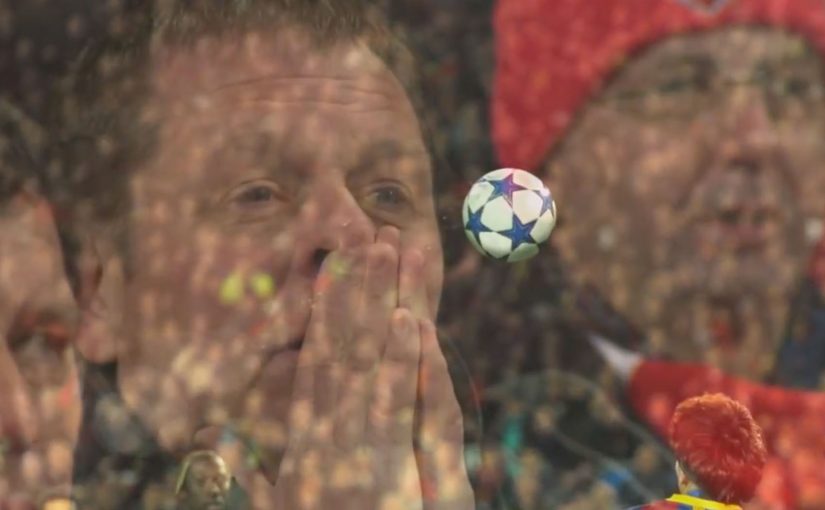
The UEFA Champions League attracts massive global audiences, and a large share of fans watch matches at home. Heineken’s release references over 150 million TV viewers watching live UCL coverage per match week in 220+ territories. Heineken and AKQA used that context to build Heineken StarPlayer, a dual-screen app designed to let fans interact in real time with the nail-biting action.

With StarPlayer, fans play along live on desktop and mobile by anticipating what will happen in key match moments, in real time. The promise is simple. Turn passive viewing into a competitive layer of predictions, banter and shared tension.

What StarPlayer actually adds to the match

The mechanic is built around micro-moments. Here, “micro-moments” means the short, repeatable windows where a single prediction fits without pulling you away from play. Corners, free kicks, penalties, shots, and short time windows where a fan can commit to a forecast. If you are right, you gain points. If you are wrong, you lose ground. The point is not the points. The point is sustained attention and social comparison. Because each forecast is time-boxed and resolved by the next play, the loop creates tension and keeps fans scanning for the next peak moment.

In sports sponsorship, the hard part is not reach. It is converting 90 minutes of attention into 90 minutes of participation.

In global sports sponsorships, the scarce resource is not exposure, it is credible participation during the live window.

The real question is whether you can turn the second-screen reflex into a ritual that heightens the match instead of competing with it.

Why the dual-screen idea fits the way fans really watch

StarPlayer leans into two truths. First, a lot of fans watch at home rather than in stadiums. Second, many are already using a second device during the match, either to check stats, message friends, or follow commentary. StarPlayer turns that second-screen habit into a structured game loop. It also respects viewer control. You can engage in bursts, choose the moments you want to play, and keep your focus on the match while the phone or laptop becomes your companion layer.

Extractable takeaway: If your audience already second-screens, convert that habit into one-tap decisions tied to predictable peaks, so the companion layer adds tension without stealing attention from the main screen.

What the brand is really buying

Heineken positions StarPlayer as “made to entertain” applied to sport viewing. The business intent is to make the sponsorship feel like an experience, not just a logo. If the brand becomes part of the ritual, it earns recall that is tied to real match emotions, not ad breaks. This kind of activation is worth doing only when it becomes part of the viewing ritual, not an interruption layered on top.

The work later earns major industry recognition. Heineken Star Player is listed as a Cyber Gold Lion (Mobile) at Cannes Lions, credited to AKQA London.

Steal the second-screen prediction loop

  • Design around predictable peaks. Build interactions for moments people already lean forward for.
  • Keep the loop lightweight. A decision in seconds beats anything that competes with the main screen.
  • Make it social by default. Rivalry, banter and comparison are the fuel. Solo play is the backup.
  • Optimise for “stickiness”, not clicks. The win condition is returning to the second screen again and again during the match.

A few fast answers before you act

What is a “dual-screen” experience in sports marketing?

A dual-screen experience is when the main content stays on TV, while a phone or laptop adds a companion layer. The second screen can enable play, prediction, stats, chat, or rewards without interrupting the match.

Why do prediction mechanics work especially well in live sport?

Because sport is already a sequence of uncertain outcomes. Predictions let fans externalise their gut feel, then get instant feedback, which creates tension and repeat engagement.

What is the simplest version of Star Player a brand could copy?

Pick 5 to 10 repeatable match moments. Create one-tap predictions with a short countdown. Score it. Add a friend leaderboard. Keep everything playable in under five seconds.

How do you avoid the second screen distracting from the match?

Design for bursts. Keep interactions tied to natural pauses or peak moments. Use quick taps, not typing. The TV remains the hero.

What metrics matter for a second-screen activation?

Time-in-experience per match, repeat participation across matches, and social play rate. For brand outcomes, track recall and sponsorship attribution uplift, not just installs.