
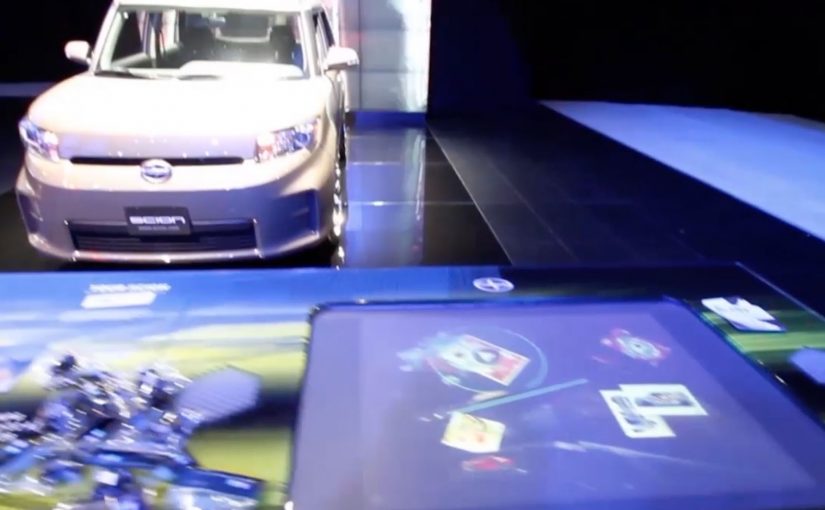
Toyota Scion “Microsoft Surface Experience”

You walk up to a Microsoft Surface table at a Scion auto show stand and pick up one of the collectible cards. You place it on the table and the surface immediately reacts. Photos, video content, regional sales information, and localized events appear around the card. You flip the card over and it triggers a musical element. Beats, bass, or vocals. When all eight cards are on the table at the same time, the full song plays and the table turns into a simple, social remix station.

Auto shows as a lab for new interfaces

At the 2011 International Motor Show in Frankfurt, the pattern is easy to spot first-hand. The brands that win attention make exploration physical and obvious.

The activation. Scion meets Microsoft Surface

If you visit upcoming auto shows late this year or in 2012, you can run into the Scion Surface Experience, built on Microsoft Surface tables. Toyota’s agency Juxt Interactive designs the experience to let visitors explore Scion’s product, racing, and cultural affiliations in an unexpected way.

How it works. Eight cards, two sides

The interaction is built around a deck of eight collectible cards:

  • Place a card on the Surface and the table reveals photos, video content, regional sales information, and localized events.
  • Flip the card over and it triggers one element of a song, such as beats, bass, or vocals.
  • Place all eight cards on the Surface at once and the full song plays.

Once the full track is unlocked, guests can remix the song in their own way. It reinforces the self-expression that sits at the core of the Scion brand story.

In auto show environments, where multiple brands compete for brief attention in the same hall, interfaces that make participation obvious outperform passive display messaging.

The take-home loop. Physical tokens for digital content

The cards do not end when the stand visit ends. Guests can take their cards home and use them to download digital content connected to the auto show experience. The business intent is clear: use play to pull visitors into deeper product content, then extend recall beyond the booth with a take-home trigger.

Why this works. Exploration first, messaging second

This is a clean example of experiential design where the interface creates the interest. The collectible cards make the first step easy, the Surface makes the response immediate, and the “complete the set” mechanic rewards curiosity. The “complete the set” mechanic means each added card reveals more value, so the interaction naturally pulls people toward finishing the sequence together. Because each added card changes the output immediately, the table turns product exploration into a visible group activity, which keeps people engaged longer than a passive stand screen.

Extractable takeaway: When you want people to explore branded content, give them a physical trigger, an immediate digital response, and a group reward for going deeper.

The real question is how to turn product exploration into something people want to start, continue, and share with the people beside them.

What to steal from this interface-led booth

  • Make the first move physical. Use a tangible trigger that is obvious, low-friction, and instantly responsive.
  • Turn content into discovery. Let people unlock information through curiosity, not a forced linear demo.
  • Design for small groups. Build in a reason to collaborate, compare, and “complete the set” together.
  • Extend the moment beyond the booth. Give visitors a take-home token that continues the experience after the event.

A few fast answers before you act

What is the Toyota Scion Microsoft Surface Experience?

An auto show installation that uses Microsoft Surface tables and eight collectible cards to explore Scion content and trigger a music remix experience.

What happens when a card is placed on the table?

The Surface reveals photos, video content, regional sales information, and localized events tied to the stand experience.

What happens when the card is flipped?

It triggers a part of a song, such as beats, bass, or vocals.

Why are there eight cards?

Placing all eight cards on the Surface at the same time unlocks the full song, and turns the table into a simple remix station.

What is the lasting value beyond the booth moment?

Visitors can take the cards home and use them to download digital content related to the auto show experience.

Toyota: A Glass of Water

A Glass of Water is a challenge created by Saatchi & Saatchi Stockholm for Toyota in Sweden. Its mission is to help drivers cut down their fuel consumption by 10% and reduce CO2 emissions, aligned with Toyota’s stated zero-emission vision.

When drivers register on the program website, they accept the challenge to place a glass of water on their dashboard or cup holder, then drive in a smooth manner that avoids spillage.

According to Toyota, the less you spill, the gentler you drive. Therefore the less fuel you consume.

A rule you can test on your next drive

The brilliance is the simplicity. No special car, no expert coaching, no complicated scorecard. Just a physical feedback loop that makes every harsh brake and every aggressive turn visible in the most basic way possible.

How the mechanism teaches eco-driving

Spilling is the metric. If you keep the water steady, you are accelerating, braking, and cornering more smoothly. That smoother style tends to reduce wasteful energy spikes, which is the same principle behind most eco-driving advice, translated into something you can feel immediately.

In European automotive marketing, behavior-change challenges work best when the rule is simple enough to try on the next drive.

Why it lands

It turns an abstract goal. “reduce fuel consumption”. into a personal game with instant feedback. The glass makes you self-correct without being told what to do, and it makes eco-driving feel like mastery rather than sacrifice. It also travels well as a story because anyone can explain it in one sentence.

Extractable takeaway: If you want people to change a daily behavior, give them a physical, low-effort indicator that converts “doing better” into a visible result they can improve on.

What Toyota is really buying

This is not just awareness. It is repeatable participation. Each drive becomes a new attempt, and each attempt reinforces the brand’s association with smarter, calmer driving rather than with lecturing about emissions.

The real question is how to make smoother driving feel self-evident and repeatable, not how to explain eco-driving more forcefully.

What to steal from the water-glass challenge

  • Use a single, legible metric. Spills are binary and instantly understood.
  • Make the feedback loop physical. Physical cues outperform abstract dashboards for habit shifts.
  • Lower the start barrier to almost zero. If people can start today, they will.
  • Turn restraint into skill. People adopt habits faster when it feels like competence.

A few fast answers before you act

What is A Glass of Water?

A driving challenge where you place a glass of water on the dashboard or cup holder and try to drive smoothly enough not to spill, as a proxy for reducing fuel consumption.

Why does “not spilling” relate to fuel savings?

Because avoiding spills requires gentler acceleration, braking, and cornering. That smoother driving style tends to reduce inefficient energy spikes.

What makes this different from typical eco-driving advice?

It replaces instructions with immediate feedback. The glass shows you how you are driving without needing an expert or a complex display.

What is the biggest risk with this kind of challenge?

If people treat it as a stunt rather than a habit tool, the effect fades quickly. The challenge needs repetition to translate into lasting driving style change.

How should a brand measure success for a behavior challenge like this?

Participation volume, repeat participation, and any measured or self-reported fuel consumption improvement among participants, not only views or clicks.

3D projection mapping on a Toyota Auris

Instead of projecting onto a building, Glue Isobar projects a CG car directly onto a real Toyota Auris Hybrid. Here, projection mapping means aligning animated visuals to the contours of a physical object so the imagery appears built into the car itself. With seven projectors working together, the result is a true 3D, 360-degree projection mapping experience on all sides of the car. You can walk around it and experience the visuals from any angle.

What makes this projection mapping different

The twist is the surface. A real car brings complex curves, edges, and reflections. Mapping to that shape, and keeping the illusion consistent as people move around it, is the challenge that makes this feel genuinely new.

How the experience is delivered

The work uses a mix of keyframe, 2D, 3D, algorithmic, and dynamic animation to deliver the experience. The projection setup supports a 360-degree view, which is why the story holds up from multiple angles instead of depending on a single “best seat”.

In live auto launches and showroom-style reveals, this matters because the product demo and the spectacle happen in the same physical moment.

Why this lands as a launch moment

This format turns a product reveal into a live event. It gives people a reason to stop, watch, walk around, and talk. The real question is not whether the projection looks advanced, but whether the launch makes the car feel worth approaching, discussing, and remembering. The business job of a launch moment is not passive viewing but active attention that carries into conversation and recall. This is stronger than a static display because it turns the car itself into the source of attention.

Extractable takeaway: When the product becomes the performance surface, the launch works harder because the spectacle and the proof of product presence happen in the same place.

What to steal for live product reveals

  • Make the product the canvas. When the object carries the story, the experience feels specific and harder to copy.
  • Design for movement in the crowd. A 360-degree setup keeps the illusion intact even when people walk around and viewpoints change.
  • Use complexity where it creates visible payoff. Multiple projectors are justified when they unlock surfaces and angles a single beam cannot cover.
  • Treat it as a performance, not a display. The reveal works best when the product appears to “do something”, not just sit there.

A few fast answers before you act

What is 3D projection mapping in this example?

It is the technique of projecting animated visuals onto a physical object, aligned to its shape so the imagery appears to belong to the object rather than a flat screen.

Why use seven projectors?

To cover the full vehicle and maintain the illusion across multiple surfaces, including areas you can only see when walking around the car.

Why project onto the car instead of a separate screen?

Because the effect feels more product-specific. The visuals appear attached to the vehicle, which makes the reveal more memorable than showing the same animation beside it.

What makes “360-degree” important for live audiences?

People do not stand in one spot. If the experience works from many angles, it feels real in a public space and stays compelling as crowds move.

What is the main lesson for product launches?

Make the product the stage. When the object itself becomes the canvas, the experience feels specific, memorable, and inherently shareable.