
The TVC Is Not Dead. Weak Systems Are.

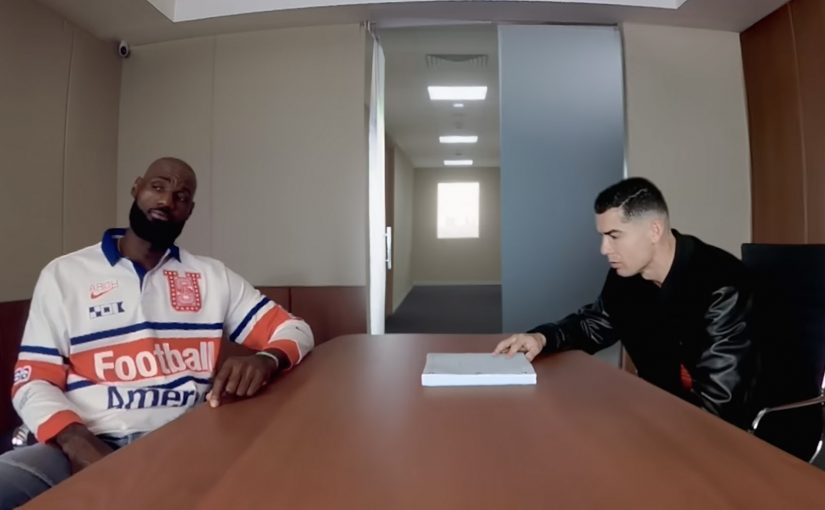
Nike’s Rip the Script starts with a control problem.

A director wants order. The footballers keep breaking the plan.

That is the useful lesson for brand marketers: campaign systems matter, but they only scale when the creative idea has enough energy to make people participate.

A campaign system is the connected set of assets, channels, behaviours, commerce surfaces, data signals and governance choices that turn one idea into repeated consumer action.

The June pattern – fandom became the operating layer

A lot of the work around World Cup 2026 was not built as a simple sponsorship message.

It was built as a campaign system.

That is the right direction.

A tournament is not just a media moment. It is a sequence of consumer behaviours.

People plan where to watch. They buy food. They wear colours. They argue about players. They collect things. They scroll before the match. They message during the match. They look for highlights after the match. They repeat the ritual for weeks.

This is the mechanism brands are chasing: one tournament trigger becomes repeatable actions across product, retail, social, CRM, creator, commerce and media surfaces.

The context matters because World Cup 2026 marketing has already started before the tournament itself, with brands trying to enter fan rituals before match attention peaks.

McDonald’s is a useful contrast example because its FIFA World Cup 26 Meal and collectible cups turn fandom into a clear purchase and collecting behaviour.

As a June sports-marketing contrast, Uber Eats’ Ding Dong Deals points in a similar direction: make the offer feel like part of the sports reaction cycle, not just a discount sitting outside the moment.

Strategically, that all makes sense.

The real question is not whether the campaign has enough channels, but whether the idea gives those channels something people actually want to repeat.

The problem – participation mechanics are not the same as energy

This is where a lot of modern campaign thinking gets lazy. Teams build the mechanics of participation and then mistake those mechanics for desire. They create the collectible, the offer, the social format, the content calendar, the retail activation and the measurement layer, but the work still does not always feel alive.

The position here is clear: the TVC is not dead, but weak campaign systems are.

Here, TVC means the brand’s hero film asset: the emotionally loaded centrepiece that can still create memory, even when most distribution now happens across social, retail, commerce, CRM and creator surfaces.

The problem is not that brands are building systems. They should be. The problem is that campaign systems can make average ideas look more sophisticated than they are. They add surfaces, decks, journeys, assets, touchpoints and reporting structures, but they do not automatically add tension, humour, memory, emotion or cultural velocity.

That matters because consumers do not participate because the operating model is elegant. They participate because the thing has enough pull to earn the behaviour.

Nike’s advantage – the TVC has enough voltage to feed the system

Nike’s Rip the Script works because it does not feel like a brand politely entering football culture. It feels like football culture losing control in exactly the right way.

Creative voltage is the emotional force that makes an idea memorable enough to be clipped, argued with, reposted, remixed, bought into and carried across channels.

The TVC has that voltage because it turns the basic idea, players breaking away from a controlled script, into the form of the film itself. The director wants order. The players ignore him. The scripted goodbye gives way to instinct, chaos, cameos, jokes, pace and momentum.

That is why the campaign idea becomes legible without being over-explained. The work is not simply saying “ditch the playbook.” It behaves like a control system collapsing under the force of football instinct.

Because it generates distinctive moments that can be cut, debated, reposted and reused, the TVC gives the wider campaign system something worth distributing. That is what many campaign systems miss. They start with the architecture and hope the creative fills it. Nike starts with creative force strong enough to feed the architecture.

The operating lesson – do not build the system before the energy

For brand teams, this is not a nostalgia argument for big films. The answer is not to abandon systems and go back to hero-film thinking.

The answer is to stop treating systems as substitutes for ideas.

A modern campaign still needs the full operating stack: social fragments, commerce surfaces, retail or platform behaviour, creators, athletes, partners, media architecture, CRM logic where relevant, and measurement that separates attention, participation, conversion and repeat behaviour.

But the sequence matters. If the idea is weak, the system becomes an expensive distribution machine for something people did not care about in the first place. If the idea has energy, the system becomes a multiplier.

That is the business difference. One version creates operational complexity. The other creates commercial compounding.

What Nike gets right – the TVC behaves like an operating asset

The lazy conclusion is that Nike won because it made the best film. That is only half true.

Nike won because the TVC behaves like an operating asset.

An operating asset is creative work designed to create reusable value across channels, formats, markets, partners and consumer behaviours.

Rip the Script gives the brand multiple assets inside one idea. It gives scenes for social cuts, faces for fan debate, jokes for football pages, cameos for wider culture, and a Nike Football world that can stretch beyond one upload.

That is why the TVC matters. Not because it is long. Not because it is expensive. Not because it has famous people in it. It matters because it creates memory structures that the rest of the system can use.

The brand test – design for voltage before scale

Large brand organizations are good at building systems. They can build channel matrices, map consumer journeys, create modular content models, localise assets, and connect retail, ecommerce, CRM, social, media and measurement. But the June lesson is uncomfortable: operational maturity does not compensate for creative weakness.

The takeaway: treat campaign systems as distribution architecture, not idea substitutes. Build the emotional idea first, then design the fragments, commerce layers, creator surfaces, data signals, governance and measurement that let that idea travel without becoming operational theatre.

That is the useful operating test. Before asking how many channels the campaign can fill, ask whether the core idea creates enough feeling to deserve those channels.

The future is not TVCs versus systems.

The future is TVCs powerful enough to become systems.


A few fast answers before you act

Is this an argument against campaign systems?

No. Campaign systems are essential when brands need repeatable participation across media, commerce, retail, social and CRM. The argument is that systems should multiply strong ideas, not disguise weak ones.

What does TVC mean in this context?

TVC means the brand’s hero film asset. It does not mean the campaign only lives on television. It means the central piece of creative work that carries the emotional idea and gives the wider system something to distribute.

What did Nike do better than most June campaigns?

Nike created a TVC with enough cultural energy to become a wider operating platform. Rip the Script gives social, retail, creators, football media and fans reusable material instead of forcing channels to carry a thin idea.

Why are participation mechanics not enough?

Participation mechanics only define what people can do. They do not explain why people would care enough to do it, repeat it, share it or attach meaning to it.

Where do McDonald’s and Uber Eats fit in the argument?

They are useful contrast examples because both show the modern move toward behaviour-led campaign design. McDonald’s connects World Cup attention to meals and collectibles, while Uber Eats connects offer value to sports-reaction formats.

What should brand marketing teams change?

They should separate system readiness from idea strength. A campaign can be well-integrated, measurable and operationally mature while still lacking the emotional force needed to travel.
Nike Football: The Last Game

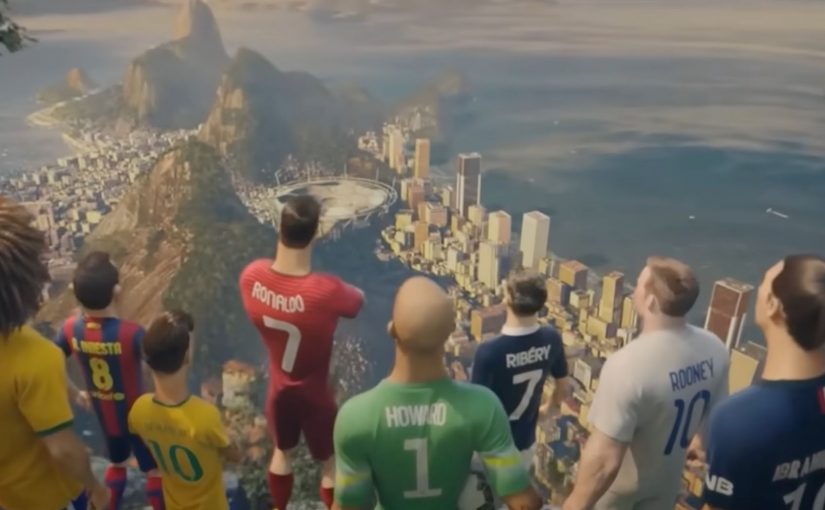
In a build up to the first match of the 2014 FIFA World Cup, Nike Football released a five minute animated film that features some of the world’s greatest footballers on a mission to save football from the hands of a villainous mastermind, The Scientist.

In a future where brilliant football has ceased to exist and the game has become almost extinct, Brazilian legend Ronaldo (O Fenómeno) decides enough is enough and goes on a mission to reignite the game with brilliant football with the help of a re-assembled group of the world’s most brilliant players.

In the final minutes of the film, Cristiano Ronaldo, Wayne Rooney, Neymar Júnior, Zlatan Ibrahimović, Andrés Iniesta, David Luiz, Franck Ribéry, Tim Howard and Ronaldo (O Fenómeno) are seen battling the “perfect” football clones in a winner take all match.

How the plot carries Nike’s platform

The film pits “brilliant football” against a future of optimized, risk-free play, so “Risk Everything” reads like a choice between creativity and extinction. Here, a brand platform means the recurring campaign idea that frames the work.

In global tournament marketing, this kind of work competes with entertainment, not other ads.

The real question is how you turn a tournament moment into a story people choose to watch and share, even when they do not care about the sponsor.

Why this story structure is so effective

By giving creativity a face (the players) and safety a face (The Scientist and his clones), the film turns an abstract brand message into a clear, watchable conflict.

Extractable takeaway: If your platform is an attitude, dramatize it as a choice with consequences, then let the audience feel the outcome instead of explaining it.

  • It turns a brand platform into a myth. “Risk Everything” translates naturally into a fight for football’s soul.
  • It uses a clear villain to sharpen the message. The Scientist represents control, safety, and sameness. The players represent creativity and individual brilliance.
  • It makes the product message implicit. You do not need to be told that creativity wins. You watch it win.

What marketers can take from “The Last Game”

When you have a cultural moment as big as the World Cup, the winning work often behaves like entertainment first. Nike built a mini-universe with stakes, characters, and a simple conflict. That gives the story a reason to be shared beyond football fans, and it gives the brand a clear point of view without sounding like advertising.

  • Lead with stakes. Make the outcome matter before you ask anyone to share.
  • Give the tension a face. A clear opponent sharpens what you stand for, and what you stand against.
  • Keep the product message implicit. Show the behavior you want to reward, then trust viewers to connect the dots.

A few fast answers before you act

What is Nike Football “The Last Game”?

It is a five-minute animated film released ahead of the 2014 FIFA World Cup where Ronaldo (O Fenómeno) and a group of top players try to save football from The Scientist and his “perfect” clones.

Who are the players featured in the final match?

Cristiano Ronaldo, Wayne Rooney, Neymar Júnior, Zlatan Ibrahimović, Andrés Iniesta, David Luiz, Franck Ribéry, Tim Howard and Ronaldo (O Fenómeno).

What is the core idea behind the villain “The Scientist”?

He represents a future of controlled, optimized, risk-free football. The film positions creative, brilliant play as the antidote.

Why does this work so well ahead of a tournament?

It amplifies the emotion people already bring to the World Cup and gives them a shareable story that feels like culture, not a commercial break.

Nike Football “My time is now”

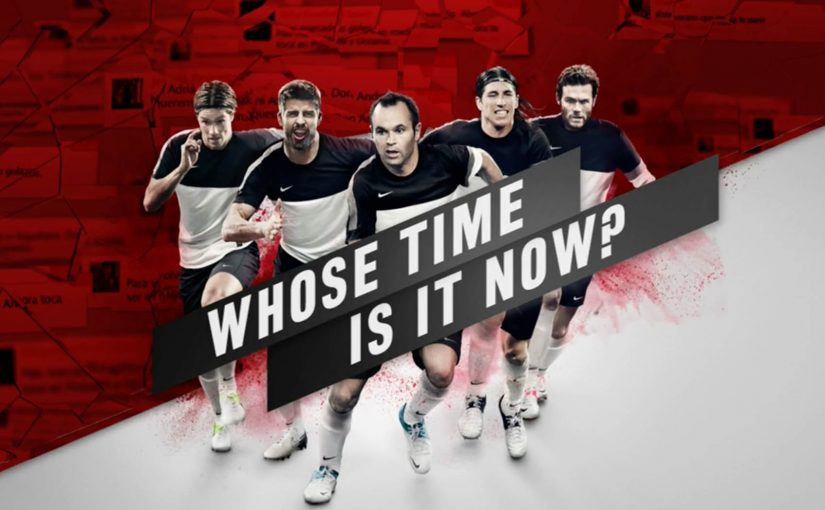
In Puerta del Sol, Madrid’s epicenter, a huge Nike “static” banner behaves like a live scoreboard. As Euro 2012 conversations spike, the face on the banner changes. Each day, the Spanish player who dominates social chatter becomes the protagonist on the canvas. Two fan messages appear alongside him, selected from submissions flowing in through Nike’s Facebook experience.

What the campaign does in public

Turn real-time social conversation into real-world status. Then make “My Time Is Now” visible, in public, every day.

What Nike and DoubleYou build during Euro 2012

Nike works with DoubleYou on a real-time social media monitoring campaign focused on Spanish national-team players. The system tracks mentions and engagement across Facebook and Twitter, then turns that data into a live ranking.

Fans see the leaderboard through a custom Facebook app integrated into Nike Football Spain. The ranking updates continuously, creating a daily “who owns the moment” race that mirrors what is happening on the pitch.

How it works

Step 1. Capture the conversation in real time

The activation monitors references to players across Twitter and Facebook.

Step 2. Translate the conversation into a live ranking

Inside the Facebook experience, the campaign visualizes comments and produces an automatically updated ranking of who is generating the most conversation, refreshed minute by minute.

Step 3. Publish the result into the physical world

Each day, the player who attracts the most social conversation becomes the ambassador of Nike’s message “My Time Is Now” on the large-format placement in Puerta del Sol. A static billboard turns into an interactive billboard because it is connected to the live social pulse.

Step 4. Let fans write onto the execution

From the app, fans also submit messages linked to the player of the day. Nike selects two of those messages and publishes them next to the player on the banner.

In sports sponsorship, the scalable advantage is not just hearing fan momentum, but turning it into a public signal people can rally around.

Why this is more than “social listening”

The real question is how to make live conversation feel consequential while the event is still unfolding. This is not monitoring for reporting. It is monitoring as a publishing engine. Nike turns fan conversation into a daily public decision about who carries the brand line. That mechanism works because it converts abstract buzz into visible status, giving fans a reason to watch, react, and return.

Extractable takeaway: Real-time marketing gets more powerful when the signal changes something public, visible, and easy to argue about, not when it just updates a dashboard.

The business intent is to keep fans returning to Nike’s owned experience during the tournament, while tying that repeat attention back to sponsored players and the brand line.

  • The social layer has consequence. The ranking determines who gets featured publicly.
  • The physical layer gives the digital behavior weight. People do not just see a number in an app. They see a player crowned in the center of Madrid.
  • The loop is fast enough to feel like sport. The leaderboard updates continuously, so fans experience momentum, not a static end-of-day recap.

The line that makes the whole thing sticky

At the end, the leading player is set to bear Nike’s message of “My Time Is Now”.

And the player is…

What to steal from Nike’s live ranking billboard

  • Turn chatter into a scoreboard: Convert real-time conversation into points people can instantly understand and debate.
  • Reward the behaviour you want repeated: Make fans check back by updating standings during the event, not after it.
  • Use sponsorship as a story engine: Anchor the mechanic to the athletes you sponsor so the brand connection stays tight.
  • Make the output social by default: Put the ranking in a format that is easy to share and argue about inside the platform.
  • End with a single “hero moment”: Let one clear winner carry the slogan so the campaign lands as a climax, not a dashboard.

A few fast answers before you act

What is the campaign in one sentence?

A real-time social monitoring system ranks Spanish players by conversation volume and makes the top player the daily face of a live billboard in Puerta del Sol.

Where do fans see the ranking?

Fans see the ranking in a custom Facebook app integrated into Nike Football Spain.

What makes this different from a normal “second screen” mechanic?

The data output is not just a dashboard. It changes a public, real-world media placement and publishes user messages alongside the hero player.

Why does the billboard matter more than the app alone?

The billboard turns digital attention into visible public status, so the campaign feels culturally present rather than trapped inside a social feed.

What is the repeatable pattern for brands?

If you can connect live signals to live publishing, you turn attention into status. That is how real-time becomes culturally meaningful.