
The TVC Is Not Dead. Weak Systems Are.

Nike’s Rip the Script starts with a control problem.

A director wants order. The footballers keep breaking the plan.

That is the useful lesson for brand marketers: campaign systems matter, but they only scale when the creative idea has enough energy to make people participate.

A campaign system is the connected set of assets, channels, behaviours, commerce surfaces, data signals and governance choices that turn one idea into repeated consumer action.

The June pattern – fandom became the operating layer

A lot of the work around World Cup 2026 was not built as a simple sponsorship message.

It was built as a campaign system.

That is the right direction.

A tournament is not just a media moment. It is a sequence of consumer behaviours.

People plan where to watch. They buy food. They wear colours. They argue about players. They collect things. They scroll before the match. They message during the match. They look for highlights after the match. They repeat the ritual for weeks.

This is the mechanism brands are chasing: one tournament trigger becomes repeatable actions across product, retail, social, CRM, creator, commerce and media surfaces.

The context matters because World Cup 2026 marketing has already started before the tournament itself, with brands trying to enter fan rituals before match attention peaks.

McDonald’s is a useful contrast example because its FIFA World Cup 26 Meal and collectible cups turn fandom into a clear purchase and collecting behaviour.

As a June sports-marketing contrast, Uber Eats’ Ding Dong Deals points in a similar direction: make the offer feel like part of the sports reaction cycle, not just a discount sitting outside the moment.

Strategically, that all makes sense.

The real question is not whether the campaign has enough channels, but whether the idea gives those channels something people actually want to repeat.

The problem – participation mechanics are not the same as energy

This is where a lot of modern campaign thinking gets lazy. Teams build the mechanics of participation and then mistake those mechanics for desire. They create the collectible, the offer, the social format, the content calendar, the retail activation and the measurement layer, but the work still does not always feel alive.

The position here is clear: the TVC is not dead, but weak campaign systems are.

Here, TVC means the brand’s hero film asset: the emotionally loaded centrepiece that can still create memory, even when most distribution now happens across social, retail, commerce, CRM and creator surfaces.

The problem is not that brands are building systems. They should be. The problem is that campaign systems can make average ideas look more sophisticated than they are. They add surfaces, decks, journeys, assets, touchpoints and reporting structures, but they do not automatically add tension, humour, memory, emotion or cultural velocity.

That matters because consumers do not participate because the operating model is elegant. They participate because the thing has enough pull to earn the behaviour.

Nike’s advantage – the TVC has enough voltage to feed the system

Nike’s Rip the Script works because it does not feel like a brand politely entering football culture. It feels like football culture losing control in exactly the right way.

Creative voltage is the emotional force that makes an idea memorable enough to be clipped, argued with, reposted, remixed, bought into and carried across channels.

The TVC has that voltage because it turns the basic idea, players breaking away from a controlled script, into the form of the film itself. The director wants order. The players ignore him. The scripted goodbye gives way to instinct, chaos, cameos, jokes, pace and momentum.

That is why the campaign idea becomes legible without being over-explained. The work is not simply saying “ditch the playbook.” It behaves like a control system collapsing under the force of football instinct.

Because it generates distinctive moments that can be cut, debated, reposted and reused, the TVC gives the wider campaign system something worth distributing. That is what many campaign systems miss. They start with the architecture and hope the creative fills it. Nike starts with creative force strong enough to feed the architecture.

The operating lesson – do not build the system before the energy

For brand teams, this is not a nostalgia argument for big films. The answer is not to abandon systems and go back to hero-film thinking.

The answer is to stop treating systems as substitutes for ideas.

A modern campaign still needs the full operating stack: social fragments, commerce surfaces, retail or platform behaviour, creators, athletes, partners, media architecture, CRM logic where relevant, and measurement that separates attention, participation, conversion and repeat behaviour.

But the sequence matters. If the idea is weak, the system becomes an expensive distribution machine for something people did not care about in the first place. If the idea has energy, the system becomes a multiplier.

That is the business difference. One version creates operational complexity. The other creates commercial compounding.

What Nike gets right – the TVC behaves like an operating asset

The lazy conclusion is that Nike won because it made the best film. That is only half true.

Nike won because the TVC behaves like an operating asset.

An operating asset is creative work designed to create reusable value across channels, formats, markets, partners and consumer behaviours.

Rip the Script gives the brand multiple assets inside one idea. It gives scenes for social cuts, faces for fan debate, jokes for football pages, cameos for wider culture, and a Nike Football world that can stretch beyond one upload.

That is why the TVC matters. Not because it is long. Not because it is expensive. Not because it has famous people in it. It matters because it creates memory structures that the rest of the system can use.

The brand test – design for voltage before scale

Large brand organizations are good at building systems. They can build channel matrices, map consumer journeys, create modular content models, localise assets, and connect retail, ecommerce, CRM, social, media and measurement. But the June lesson is uncomfortable: operational maturity does not compensate for creative weakness.

The takeaway: treat campaign systems as distribution architecture, not idea substitutes. Build the emotional idea first, then design the fragments, commerce layers, creator surfaces, data signals, governance and measurement that let that idea travel without becoming operational theatre.

That is the useful operating test. Before asking how many channels the campaign can fill, ask whether the core idea creates enough feeling to deserve those channels.

The future is not TVCs versus systems.

The future is TVCs powerful enough to become systems.


A few fast answers before you act

Is this an argument against campaign systems?

No. Campaign systems are essential when brands need repeatable participation across media, commerce, retail, social and CRM. The argument is that systems should multiply strong ideas, not disguise weak ones.

What does TVC mean in this context?

TVC means the brand’s hero film asset. It does not mean the campaign only lives on television. It means the central piece of creative work that carries the emotional idea and gives the wider system something to distribute.

What did Nike do better than most June campaigns?

Nike created a TVC with enough cultural energy to become a wider operating platform. Rip the Script gives social, retail, creators, football media and fans reusable material instead of forcing channels to carry a thin idea.

Why are participation mechanics not enough?

Participation mechanics only define what people can do. They do not explain why people would care enough to do it, repeat it, share it or attach meaning to it.

Where do McDonald’s and Uber Eats fit in the argument?

They are useful contrast examples because both show the modern move toward behaviour-led campaign design. McDonald’s connects World Cup attention to meals and collectibles, while Uber Eats connects offer value to sports-reaction formats.

What should brand marketing teams change?

They should separate system readiness from idea strength. A campaign can be well-integrated, measurable and operationally mature while still lacking the emotional force needed to travel.
When AI Starts Shopping for Us

A shopper does not type “treadmill” anymore.

They ask for a treadmill that is good for indoor marathon training, easy on the knees, and not too expensive.

That small shift changes the whole commerce model. The consumer is no longer moving through a store, page by page, filter by filter, until they find a product. The consumer is bringing intent, constraints, context, and comparison logic into one AI-led interaction.

Agentic commerce is commerce where AI agents help consumers move from intent to action, including discovery, comparison, recommendation, checkout, and post-purchase support.

From discovery to decision – the new shopping baseline

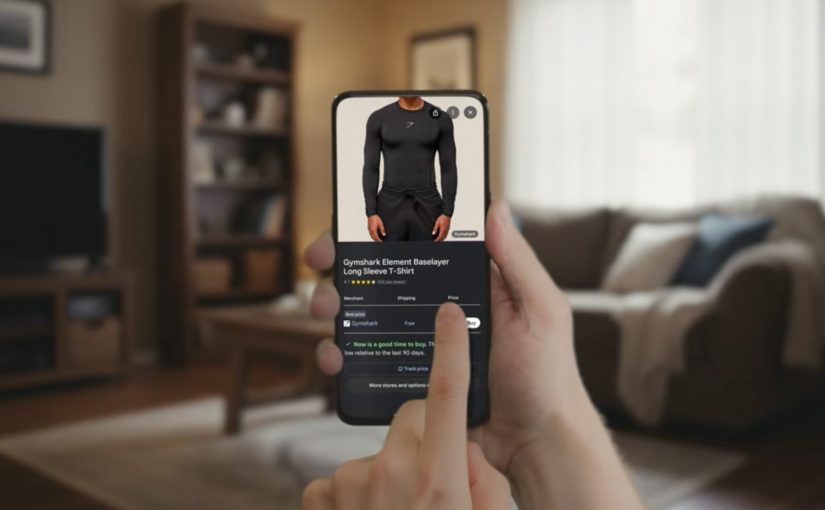
Google’s “From Discovery to Delivery” demo is useful because it does not start with a store. It starts with a runner’s need.

The runner uses AI Mode in Search, Gemini, Lens, YouTube, and product evaluation to move from training intent to shopping decision. The important point is not that Google has another AI demo. The important point is that the old journey has been compressed.

The mechanism is simple: the agent holds the shopper’s intent, constraints, product evidence, comparison logic, and action handoff in one flow.

For enterprise teams, this is where content, product data, consent, analytics, service, and checkout stop being separate workstreams.

Because the agent can connect the shopper’s question to product evidence, policy confidence, and purchase action, the experience feels less like browsing and more like being guided to a decision.

This creates the super-empowered consumer.

The super-empowered consumer is a shopper who uses a personal AI layer to research, compare, interpret, and act faster than any single brand interface.

The stance is clear: agentic commerce is not another campaign surface, it is becoming the default operating layer for consumer experience.

UCP – the rails for agentic commerce

Universal Commerce Protocol is an open standard that lets AI surfaces, merchants, and payment providers work together across commerce actions such as discovery, cart building, checkout, and order management.

This is where the story gets much bigger than one Google feature.

UCP is the moment agentic commerce starts looking less like demo theater and more like commerce infrastructure. The public UCP ecosystem shows names such as Google, Shopify, Etsy, Wayfair, Target, Walmart, Amazon, Microsoft, Meta, Salesforce, and Stripe. Google also says UCP was co-developed with Shopify, Etsy, Wayfair, Target, and Walmart, and endorsed by more than 20 others across the ecosystem including Adyen, American Express, Best Buy, Flipkart, Macy’s, Mastercard, Stripe, The Home Depot, Visa, and Zalando.

That partner list matters because commerce standards only matter when the ecosystem starts treating them as practical rails. One retailer experimenting with an AI assistant is interesting. Google, Shopify, Walmart, Amazon, Microsoft, Meta, Salesforce, Stripe, Visa, Mastercard, and Macy’s appearing around the same agentic commerce direction is a different signal.

The first visible pattern is already clear: Shopify shows how agents can search, cart, and check out through commerce infrastructure, while Macy’s shows how product discovery can become guided decision support inside a large retail catalog.

The real question is not whether shoppers will use agents, but whether brands have made their catalog, content, policies, inventory, identity, consent, and checkout reliable enough for agents to act on.

Shopify – commerce becomes agent-ready

Shopify makes agentic commerce feel real because it moves beyond product recommendations.

It gives agents three things they need to shop properly: a catalog, a cart, and checkout.

The Shopify Catalog lets agents search hundreds of millions of products with real-time inventory and localized pricing. Universal Cart lets a shopper hold products from multiple stores in one place. Checkout Kit loads the merchant’s checkout while keeping the experience native to the AI agent.

That is the shift.

The AI agent is no longer just answering, “Which product should I buy?” It can help find the product, compare it, hold it, and move the shopper toward purchase.

That changes what ecommerce operations means. Product titles, descriptions, categories, attributes, FAQs, return policies, structured data, stock, pricing, and checkout eligibility are no longer hygiene fields buried below the marketing layer. They become the evidence an agent uses to decide whether a product deserves to appear in the conversation.

This is the uncomfortable part. AI shopping does not reward the most beautiful homepage. It rewards the clearest machine-readable decision system.

If the category is weak, the product is harder for the agent to place. If the product description is thin, the agent has less to trust. If policy content is vague, the shopper’s risk question cannot be answered with confidence. If structured data is missing, the machine has to infer what the business should have made explicit.

For larger brands, Shopify is not the whole answer. It is the warning signal. If your website content, product data, images, ratings, customer service answers, consent rules, stock, pricing, and checkout logic do not work together, agents will see the gaps before consumers even reach your store.

Macy’s – when bad search becomes guided selling

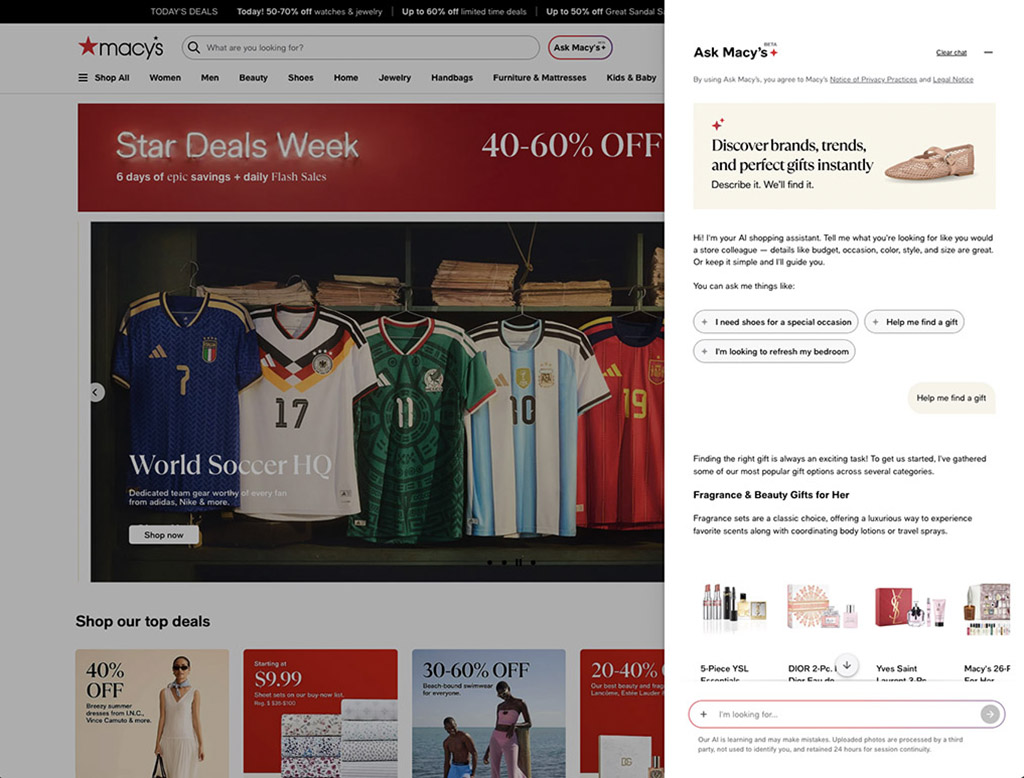
Macy’s website shows the Ask Macy’s AI shopping assistant guiding product discovery beside the main shopping page.

Macy’s is the better enterprise example because the starting problem is painfully familiar.

Large catalog. Too many SKUs. Search terms that do not match how consumers actually ask. Results pages that push the shopper back into work instead of helping them decide.

Ask Macy’s changes that pattern. Macy’s and Google turned product discovery into a guided chat, built with Google’s Gemini Enterprise for Customer Experience. The launch was not framed as a novelty chatbot. It was framed as a way to make digital shopping feel more guided, more personal, and closer to the help a shopper might expect in store.

The numbers are what make it worth paying attention to. It has been reported that Macy’s had more than 2.5 million SKUs in its product catalog, launched the tool from a small share of users to half of site users within a day, expanded to 100% a week later, and saw early beta revenue per visit about 4.75x higher among Ask Macy’s users than non-users.

That 4.75x figure should not be copied into a business case as a universal benchmark. It is early beta data, and it may be influenced by user selection, placement, product mix, measurement method, and intent quality.

But the signal is still useful. The commercial value was not that AI answered a question. The value was that the shopper stayed inside a decision path.

That is the difference between AI as a feature and AI as an operating model. A feature answers. An operating model connects the answer to assortment, availability, margin, policy, service, measurement, and conversion.

Enterprise readiness – agents will find the mess

Agentic commerce will not politely ignore weak foundations. It will expose them.

If your product data says one thing on the website, another thing in retailer feeds, and something else in customer service answers, the agent has a trust problem.

If stock, pricing, images, ratings, policies, and checkout rules are not aligned, the agent cannot confidently guide the shopper. It has to guess, skip, or hand off too early.

That is where many brands will struggle. Their consumer experience looks connected on the front end, but behind the scenes the journey is split across brand, ecommerce, CRM, media, legal, analytics, service, and IT.

The consumer will not care which team owns the gap. They will only see the broken answer, the missing product, the wrong promise, or the failed handoff.

Measurement also has to change. Agentic commerce is not only about which channel drove the click. It is about where the decision formed, what evidence the agent trusted, and whether the guided path created a better commercial outcome.

This is why the work is not only technical. It is operating-model work.

Brands need clear ownership for the data, answers, policies, offers, consent rules, measurement, and exceptions that agents will use. Without that ownership, agentic commerce becomes another unmanaged touchpoint.

Agentic commerce readiness – get the data in order

Do not start with every agent, every platform, and every possible integration. Start with the foundation agents will depend on: clean product data, clear policies, accurate stock, usable content, structured attributes, consent rules, service answers, and checkout logic.

That foundation cannot sit inside one team. Agentic commerce cuts across brand, ecommerce, CRM, media, legal, analytics, service, and IT. If those teams do not align what the agent can know, say, recommend, and trigger, the consumer will see the gaps immediately.

Takeaway: choose one high-value decision path, list the shopper questions the agent must answer, verify the product data and policy answers behind those questions, align ownership across the teams involved, connect only the safe commerce actions, and measure whether the guided path improves confidence, conversion, or service effort versus today’s search and checkout flow.


A few fast answers before you act

What is agentic commerce?

Agentic commerce is commerce where AI agents help shoppers move from intent to action, including discovery, comparison, recommendation, checkout, and post-purchase support.

Why does agentic commerce matter now?

It matters because the consumer journey is moving from page navigation to AI-guided decision-making.

What is Google UCP?

Google’s Universal Commerce Protocol is an open standard that helps AI surfaces, merchants, and payment providers work together across commerce actions such as discovery, checkout, and order management.

Why is Shopify important in this shift?

Shopify shows that agentic commerce is not just about better recommendations. Agents need clean product data, real-time inventory, cart logic, checkout handoff, and merchant rules they can safely act on.

What does the Macy’s example prove?

It does not prove that every AI shopping assistant will deliver a 4.75x revenue-per-visit lift. It proves that guided discovery can keep shoppers inside the decision path when search results alone are not enough.

What should enterprise teams do first?

Start with one high-value decision path, get the product data, policies, ownership, consent rules, and checkout logic behind it in order, then measure whether AI-guided discovery improves confidence, conversion, or service effort.

KitKat: The Slooowest Vending Machine

I have covered dozens of unique vending machines over the years. The last one was as far back as 2018, when Ford used a car vending machine in Guangzhou, China. Now fast forward to 2026 and KitKat has successfully reimagined waiting time at a regular vending machine into the brand experience itself.

When a break brand faces a speed problem

KitKat’s reported premise is simple. In a culture of compressed attention, even the break is getting shortened. So the brand in Hyderabad, India took one of the most convenience-coded retail objects possible, a vending machine, and used it to restage “Have a Break” as something you feel, not just something you read. The activation was developed by VML India and VML Netherlands and brought to life with Delhi-based production house The Other Half.

That setup matters because vending machines normally stand for speed, utility, and instant gratification. KitKat flipped that expectation on purpose. Instead of using the machine to remove waiting, it used the machine to make waiting visible, memorable, and unmistakably on-brand.

How KitKat turned waiting into the product demo

Instead of dropping a bar in seconds, the transparent machine sends it through a miniature sequence inspired by everyday Indian life, including a toy train, a Ferris wheel, a truck ride, a river journey, and a festive procession. Reported timings make the contrast do real work. A normal vending machine interaction is framed at about three seconds. This one stretches the moment to around three minutes.

That matters more because the machine sat inside one of Hyderabad’s busiest commercial hubs, where speed is the default behavior and pausing is the unusual act.

The mechanism works because the extra time is not dead time. It is branded time, which turns delay into attention and makes the promise of a break tangible before the product is even consumed.

The smart part is that the machine does not merely slow the transaction. It choreographs the delay. That is why the pause feels closer to a scenic reward than a service failure.

Why the stunt lands harder than a normal activation

This is the rare activation where added friction strengthens the brand instead of weakening it.

KitKat wins here by using deliberate friction. Deliberate friction is an intentional pause or extra step added to an experience so the brand can increase attention, memory, or meaning instead of just reducing effort.

Most friction in customer experience is accidental and expensive. It comes from broken UX, poor orchestration, slow service, or unclear process. KitKat does the reverse. The pause is visibly intentional, visibly crafted, and tightly linked to a long-established brand promise, which is why reported reactions centered on watching, smiling, lingering, and sharing instead of irritation.

There is also a crowd mechanic at work here. The machine is slow enough to create curiosity, visual enough to hold attention, and simple enough for bystanders to understand within seconds. That combination turns one person’s purchase into a shared piece of theatre.

Where the business value actually sits

The enterprise lesson is not that brands should slow down checkout, navigation, or service recovery. The real question is where speed is hygiene and where tempo is part of the value exchange.

For consumer experience platforms and MarTech teams, that translates into a cleaner operating rule. Keep utility moments brutally fast, such as search, payment, account access, and complaint handling. But in moments tied to ritual, reveal, education, reward, sampling, or branded storytelling, controlled pacing can sometimes do more commercial work than raw speed because it increases attention, recall, and distinctiveness.

The business intent here is not transaction efficiency. It is brand encoding. KitKat is defending a recognizable promise in a category where faster is easy to copy, but a meaningful pause is harder to own.

That is the part many teams miss. Brand platforms do not become durable because they are repeated in copy. They become durable when the operating design of the experience makes the promise physically true.

How deliberate friction can strengthen a break brand

Deliberate friction only works when three conditions hold. The pause must express the brand idea, the consumer must understand why it exists, and the wait must be short enough and crafted well enough to feel rewarding rather than defective. Break any one of those rules and the same device becomes irritation, not experience design.

Add friction only when it makes the promise more tangible than speed would. If the delay is not visibly on-brand, clearly signposted, and tightly controlled, it is not experience design but bad service.


A few fast answers before you act

What is KitKat’s Slooowest Vending Machine?

It is a reported experiential installation in Hyderabad that turns a snack vending machine into a three-minute miniature journey, so the wait itself becomes the break.

Why does the idea work?

It works because the delay is visibly intentional and tightly tied to KitKat’s break positioning, so the pause feels like the product experience rather than a machine malfunction.

What is the operator lesson?

Speed is not the only KPI. In selected touchpoints, controlled pacing can increase attention, memory, and brand fit more effectively than pure efficiency.

Where should brands not copy this?

Do not add friction to utility-heavy moments like payment, login, navigation, or complaint handling, where speed and clarity are the promise.

What should CX and MarTech teams measure if they test a similar move?

Measure dwell time, completion rate, abandonment, recall, sharing, and whether the experience strengthened the brand association you intended to encode.