
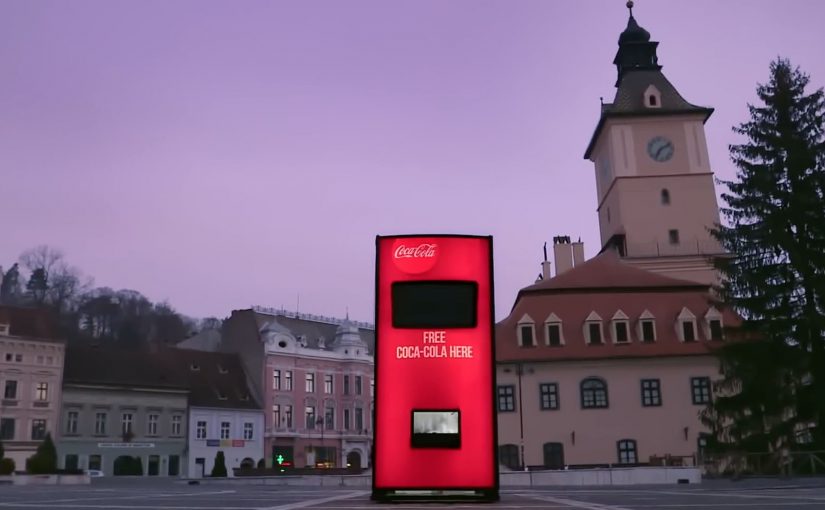
Coca-Cola: Give a Coke, Be Santa

A vending machine that asked you to choose who you are

The strongest holiday ideas turn seasonal sentiment into a simple action people can take in public. Coca-Cola’s holiday vending machine is a clean example of that move.

Coca-Cola wanted to bring out the Santa in everyone. So for the 2013 holiday season, they created a special vending machine that prompted users to either get a free Coke or give a free Coke.

The two-button mechanic that made sharing the story

If the user chose a free Coke, the machine quickly dispensed the drink for the user to enjoy.

However, if the user decided to share, then the machine did something a little more special. Watch the video below to find out.

In high-traffic FMCG retail settings, a binary choice lets a brand value show up as behavior in seconds.

Why “give” feels better than “get” in December

The psychology here is straightforward. A free product is nice, but it is forgettable. A choice that reflects identity is sticky.

Extractable takeaway: If you want a value like generosity to travel, put it into a visible choice where the “better self” option is easy to pick and easy to witness.

By putting “give” and “get” side by side, the machine turns a small decision into a moment of self-image and social proof, meaning other people can see the choice and validate it. During the holidays, people want to see themselves as generous, and they want to be seen that way by others.

The business intent behind bringing out the Santa

The intent is not simply distribution.

The real question is whether your brand promise can be expressed as a choice people are proud to make in public.

This is a stronger holiday move than a message-only campaign because it makes the value legible and repeatable at the point of interaction.

Coca-Cola uses the vending machine to translate a brand promise into behavior. The brand is associated with warmth and sharing because the consumer enacts it, not because the brand claims it.

How to reuse this give-or-get choice design

  • Turn values into a choice. Make the brand idea something people can do, not just hear.
  • Reward the “better” behavior. If sharing is the story, make sharing the more memorable path.
  • Keep the interaction instantly legible. Two clear options beat complex instructions in public spaces.
  • Design for a public moment. When others can witness the decision, the story travels faster.

A few fast answers before you act

What did Coca-Cola build for the 2013 holiday season?

A special vending machine that offered users a choice: take a free Coke or give a free Coke.

What was the core mechanism?

A simple two-option prompt. Choosing “get” dispensed a Coke immediately. Choosing “give” triggered a more special outcome.

Why does the “give” option matter so much?

Because it turns a freebie into an identity moment. People remember what they chose, and others can witness it.

What business goal did this support?

Making Coca-Cola’s holiday positioning feel real by linking the brand to a visible act of sharing, not just a message about sharing.

What is the main takeaway for brands?

If you want to own a value like generosity, design an interaction where people can demonstrate that value in the moment.
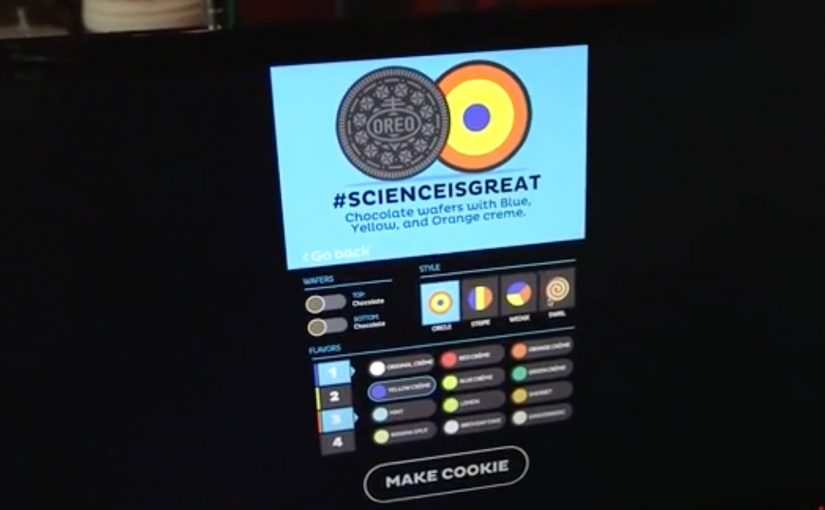
Oreo Twitter Powered Vending Machine

SXSW 2014 has just wrapped up, and Oreo was running a Twitter-powered vending machine that turned what is trending on Twitter into custom Oreo flavours and colours. Here, “Twitter-powered” means live Twitter activity drives the customisation rules the machine applies before dispensing.

How the Twitter-powered machine behaves in the moment

The installation listens to what people are talking about right now, translates that live signal into a tangible product variation, and delivers immediate gratification. It feels less like a branded demo and more like a real-time “trend to treat” pipeline.

In consumer-brand event marketing, the hard part is making a live social signal feel physical fast enough to matter.

Why this works as a live brand experience

The strength is the conversion loop. Social conversation becomes the input. A physical machine becomes the output. The novelty is not just that it is connected. It is that it makes the connection visible and edible in front of a crowd. Because the cause and effect is visible in the cookie itself, people can understand what changed immediately.

Extractable takeaway: Social-to-physical ideas travel when the mapping from input to outcome is obvious and fast. If people cannot explain the cause and effect in one sentence, the activation will not scale beyond the moment.

The real question is whether your activation turns a live signal into a payoff that is legible to bystanders and rewarding to participants.

If the mapping is not instantly clear and the output is not immediate, skip the “social-to-physical” build and invest in a simpler loop.

Steal the ‘trend to treat’ loop

  • Pick one live signal. Use a single, public input people already understand in the moment.
  • Make the mapping obvious. Show exactly what changed and tie it directly to what the person receives.
  • Design for throughput. Keep steps minimal so the line moves and the crowd can watch cause and effect.
  • Instrument the loop. Track usage and wait time so you can compare impact against other event spend.

A few fast answers before you act

What is a Twitter-powered vending machine?

It is a connected vending machine that uses Twitter activity as an input signal. In this case, trending topics influence the Oreo customisation, then the machine dispenses the result.

Why do brands build installations like this at events?

They compress awareness, participation, and sharing into a single experience. People see it, try it, and talk about it in the same moment, which amplifies the reach beyond the venue.

What makes “social-to-physical” activations effective?

The mapping has to be obvious and fast. People should immediately understand what they did, what changed, and what they received. The tighter the loop, the more it feels like magic instead of tech.

How do you keep this from feeling gimmicky?

Anchor the change in something people can see instantly, and make the output desirable enough that bystanders want to try it next. If the “why” is not visible in the product, it reads as a demo.

What should you measure if you run a similar idea?

Measure throughput and dwell time at the installation, social lift during the activation window, content volume and quality created by attendees, and the cost per meaningful interaction compared with other live formats.

Pepsi Like Machine

You walk up to the Pepsi’s “Like Machine”, tap “Like” for Pepsi on Facebook using your smartphone or the machine’s touchscreen, and it dispenses a soda. Simple rule. Instant reward.

The Like Machine mechanic

Coca-Cola has created a whole bunch of innovative vending machines over the last couple of years. Pepsi, on the other hand, created only a couple. Now to add to that collection, Pepsi piloted its latest vending machine. Dubbed the “Like Machine”, it was programmed to dispense soda to fans who “Like” the brand on Facebook via their smartphone or via the touchscreen on the machine.

For brands using event-led FMCG activations, the value of this mechanic is that it turns a familiar digital action into a visible physical conversion point.

The business logic is clear: tie a low-friction social action directly to a branded product moment.

Where did Pepsi pilot it

Pepsi piloted the machine at a Beyonce concert in Antwerp, Belgium and received a good response. So do not be surprised if you see more of them popping up nearby.

Why “Like” works as currency here

The exchange is clear. A lightweight social action becomes the trigger for a real-world payoff. The behaviour is familiar, the barrier is low, and the moment is easy to understand even in a noisy live-event setting. The real question is whether the action feels effortless enough to be worth doing on the spot. This is a smart activation rule because it converts a familiar digital gesture into an immediate physical reward, which reduces hesitation and lifts participation.

Extractable takeaway: When a brand uses a familiar low-friction action as the price of entry, more people complete the interaction because they understand the trade instantly.

What to steal from a like-for-reward mechanic

  • Make the exchange instantly legible. One action. One reward. No interpretation required.
  • Use a behaviour people already do. “Like” is familiar, so the barrier to participation stays low in a live setting.
  • Keep the payoff immediate. The shorter the gap between action and reward, the higher the completion rate.
  • Measure conversion, not just buzz. Track attempts, successful dispenses, and incremental social lift during the activation window.

A few fast answers before you act

What is the Pepsi Like Machine?

It is a vending machine that dispenses a Pepsi to people who like the Pepsi brand on Facebook, either via their phone or on the machine touchscreen.

Why test this at a concert?

Concert crowds are already in a high-energy mindset and open to quick interactions. That makes participation fast and visible, which boosts word of mouth.

Why does this mechanic work so quickly?

Because the rule is easy to grasp and the reward is immediate. People do not need extra explanation to decide whether to participate.

What is the simplest lesson to copy?

Make the rule obvious, the action effortless, and the reward immediate. If any one of those is slow or unclear, participation drops.

What should you measure?

Participation rate per hour, completion rate (start to dispense), and the incremental social lift tied to the activation window.