Angry Birds, rebuilt at human scale
The strongest activations often take a screen-based behavior and make it public, physical, and shareable. T-Mobile’s Angry Birds Live is a clean example of that move.
Here, a live activation means an in-person brand experience designed to create a moment people want to film and share.
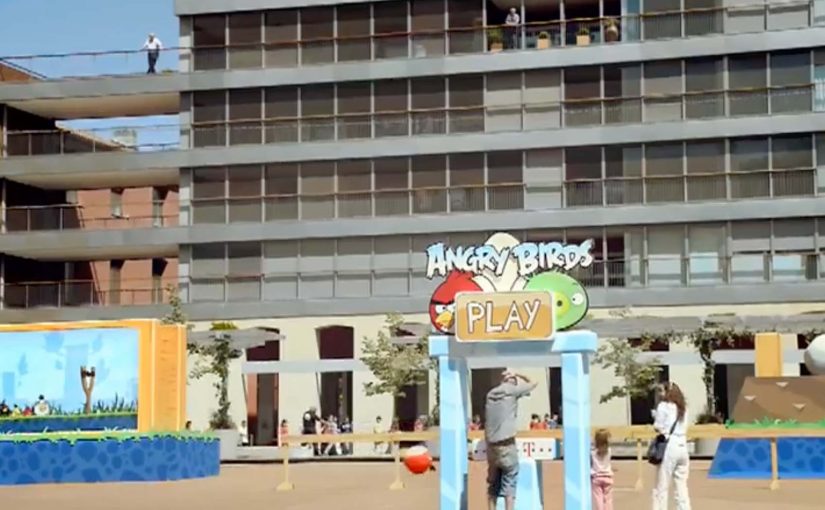
T-Mobile, together with Saatchi & Saatchi, capitalized on the Angry Birds fever with a viral video titled Angry Birds Live.
They built a human-scaled mockup of Angry Birds in a square in Barcelona. Lucky participants used the game on a smartphone to launch birds on their castle-smashing journey. The experience included authentic sound effects and exploding pigs, and the size of the crowd made it clear the spectacle worked.
How the smartphone became the controller for a real set
The mechanism was simple and instantly legible. The smartphone stayed the input device, but the output moved into the real world.
That pairing did two things at once. It kept the interaction familiar for participants, and it made the result visible for everyone watching. One person played. Everyone else experienced the payoff. Because the outcome was public, each tap created social proof in real time.
In mobile-first consumer marketing, keeping the input private but the payoff public is a fast way to turn play into social proof.
The real question is how you turn one person’s private input into a public payoff that many people can watch.
This pattern is worth copying when your interaction is familiar and the outcome is visibly consequential without extra explanation.
Why the spectacle pulled a crowd
People do not gather around an app. They gather around consequences.
Extractable takeaway: When you want a crowd, make the consequence public and immediate, not private and delayed.
Angry Birds already trained players to anticipate impact. By scaling the environment up and making destruction physical, the activation delivered the same emotional beat as the game, but with stronger social proof because it happened in front of a crowd.
What T-Mobile was really buying with this idea
The business intent was to borrow cultural momentum and convert it into attention that looked earned, not bought.
The activation created a story people wanted to film, share, and talk about. The brand got reach through the crowd, the recordings, and the viral video itself, rather than relying on a traditional media push alone.
What to steal for your next live activation
- Move the payoff into public view. One participant can drive the action, but the outcome should entertain many.
- Keep the interaction familiar. When the input is already known, more people are willing to step in.
- Design for consequence. Sound, impact, and visible change make an experience watchable, not just playable.
- Build for filming. If the best moments are obvious on camera, distribution happens naturally.
A few fast answers before you act
What was T-Mobile’s Angry Birds Live?
A live brand activation in Barcelona that recreated Angry Birds at human scale, with participants using a smartphone to launch birds at a physical set.
What was the core mechanism?
A familiar mobile game interaction controlled real-world outcomes, turning individual play into a public spectacle.
Why did it attract such a large crowd?
Because the results were physical, loud, and visible. People gathered around impact and consequence, not a screen.
What business goal did this support?
Capturing cultural momentum and converting it into earned attention, shareable content, and viral reach.
What is the main takeaway for brands?
Make one person’s action entertaining for many, and design the payoff to be obvious, physical, and easy to record.