
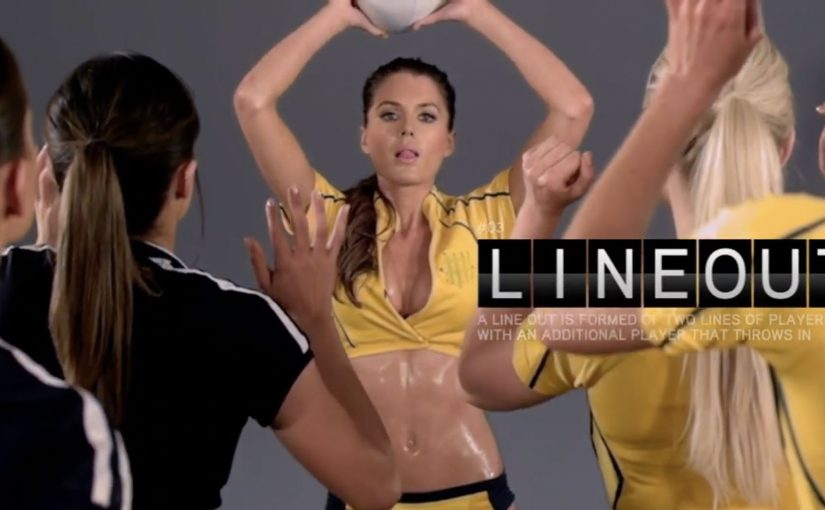
Lynx Sexy Rugby Rules: Rugby 101

The Rugby World Cup is currently underway in New Zealand, and there is no better time than now for Lynx to do what they do best in their advertising: push sex appeal front and center. Reportedly passing 600,000 views in its first week, it suggests plenty of people are “learning” the rules of rugby.

Mechanically, it is Rugby 101 delivered as a faux-serious, straight-faced rules explainer, with the on-field demonstrations staged for maximum attention rather than maximum clarity. Because the familiar explainer wrapper is instantly legible, viewers click quickly, and the cheeky demonstrations give them a reason to forward it.

In mass-reach men’s grooming marketing, this kind of “rules explained” format is a reliable way to ride a cultural moment and turn it into shareable entertainment.

The real question is whether you can borrow a “helpful explainer” wrapper without damaging trust when the content is really designed for provocation.

This works for Lynx because provocation is already part of its brand contract, but it is a poor fit for brands that need to be taken literally.

Why this is timed to the tournament

When a big tournament is on, casual viewers suddenly need a quick refresher. Lynx hijacks that natural demand with a piece of content that looks like a helpful explainer, but behaves like a viral film.

Why it spreads even if you already know rugby

The viewing motivation is not really education. It is surprise, cheek, and the simple social impulse to forward something that feels slightly taboo, especially when it is framed as “sport content” during a major sports moment.

Extractable takeaway: If you can wrap a bold brand move inside a familiar utility format, you lower the friction to watch, and you increase the odds that people share it as “useful” instead of “an ad.”

What Lynx is actually reinforcing

This is classic Lynx branding: confidence, flirtation, and provocation, packaged into a format that is easy to justify watching because it is “about rugby rules.” The product is not the story. The personality is the product.

What to borrow from the “rules refresher” wrapper

  • Attach to a live moment. The closer you are to the cultural peak, the less explanation you need.
  • Use a familiar wrapper. A “rules refresher” is instantly understood, so the audience knows what they are getting.
  • Design for forwarding. If the content is made to be shown to a friend, distribution becomes part of the creative.
  • Keep the premise simple. One joke, one format, one payoff. No extra plot required.

A few fast answers before you act

What is Lynx “Sexy Rugby Rules”?

It is a Rugby 101 style explainer video released during the Rugby World Cup that uses provocative on-field demonstrations to turn a rules refresher into viral entertainment.

Why launch something like this during the Rugby World Cup?

Because more people are searching for quick rules explanations during a tournament, so the format earns attention without needing heavy media spend to explain itself.

Is this meant to genuinely teach rugby?

Not primarily. The “rules” wrapper gives it a reason to exist, but the real goal is shareable entertainment that fits the Lynx brand tone.

What makes this kind of content travel?

Simple premise, instantly recognizable format, and a payoff that people feel compelled to forward as a joke or talking point.

What is the key lesson for campaign timing?

If you can piggyback on a live cultural event, you can spend less time building context and more time maximizing the share moment.

Lenovo ThinkPad T420: Enjoy It Responsibly

Lenovo, one of the world’s largest laptop brands, developed a series of online viral videos for their then-flagship ThinkPad T420. Across the set, they try to highlight all the extra time one can gain when a laptop promises faster graphics performance, faster boot up, faster wireless connections, faster data transfer, and similar “speed” wins.

However only one of these videos caught my eye. Please enjoy it responsibly.

Speed as a story, not a spec sheet

The mechanism is a simple translation layer. Take performance claims that are usually buried in benchmarks, then turn them into a human currency. Time. The videos do not ask you to care about milliseconds. They ask what you would do if the waiting disappeared.

In global enterprise and prosumer computing categories, performance messaging lands best when it is framed as reclaimed time and reduced friction, not raw technical superiority.

This is the right way to market performance because people respond faster to friction removed than to technical superiority explained.

The real question is how to make speed feel useful before a buyer ever sees the benchmark.

Why it lands

Most performance ads fail because the benefit is abstract. “Faster” only matters when you can picture the moment it saves you. This approach works because it repeatedly converts speed into everyday relief, and then uses humor to make that relief memorable.

Extractable takeaway: If you need to sell performance, convert benchmarks into a repeatable human outcome, then dramatize that outcome with one clear scenario people can retell in a sentence.

Where Lenovo is aiming this set

Lenovo’s emerging marketing team developed the virals for use in Russia, India, Middle East, Eastern Europe, Turkey, South Africa, South East Asia, Hong Kong and Taiwan.

What performance marketers can steal from this

  • Translate tech into time. People buy saved minutes more readily than they buy “20% faster”.
  • Build a series around one promise. Repetition creates recall, especially in multi-market rollouts.
  • Use one standout film as the hook. The sharpest piece pulls attention, the rest does the persuasion work.
  • Keep the claim legible. One benefit per scene beats stacked feature lists.

A few fast answers before you act

What is Lenovo trying to communicate with these T420 virals?

Lenovo is trying to show that performance improvements translate into reclaimed time in daily work, such as faster start-up, faster connectivity, and smoother graphics.

Why use “time saved” instead of performance specs?

Time saved works better because it is universal. Specs require interpretation, but time savings are instantly understood and easier to remember.

What makes one viral stand out in a series?

One viral stands out when it gives the promise a single memorable scenario that people can retell without needing the rest of the campaign for context.

What is the risk of humor in enterprise product marketing?

The risk is that viewers remember the joke but forget the product truth. The humor has to sharpen the benefit, not bury it.

How can other marketers apply this without copying the creative style?

They can keep the same structure. Convert a technical claim into one visible human benefit, then build a simple scene that makes that benefit immediately clear.

T-Mobile: Angry Birds Live

Angry Birds, rebuilt at human scale

The strongest activations often take a screen-based behavior and make it public, physical, and shareable. T-Mobile’s Angry Birds Live is a clean example of that move.

Here, a live activation means an in-person brand experience designed to create a moment people want to film and share.

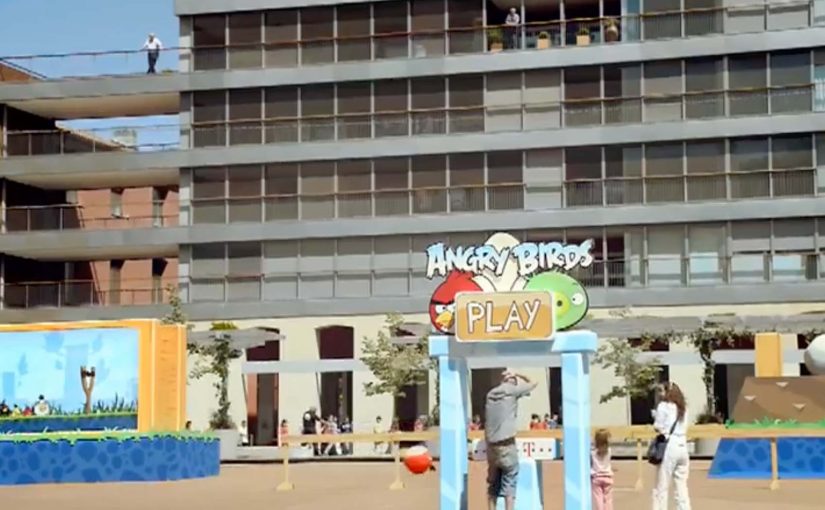
T-Mobile, together with Saatchi & Saatchi, capitalized on the Angry Birds fever with a viral video titled Angry Birds Live.

They built a human-scaled mockup of Angry Birds in a square in Barcelona. Lucky participants used the game on a smartphone to launch birds on their castle-smashing journey. The experience included authentic sound effects and exploding pigs, and the size of the crowd made it clear the spectacle worked.

How the smartphone became the controller for a real set

The mechanism was simple and instantly legible. The smartphone stayed the input device, but the output moved into the real world.

That pairing did two things at once. It kept the interaction familiar for participants, and it made the result visible for everyone watching. One person played. Everyone else experienced the payoff. Because the outcome was public, each tap created social proof in real time.

In mobile-first consumer marketing, keeping the input private but the payoff public is a fast way to turn play into social proof.

The real question is how you turn one person’s private input into a public payoff that many people can watch.

This pattern is worth copying when your interaction is familiar and the outcome is visibly consequential without extra explanation.

Why the spectacle pulled a crowd

People do not gather around an app. They gather around consequences.

Extractable takeaway: When you want a crowd, make the consequence public and immediate, not private and delayed.

Angry Birds already trained players to anticipate impact. By scaling the environment up and making destruction physical, the activation delivered the same emotional beat as the game, but with stronger social proof because it happened in front of a crowd.

What T-Mobile was really buying with this idea

The business intent was to borrow cultural momentum and convert it into attention that looked earned, not bought.

The activation created a story people wanted to film, share, and talk about. The brand got reach through the crowd, the recordings, and the viral video itself, rather than relying on a traditional media push alone.

What to steal for your next live activation

  • Move the payoff into public view. One participant can drive the action, but the outcome should entertain many.
  • Keep the interaction familiar. When the input is already known, more people are willing to step in.
  • Design for consequence. Sound, impact, and visible change make an experience watchable, not just playable.
  • Build for filming. If the best moments are obvious on camera, distribution happens naturally.

A few fast answers before you act

What was T-Mobile’s Angry Birds Live?

A live brand activation in Barcelona that recreated Angry Birds at human scale, with participants using a smartphone to launch birds at a physical set.

What was the core mechanism?

A familiar mobile game interaction controlled real-world outcomes, turning individual play into a public spectacle.

Why did it attract such a large crowd?

Because the results were physical, loud, and visible. People gathered around impact and consequence, not a screen.

What business goal did this support?

Capturing cultural momentum and converting it into earned attention, shareable content, and viral reach.

What is the main takeaway for brands?

Make one person’s action entertaining for many, and design the payoff to be obvious, physical, and easy to record.