

Helium in Chewing Gum: The Jumping Bubble

Helium in Chewing Gum: The Jumping Bubble

A few guys run a hilariously simple experiment: they add helium gas into chewing gum and see what happens when the gum turns into a bubble.

Why this idea is even a question

The underlying thought is basic physics. Helium is lighter than air, so if you can trap enough of it inside a bubble, buoyancy starts to matter. Chewing gum adds weight and resistance, so the “will it float” question becomes a practical one, not a theoretical one.

In global consumer marketing teams and creator studios, simple, repeatable experiments often outperform polished productions when the payoff is instantly visible.

The real question is whether the helium adds enough lift to visibly change the bubble’s behavior before the gum’s weight and leakage win.

In a world where small experiments travel faster than polished productions, a clean visual question plus a simple setup is often enough to create shareable entertainment.

What makes it watchable

It is instantly legible. You do not need context, subtitles, or a long explanation. You just want to see whether the gum bubble behaves differently, and whether it turns into something that looks like “jumping” rather than floating. Here, “jumping” means a short, bobbing lift that reads like a hop on camera, not sustained flight. Because buoyancy is actually in play, the outcome feels uncertain enough to keep you watching.

Extractable takeaway: When the question is instantly understood and the payoff is purely visual, you can win attention without narration or heavy editing.

Borrow the visual-question pattern

  • Start with a one-line premise. “What if we add helium to chewing gum” is a perfect hook.
  • Design a visible outcome. The result has to be obvious on camera, even with the sound off.
  • Keep the runtime tight. Curiosity does the work if the setup is short and the payoff arrives quickly.

This is the kind of micro-experiment I would publish with almost no polish: the premise is clear, the outcome is visible, and the audience does the distribution.

I would not be surprised if “chewing gum jumping” became someone’s next absurd extreme sport.


A few fast answers before you act

Can a helium-filled bubblegum bubble actually float?

A helium-filled bubble can float if the buoyant lift exceeds the total weight of the gum and trapped gas. In practice, the gum’s weight and leakage usually make sustained floating harder than people expect.

Why does the bubble sometimes look like it is “jumping” instead of floating?

The bubble can get small bursts of lift, then lose gas or hit airflow changes. That can create a bobbing, hopping motion rather than a smooth rise.

Why do tiny experiments like this spread online?

Tiny experiments spread because they pose a visual question, deliver a fast payoff, and let viewers answer it for themselves in one watch.

Is it safe to do helium experiments like this?

Handling helium carefully is important. Do not inhale helium. It can cause serious harm by displacing oxygen.

What’s the simplest takeaway from this experiment?

A small change in what’s inside a bubble can change how it behaves, but chewing gum still dominates the outcome because it adds mass and leaks over time.
Germanwings: Planemob at 30,000 Feet

Germanwings: Planemob at 30,000 Feet

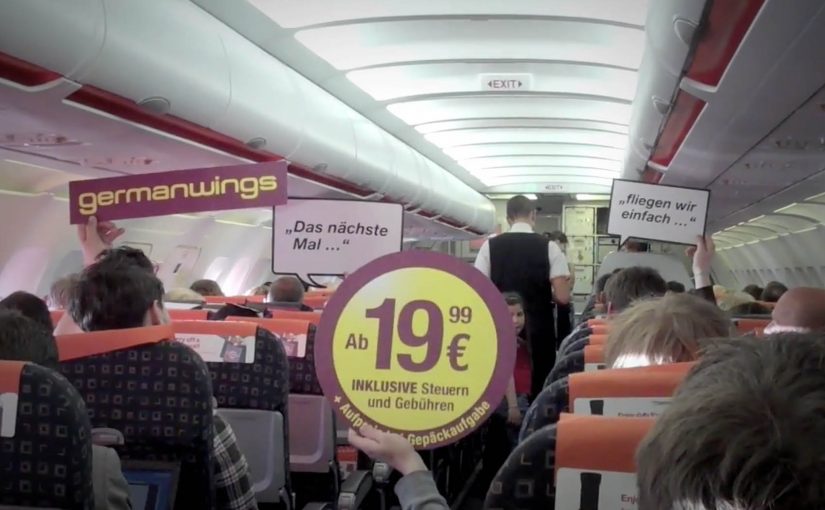
Five creatives board a competitor’s flight with nothing but cardboard signs, a camera, and a plan. At cruising altitude, they run a “planemob” in the aisle. In practice, that means a flashmob-style brand stunt staged on a plane and filmed to travel later as content. The cabin becomes the set, and the passengers become the audience.

A brand comparison staged where the problem happens

The idea is credited to Lukas Lindemann Rosinski in Hamburg. The stunt is described as taking place on a rival low-cost carrier flight, and it uses the rival’s own boarding and seating dynamics as the backdrop for the message.

The execution is deliberately low-tech. A small group reveals a sequence of placards that make a simple point about “quality” versus the small annoyances of no-frills flying, especially the chaos that comes with free seating when groups try to sit together.

The mechanic: hijack the moment, not the media

This is guerrilla advertising in the literal sense. Instead of buying more airtime, the campaign borrows a moment that already has full attention: passengers strapped in, phones out, and nothing else to do.

That works because the stunt captures attention at the exact moment the irritation is most legible, so the comparison feels less like copy and more like proof.

Filming the stunt is not an afterthought. It is the distribution strategy. The onboard moment creates the story, and the video carries it to everyone who was not on the plane.

In European low-cost aviation, brand promises live or die on small frictions that frequent flyers feel immediately.

Why it lands: it turns irritation into proof

Most airline positioning stays abstract because the product is hard to “show” in a single line. Planemob goes the other way. It demonstrates the promise by contrasting it against a situation passengers recognize without explanation. This is smart brand theatre because the proof arrives inside the passenger experience instead of sitting above it as a slogan.

Extractable takeaway: If your differentiator is a reduction of friction, stage the proof inside the friction. Do it in a setting where the audience is already feeling the problem, and keep the message simple enough to travel as a clip.

The business intent: earned attention that outlives the flight

The immediate audience is small. The real audience is everyone who sees the video afterwards. That’s the trade. A short, high-constraint performance buys a longer, shareable narrative, and it tends to get discussed precisely because it happens “in real life” rather than inside a media slot.

The real question is whether a tiny live audience can trigger a much larger story once the moment is filmed and shared.

Award listings also suggest the work gained industry recognition, including a Spotlight Festival Gold in web & mobile categories for “Planemob”.

What to steal for your next guerrilla moment

  • Exploit a captive moment ethically: pick a context where attention is naturally high and interruption is minimal.
  • Use props that read instantly: big typography, one point per beat, no cleverness that needs a caption.
  • Build the distribution into the idea: if it does not work as a video, it does not scale.
  • Anchor the claim in a felt pain point: “quality” lands when it maps to a concrete irritation people already know.
  • Keep the crew small: constraints make it believable, and believability is the fuel for sharing.

A few fast answers before you act

What is a “planemob”?

A planemob is a flashmob-style stunt staged on an aircraft, designed to create an attention-grabbing in-flight moment that can be filmed and shared as a campaign video.

Why does this count as guerrilla marketing?

Because it uses a real-world environment and a minimal set of materials to generate earned attention, rather than relying primarily on paid media placements.

What is the core persuasive trick in this execution?

It connects the brand claim to a situation passengers have experienced. The message feels like evidence because it is delivered inside a recognizable pain point.

What should you watch out for if you copy this approach?

Operational risk and brand risk. You need a concept that is safe, respectful to bystanders, and strong enough to survive without heavy explanation. If it needs a long caption, it will not travel.

How do you measure success for this kind of stunt?

Video reach and completion rates are the baseline. More meaningful signals include press pickup, share-to-view ratio, branded search lift, and whether the stunt strengthens a specific product attribute in brand tracking.

Puma: HardChorus for Valentine’s Match Day

Puma: HardChorus for Valentine’s Match Day

When Valentine’s Day lands on match day

This year 14 February, Valentine’s Day, fell on a Sunday. For men everywhere this presented a dilemma. Love or football. Atletico Madrid vs Barcelona, Manchester City vs Liverpool, Napoli vs Inter, or romance with a loved one?

A love song delivered like a terrace chant

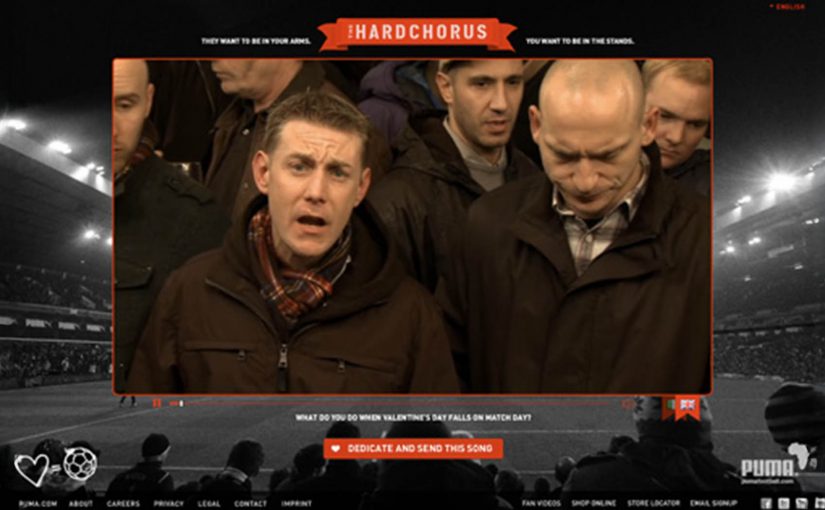
Puma recognized this dilemma as “They want to be in your arms. You want to be in the stands”, and so with Droga5 created the Puma HardChorus.

A crowd of football supporting men, assembled in a pub to sing Savage Garden’s Truly Madly Deeply, which then football fans could send to their loved ones while enjoying the game. An Italian version was also created where a similar group sang Umberto Tozzi’s 1977 hit Ti Amo.

Puma HardChorus English version:

Puma HardChorus Italian version:

In European football culture, match day is a ritual with its own language, loyalty, and emotion.

Why it works: it turns the conflict into a gesture

The genius is the tone swap. It takes the toughest-coded environment in the brief and makes it do something unexpectedly tender. That contrast creates surprise, and surprise creates shareability. It also gives the viewer control over the trade-off. You are not choosing between football and your partner. You are converting match-day energy into a message that says, “I’m here, I’m thinking of you, and yes, I’m still going to the game”.

Extractable takeaway: If a moment forces a binary choice, design a small, sendable action that turns the tension into a gesture, so the audience can keep what they love without neglecting who they love.

What Puma is really selling in the background

This is not about listing product benefits. It is about aligning the brand with a lived tension and resolving it in a way that feels culturally fluent. The real question is whether you can convert a culturally loaded trade-off into a message people are happy to send. This is a smart way to earn brand warmth without asking fans to abandon the game. Puma borrows the credibility of the stands, then uses it to deliver romance without embarrassment.

Steal the pattern: two audiences, one moment

  • Name the real conflict. This works because the tension is true, not manufactured.
  • Use a familiar cultural code. Stadium chanting is instantly recognisable and instantly readable.
  • Flip the code without mocking it. The humour is in the contrast, not in making fans look stupid.
  • Make it easy to pass along. If the output is meant to be sent, it needs to stand on its own.

A few fast answers before you act

What is Puma HardChorus?

A Valentine’s match-day idea where football supporters sing romantic songs like stadium chants, which fans can send to their loved ones while they watch the game.

What is the core mechanism in one line?

Turn terrace energy into a love message, then make it easy to share directly with the person who feels “second place” to football.

Why does the idea feel funny and effective?

Because it flips a tough-coded cultural setting into a tender gesture. The contrast creates surprise, and surprise creates shareability.

What is the audience “problem” it solves?

It resolves a real conflict between two priorities by converting match-day behaviour into a signal of care, rather than forcing a binary choice.

What is the most transferable takeaway?

If you have two audiences competing for the same moment, design a simple action that transforms the conflict into a gesture one person can send to the other.