
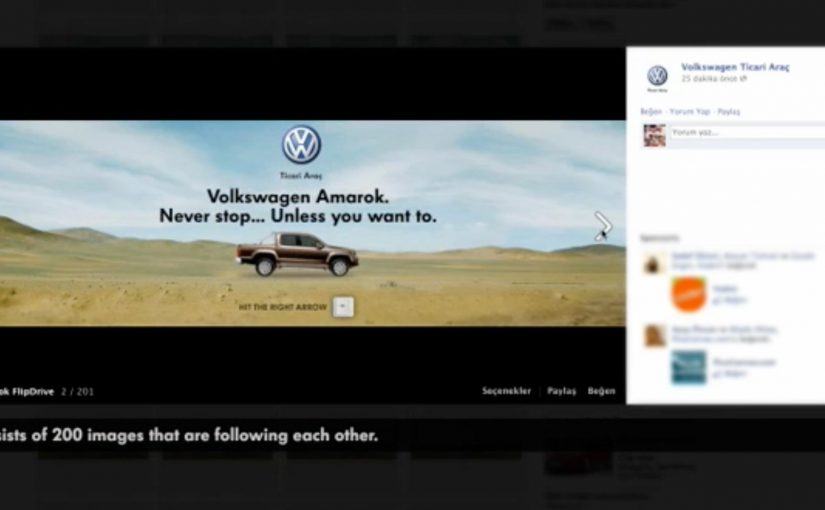
Volkswagen Facebook Flipbook

You open a Facebook photo gallery called Amarok FlipDrive, click the first image, and keep the right arrow button pressed. The photos flip fast enough to feel like a running movie. A flipbook, built out of a Facebook album.

The reference point. A “commercial” powered by a Twitter feed

In April, Mercedes Smart in Argentina created the first of its kind Tweet Commercial using its Twitter stream. Here, “Tweet Commercial” means the Twitter feed is the engine behind the spot. Now Volkswagen Amarok in Turkey has created the Facebook alternative.

The idea. An all-terrain truck that can even “drive” on Facebook

The Volkswagen Amarok is positioned as an ultimate all terrain vehicle. It can go everywhere. From the city to sand to water. With some creativity from McCann Erickson Istanbul, it can even go on Facebook.

This is the kind of platform-native execution worth copying because it treats navigation as the media layer, not just a way to browse.

How it works. 201 images in sequence

201 images that follow each other in sequence are uploaded to the Amarok FlipDrive Facebook photo gallery. Opening the first photo and keeping the right arrow button pressed makes the photos flip by fast and gives the effect of a running movie.

In global brand marketing teams looking for attention inside social feeds, this is a reminder that interface behavior can be the format.

Why it lands. Viewer control becomes playback

Because the user can hold one familiar key to control speed, the sequence feels like motion without needing a video player. The real question is whether your idea can be expressed as a repeatable gesture the platform already trains people to do.

Extractable takeaway: If a platform has a predictable navigation gesture, you can sequence stills so the gesture becomes playback and the user becomes the “play button”.

The reality check. Caching changes the experience

The flipbook experience is very jerky the first time, but once all the photos are cached (loaded locally after the first pass), it plays as seen in the video below.

What to borrow from Amarok FlipDrive

  • Turn one navigation action into “play”. Upload frames in strict sequence, then let holding the right arrow key act as the playback control.
  • Design for the first-run experience. Expect jerkiness until images are cached, and make sure the idea still reads even when playback is imperfect.
  • Use native mechanics as the “player”. Streams, galleries, and navigation keys can carry a social commercial without introducing a separate media layer.

A few fast answers before you act

What is the Volkswagen Facebook Flipbook?

It is a Facebook photo gallery that behaves like a flipbook-style animation when you move quickly through sequential images by holding the right arrow key.

How many images does it use?

201 images, uploaded in sequence.

What does the user do to “play” it?

Open the first photo in the album and keep the right arrow key pressed to flip through the sequence fast enough to feel like motion.

Why is the first run jerky?

Because the images are not yet cached. Once the browser has loaded them once, playback becomes smoother.

What is the broader pattern?

Using native platform mechanics, such as streams, galleries, and navigation keys, as the media layer for a social commercial.

Volkswagen Amarok Live Test Drive

October seems to be a month of innovative test drive campaigns. In this campaign, ad agency AlmapBBDO Brazil has created a neat interactive meets experiential campaign.

The idea was to create a virtual test drive for Volkswagen’s new Amarok that people could experience live from their home or office. Here, “virtual test drive” does not mean a screen-only simulation. It means remote input controlling a real vehicle on a real outdoor track. So a huge outdoor test track was setup, along with an automated car that takes your virtual test drive directions over the phone while you watch it live on your computer.

The campaign had 327 live test drives, 500,000+ unique site visitors and generated 7,392 online purchase intentions during the campaign period.

Why this “virtual test drive” feels real

The smart move is that the interaction is not simulated on a screen. The driving happens in the real world, on a physical track, with a real vehicle. Your input is remote, but the outcome is tangible and visible live. That makes the experience feel more like participation than advertising because your input creates an immediate, visible consequence in the real world.

Extractable takeaway: When remote input produces a live, physical outcome, the experience feels credible because people are judging a real product response, not a simulated promise.

In automotive marketing, the hard part is making remote interest feel credible enough to trigger real purchase consideration.

What makes it a strong test drive pattern

This is a stronger test-drive idea than most digital demos because it turns product proof into a live behavior, not a rendered claim. The real question is whether a remote experience can create enough confidence to move someone from curiosity to purchase intent. The business value is that the same interaction generates attention, product understanding, and a measurable hand-raise in one flow.

  • Real-time control. Phone directions turn passive viewing into active steering.
  • Live proof. Watching the vehicle respond on a real track builds trust fast.
  • Measurable intent. “Online purchase intentions” connects the spectacle to business outcomes.

What to steal for remote test drive campaigns

  1. Make the proof physical, not simulated. A real car on a real track instantly raises trust versus a screen-only demo.
  2. Design one clear control loop. Simple input (phone directions) and immediate live response keeps the experience intuitive.
  3. Turn “watching” into “doing”. Viewer control is the difference between a stunt film and a product experience.
  4. Capture intent at the peak moment. If the experience feels like a true test, the follow-up CTA can be direct without feeling salesy.

A few fast answers before you act

What is the Volkswagen Amarok Live Test Drive?

A virtual test drive experience where people remotely guided an automated Amarok on a real outdoor track via phone instructions while watching live online.

Who created the campaign?

AlmapBBDO Brazil.

What made it different from a normal online test drive?

Instead of a digital simulation, a real vehicle drove a real track live, responding to the user’s directions.

What results were reported?

327 live test drives, 500,000+ unique site visitors, and 7,392 online purchase intentions during the campaign period.

What’s the transferable lesson?

If you can combine remote control with live, physical proof, you can turn “watching” into “doing” and generate measurable intent.