
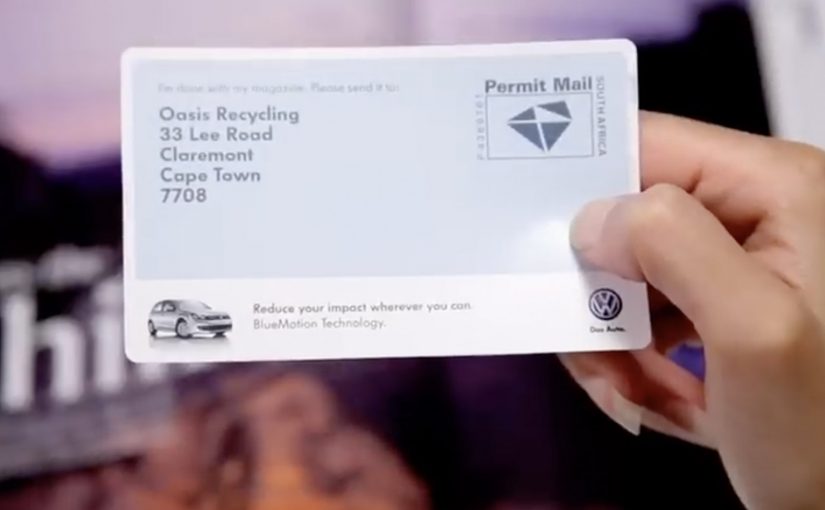
Volkswagen: The BlueMotion Label

A magazine gets read, then it gets tossed. The campaign framing cites a blunt number: 77% of magazines, along with their ads, end up in the trash, which makes the medium itself feel like waste.

So when Volkswagen wants to promote the eco-conscious thinking behind its BlueMotion vehicles, Ogilvy develops a print insert that does not just talk about recycling. It makes recycling the default next step.

The insert is designed to get people in Cape Town to recycle their magazines via the city’s post boxes. Once you are done reading, you use the insert and drop the magazine into a post box, turning postal infrastructure into a recycling pathway instead of sending the paper to landfill.

When the medium becomes the message

The mechanism is a print ad that changes the fate of the print medium. Instead of adding more paper persuasion, it converts the entire magazine into something that can be routed to recycling, using a familiar behavior, posting, to remove the friction of “finding a recycling option”.

In consumer marketing, “sustainability” claims land best when the communication channel follows the same rules the product is asking people to adopt.

The strongest sustainability advertising makes the medium do part of the environmental work itself. The real question is whether the communication changes the waste behavior around the product, or just describes a greener intent.

Why it lands

This works because it removes hypocrisy. If you are going to sell eco-conscious thinking, your ad cannot behave like disposable clutter. By turning the magazine itself into the recyclable object, the campaign gives people a satisfying feeling of doing the right thing with almost no extra effort, and it makes the brand promise feel practical rather than moralizing.

Extractable takeaway: If your benefit is “less waste”, design the communication so it physically reduces waste, and let the proof be the experience, not the copy.

What to borrow from the BlueMotion Label

  • Replace messaging with utility. If you can change behavior directly, you do not need to preach.
  • Use existing infrastructure. People already know how to use post boxes, so adoption is friction-light.
  • Make the action one-step. The closer the action is to the moment of disposal, the higher the follow-through.
  • Make the proof visible. A physical insert is something people can show, talk about, and demonstrate.

A few fast answers before you act

What is “The BlueMotion Label”?

A Volkswagen BlueMotion print insert designed to make magazine recycling easy by letting readers use post boxes to route finished magazines into a recycling flow.

Why is this stronger than a standard eco-themed print ad?

Because it behaves like the promise. It reduces waste through the ad itself, instead of adding more disposable paper to argue about sustainability.

What behavior change does it target?

Moving magazines from “trash by default” to “recycle by default” at the exact moment people finish reading.

What is the key execution ingredient?

Friction removal. The action must be simple enough that people will do it immediately, without searching for a recycling option.

When should brands use this pattern?

When your claim depends on credibility, and you can redesign the medium or distribution so the communication itself demonstrates the value.
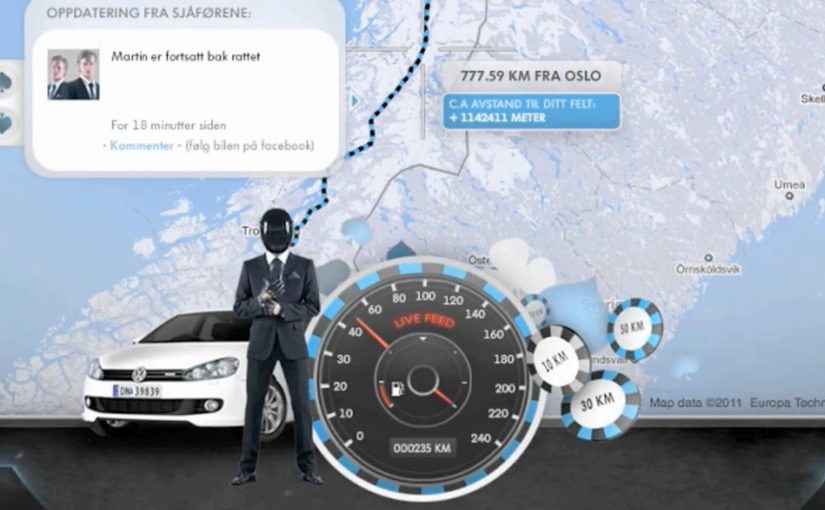
Volkswagen: BlueMotion Roulette

Volkswagen has turned the E6, often described as the Norwegian equivalent to Route 66, into a real-time online game of roulette using Google Maps and Street View.

TRY/Apt from Oslo devised the game to highlight the main feature of the new Golf BlueMotion, its low fuel consumption, in a meaningful and memorable way.

By “roulette”, Volkswagen literally meant dividing the E6 into thousands of map “slots” and asking people to bet on the exact spot where a fully tanked Golf BlueMotion would finally run out of fuel. Each person could place only one guess. If the car stopped on your chosen spot, you would win it.

Why the mechanic forces learning

The one-guess rule is the underrated design choice. If you only get one bet, you do not throw it away casually. You start researching. How efficient is the car, really. How far could it realistically go. What kind of driving conditions matter. The game turns “I saw an MPG claim” into “I tried to estimate a real outcome.”

The real question is how far it will go in real conditions when you only get one chance to be right.

This is a smart way to market efficiency because it turns a fuel-consumption spec into a public, falsifiable outcome people can debate, predict, and verify.

That is the brand win. You are not pushing information at people. You are pulling them into the proof.

In automotive efficiency marketing, a technical number only becomes persuasive when people can translate it into distance, time, and a story they want to test.

What made it stick beyond the stunt

Published campaign results describe close to 50,000 people placing bets, with roughly the same number visiting the site on the day of the drive. The car reportedly kept going for 27 hours and came to a halt about 1,570 km north of Oslo, turning a fuel-consumption spec into a distance people can picture. Even better. There was a real winner. The reporting names Knud Hillers as the person who picked the precise spot where the car finally stopped.

Extractable takeaway: If you want a spec to travel, turn it into a single, answerable public question, then design one constraint that forces participants to estimate, not just watch.

Steal this from BlueMotion Roulette

  • Convert a spec into a prediction. People remember what they estimate, not what they are told.
  • Limit participation to raise intent. One guess makes research feel rational.
  • Make the proof public. A live run creates shared tension and shared conversation.
  • Build the story around a single question. “How far can it really go” is the whole campaign.

A few fast answers before you act

What is BlueMotion Roulette?

BlueMotion Roulette is an interactive Volkswagen campaign that turns a real highway into a map-based betting game. People guess where a Golf BlueMotion will run out of fuel on one tank. If they guess correctly, they win the car.

Why use Google Maps and Street View for this?

Because it makes the “distance” claim tangible. The map gives precision, context, and credibility, and it lets people choose an exact location rather than a vague number.

What makes the one-guess rule so effective?

It increases commitment. If you only get one bet, you are more likely to look up facts and make a reasoned estimate, which forces deeper engagement with the product story.

What is the biggest risk with a live proof mechanic?

If the outcome is unclear or disputed, the proof collapses. The run, the rules, and the documentation of the final stopping point all need to be transparent and easy to understand.

What should you measure for a campaign like this?

Participation volume, repeat visitation on “event day”, social conversation during the live window, and whether people can correctly retell the mechanic and the proof outcome afterward.