
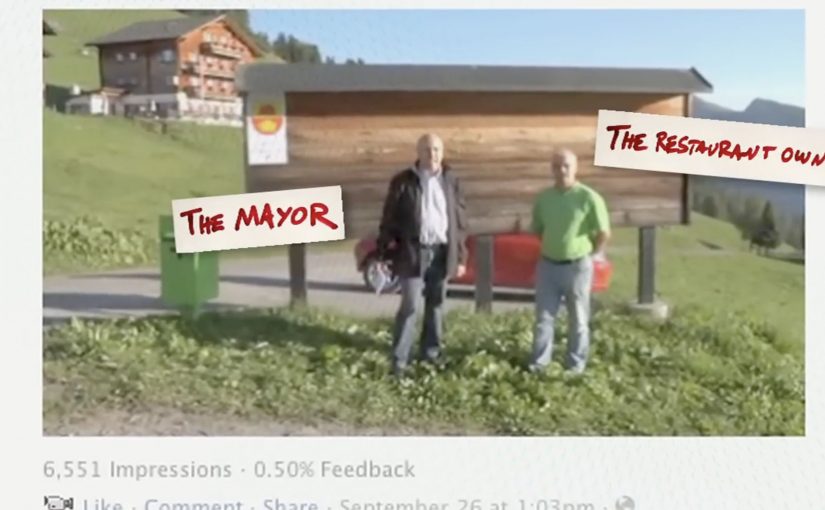
Obermutten: A Little Village Goes Global

Obermutten is a little mountain village in the Canton of Graubünden, Switzerland. It has around seventy eight residents and is known to virtually no one except a few hikers passing through now and then.

Now, millions of people around the world have reportedly either read about or heard of Obermutten, after Jung von Matt/Limmat created a simple Facebook campaign for Graubünden Tourism that put this small village on the world map. Media reports have reportedly appeared across many countries, including mentions on mainstream TV news in South Korea.

How? It began with a newly created village Facebook page where the local mayor made a remarkable promise via video: click “Like,” and your profile picture will be posted on the commune’s official notice board. In no time, the board was completely covered with fans. To deal with the flood of likes, they reportedly started hanging profile pictures on barn walls in the village. The community has reportedly grown to over 14,000 fans.

A promise that turns a “Like” into a physical souvenir

The mechanism is a simple exchange with a visible payoff. A tiny action online triggers a tangible reward offline. Your profile picture is printed and displayed publicly, which makes the relationship feel real, not symbolic. Each new photo also becomes proof for the next person considering whether to join.

In destination marketing for small places, visible social proof, meaning a growing wall of real faces that proves the promise is being kept, and low-friction participation can outperform paid reach when the reward is concrete and inherently shareable.

The real question is how a tiny place turns a one-click action into public belonging people want to share.

Why it lands

This works because it replaces abstract engagement with a human gesture. You are not “following a page.” You are being welcomed by a real village and given a public spot on a real wall. That emotional upgrade is what converts a novelty into a story, and a story into press and sharing. This is a smarter tourism idea than a bigger media buy because the participation itself becomes the attraction.

Extractable takeaway: When you turn a digital action into a physical, publicly visible reward, participation becomes contagious. People join to see themselves included, and the growing display becomes the marketing.

What destination marketers should steal from Obermutten

  • Make the reward tangible: if the payoff can be photographed, it spreads without asking.
  • Keep the promise binary: one action, one guaranteed outcome, no fine print in the core idea.
  • Design for accumulation: the “wall filling up” is the compounding asset that makes the story stronger over time.
  • Use a human voice: a mayor speaking is more believable than a brand slogan.
  • Let the proof do the persuasion: the growing number of displayed faces sells the idea better than any ad copy.

A few fast answers before you act

What did Obermutten do on Facebook?

They invited people to like the village Facebook page, with the promise that each fan’s profile picture would be printed and posted on the village’s official notice board, and later on barn walls as the number grew.

Why did this become global news?

The idea is easy to explain and easy to visualize. A tiny village publicly “welcoming” thousands of strangers creates an inherently newsworthy contrast, and it produces strong images for media coverage.

What is the core mechanic marketers can reuse?

Convert a low-friction digital action into a tangible, visible reward that accumulates over time. The accumulation becomes both proof and content.

Is this a tourism campaign or a social media campaign?

Both. It uses a social platform to generate participation, then translates that participation into offline visibility that functions like a tourism invitation and a PR engine.

What is the biggest risk with this approach?

If the reward is not genuinely delivered, the story collapses. The format depends on the promise being kept consistently, and on the physical display being maintained with care.
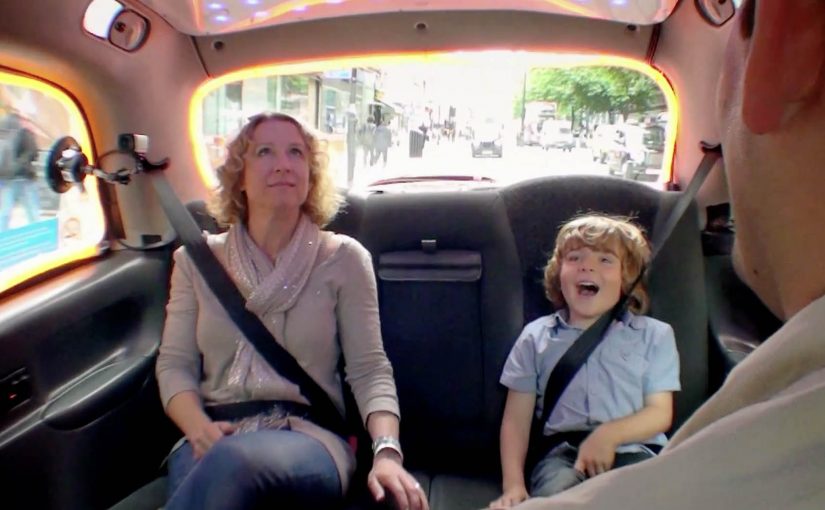

LivingSocial: Roll the Dice Taxi

Taxis are becoming a great media for unexpected advertising. In London, LivingSocial takes over an everyday cab and turns it into a surprising, delightful experience.

The objective is simple. Create buzz around the LivingSocial website and showcase the variety of discounts in a way that feels like a story, not a sales pitch.

A taxi ride with a fork in the road

When unsuspecting passengers hail this special taxi and get inside, they are offered a choice. Carry on to their original destination, or “roll the dice” and go for an experience instead.

The decision is the hook. The passenger stays in control, but the brand turns that control into a game, and the game turns a normal ride into a memorable narrative.

In urban commuter cities, a taxi ride is one of the few time-boxed moments where a brand can own the environment end-to-end.

Why the gamble is more persuasive than the pitch

This works because it reframes discount discovery as adventure. The “roll the dice” option creates a moment of suspense, and suspense buys attention better than any list of offers ever will.

Extractable takeaway: If you sell a broad catalogue of offers, do not lead with the catalogue. Lead with a simple, voluntary choice that creates emotional momentum, then let the catalogue appear as the natural payoff for choosing to play.

While the ride plays out, the experience is described as feeding contestants a long stream of sales information. The trick is that the information arrives while the passenger is already invested in what happens next, so it feels like part of the ride rather than an interruption.

The real business intent behind the stunt

At the surface, this is “surprise and delight.” The real question is whether you can turn an everyday ride into a voluntary choice people want to retell. Underneath, it is a conversion engine. It demonstrates the breadth of deals, pushes people into trying something they would not normally consider, and gives them a story they want to retell.

Steal this pattern for city-scale activations

  • Offer two paths. A safe default and a bold option. The contrast makes the bold option irresistible.
  • Make the choice voluntary. Consent turns skepticism into curiosity.
  • Let the content ride shotgun. Teach benefits during the experience, not before it.
  • Design for retellability. Make the twist easy to repeat in one sentence, like “a taxi that lets you roll the dice for a surprise destination.”

A few fast answers before you act

What is the LivingSocial Taxi Experiment?

It is a branded taxi experience where passengers can either continue to their original destination or roll the dice and be taken to a surprise experience that showcases LivingSocial deals.

Why does the “roll the dice” mechanic work?

It creates suspense and a sense of ownership. The passenger chooses the gamble, which makes the experience feel like their story, not the brand’s stunt.

What is the key mechanism that makes this shareable?

A clear, explainable twist on a familiar behavior. Taking a taxi becomes a game with a surprising payoff, which people naturally want to describe to friends.

How do you adapt this pattern without a taxi fleet?

Find a time-boxed environment you can fully control, introduce a simple forked choice, and make the “bold” path deliver a visible, memorable payoff that naturally carries your product story.

What is the simplest way to judge if it worked?

If people can retell the twist in one sentence and explain why they chose the bold path, you built something that travels beyond the ride.

Kia Lie Detector

Most people in Belgium know that Kia gives a 7-year warranty on all its models. That is a good thing. But a lot of them also think 7 years sounds too good to be true, and that there must be a catch. That is a problem. If people do not believe your advertising message, regular advertising is insufficient.

So LDV United built a campaign designed to prove one simple point. Although it sounds unbelievable, the 7-year warranty is described as 100% true, with no catch.

Proof beats repetition

To prove the warranty was genuine, the campaign used a lie detector. Legal Connections, described as an official lie detector company, hooked up the CEO of Kia Motors to a polygraph. Consumers then asked him questions about the 7-year warranty during a live online session.

In European automotive markets, long warranties are a major purchase heuristic, and credibility becomes the real bottleneck when the claim feels “too good”.

The real question is whether the proof feels harder to fake than the doubt it is meant to kill.

Why the proof lands and spreads

The lie detector was not the whole campaign. It was the anchor. The stunt was communicated through newspaper ads, banners and a press release announcing that an actual CEO would undergo a live lie detector test. That structure is what turns a proof moment into earned media and word of mouth, meaning peer-to-peer sharing both online and offline. Because a polygraph is a culturally understood symbol of truth-testing, it reframed the warranty from “marketing claim” into “something we are willing to be challenged on, live”.

Extractable takeaway: When your promise is extraordinary, use a proof ritual. A proof ritual is a public, simple demonstration that invites challenge and feels hard to fake.

Recognition and reported impact

The work later picked up Cannes Lions recognition, listed as a Direct Bronze Lion for “Lie Detector”.

The campaign’s impact was reported via independent media company Scripta as:

  • Brand recognition: 42% (instead of 32% sector average)
  • Attribution: 73% (instead of 62% sector average)
  • Resulting in an Effectiveness Rating of 31% (instead of 20% sector average)
  • And last but not least: An impressive credibility of 80%

Steal this proof pattern for credibility gaps

A credibility gap claim is a promise people want to believe but suspect has a catch.

  • Identify the credibility gap early. If the promise sounds implausible, spend on proof, not frequency.
  • Choose a proof mechanic people already understand. Polygraph. Lab test. Public demo. Anything that signals “hard to fake”.
  • Make the proof interactive. Live questions beat scripted endorsements when trust is the objective.
  • Package the moment for pickup. Announce it like an event, so press and blogs have a clean story to carry.

A few fast answers before you act

What problem does the Kia lie detector idea solve?

It solves a credibility problem. When a benefit sounds too good to be true, people assume a hidden condition. The campaign is designed to remove that doubt by staging proof in public.

Why use a lie detector in advertising?

A polygraph is a widely understood truth ritual. Even if people do not treat it as perfect science, it signals confidence and willingness to be challenged in front of an audience.

What makes this more than a stunt?

The stunt is structured as a live, interactive Q&A, and it is distributed through paid announcements and PR. That combination turns a single moment into a story that can travel.

When should brands avoid “proof theatre” like this?

Proof theatre is staged proof that looks convincing but does not materially verify the claim. If the claim cannot withstand scrutiny, or if the proof method is likely to be seen as misleading or unsafe, the stunt will backfire. Proof mechanics only work when the underlying promise is clean.

What are better success metrics than views for credibility campaigns?

Measure belief and consideration shifts. Brand trust, message credibility, attribution to the correct benefit, and downstream intent signals are usually more meaningful than raw reach.