
McDonald’s: Pick N’ Play Billboard Game

McDonald’s: Pick N’ Play Billboard Game

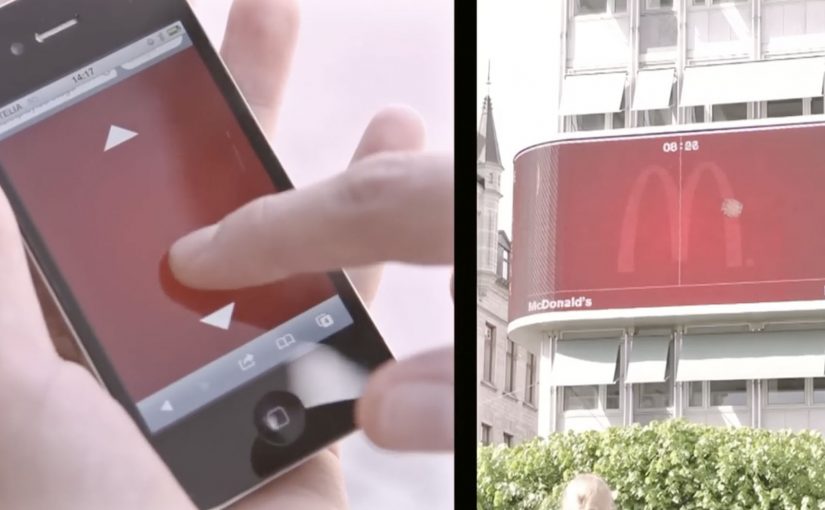
You are walking through central Stockholm and a McDonald’s billboard does something unusual. It invites you to play a quick Pong-style challenge on the screen, using your own phone as the controller.

DDB Stockholm has created another interactive outdoor campaign for McDonald’s Sweden called Pick N’ Play. Passers-by use their mobile phones as controllers to play for a chosen McDonald’s treat. If they last for more than 30 seconds, they score a coupon that earns them free fast food at a nearby McDonald’s.

Reportedly, the interaction avoids an app download and instead uses a simple mobile web flow, with proximity checks (via phone location) so only people physically near the screen can play.

Why this one pulls a crowd

The mechanic is instantly legible. Most people recognize Pong in a split second, which lowers hesitation and increases participation. The billboard also creates a public spectacle, which adds social proof and makes stopping feel normal, not awkward.

Extractable takeaway: This is rewarded interactivity, meaning the payoff is gated behind sustained attention instead of a tap. In outdoor, that simple “earn it” rule turns a public glance into a deliberate, measurable action.

What McDonald’s is really buying

The prize is not the point. The real value is a measurable bridge from street attention to store visit. A time-based win condition filters for people who are actually willing to pause, focus, and then act, which makes the coupon a higher-signal trigger than a generic discount blast.

The real question is whether your DOOH idea can turn a public moment into a private, trackable action without adding friction.

In global consumer brands and retail environments, interactive digital out-of-home earns its keep when it connects a public moment of attention to a private, trackable action on a personal device.

Steal these moves for your next DOOH game

  • Use a mechanic people already know. Familiar rules beat clever rules in outdoor contexts.
  • Make the phone the interface. It turns a billboard into a controllable experience and a trackable session.
  • Reward endurance, not clicks. Time-in-game is a simple proxy for real attention.
  • Close the loop fast. A coupon that can be redeemed nearby turns novelty into footfall.

Last year they had challenged pedestrians to take pictures of McDonald’s food to get it for free.


A few fast answers before you act

What makes an interactive billboard work in practice?

An interactive billboard works when the invite is understood in seconds and the first action feels effortless on a phone.

Do you need an app to control a billboard with a phone?

No. Campaigns like this are often built as mobile web experiences so participation is immediate and friction stays low.

How do you stop people from playing remotely?

By verifying proximity. A common approach is using phone location to confirm the player is physically near the screen before the session starts.

Why use a 30-second target?

It is long enough to prove engagement, short enough to feel achievable, and simple enough to explain with one line of copy.

What is the business upside versus a normal coupon?

You get a higher-intent audience. The coupon is earned through attention and action, which tends to correlate with stronger redemption and store visitation.

Royal Copenhagen: Hand painted billboard

Royal Copenhagen: Hand painted billboard

A giant porcelain plate appears on a billboard, completely blank. Then, over the course of the day, painters slowly build the familiar Royal Copenhagen decoration in public, stroke by stroke, until the finished pattern looks like it has come straight from the workshop.

That is the core move in this Royal Copenhagen work with Uncle Grey. If the product is handmade and unique, the advertising has to behave the same way. So the “ad” becomes a craft demonstration on an outdoor canvas.

The result is a simple proof mechanism, meaning the audience can verify “handmade and unique” just by watching the work happen. Mass-produced porcelain cannot do this. It cannot show its human hand in real time. This can.

A billboard that performs the brand promise

Most outdoor work is finished before you ever see it. This one unfolds in front of you. The billboard starts as an empty plate and ends as a completed piece, creating a living before-and-after story that pedestrians can witness at any point in the day.

In heritage premium brands, the fastest way to defend value is to make the making visible.

That pacing matters because it turns a static placement into a timed event, and it gives people a reason to look twice. The craft is not described. It is staged.

Why “unique” needs more than a tagline

When a category is full of cheaper alternatives, “quality” becomes a noisy claim. The smarter route is evidence. A hand-painted billboard is evidence because it is expensive, slow, and visibly human. Those traits map directly onto the message Royal Copenhagen wants to protect. Premium brands should default to observable proof over polished slogans. The real question is whether your premium claim can be witnessed, not merely asserted.

Extractable takeaway: If “craft” is part of your margin, design a proof people can watch unfold, not a line they have to trust.

What the business intent looks like in plain terms

The intent is to justify premium pricing without talking about price. By demonstrating labour and skill at scale, the campaign anchors the idea that the products are not interchangeable with mass-manufactured porcelain. Some coverage at the time described significant sales impact, including one report that framed results as a sharp uplift within 24 hours.

Stealable moves for a “craft” narrative

  • Turn a value claim into a process. If you say “handmade,” show the hand.
  • Use time as a creative device. Progression creates curiosity and repeat attention.
  • Make the proof uncheatable. The point is not novelty. The point is credibility.
  • Scale the detail. When a small craft becomes a large public act, people notice the effort.

A few fast answers before you act

What is the Royal Copenhagen hand-painted billboard?

It is an outdoor execution where a large “porcelain plate” billboard starts blank and is hand-painted live over time, mirroring how Royal Copenhagen porcelain decoration is applied by hand.

Why does painting it live make the message stronger?

Because it converts “handmade” from a statement into observable proof. People can see the labour, time, and human touch that cheaper mass production cannot replicate.

What is the key mechanism that makes it work?

Progression. The billboard changes throughout the day, so the ad becomes an event. That creates curiosity, repeat looks, and word-of-mouth.

What kind of brands benefit most from this approach?

Brands selling premium products where craft, tradition, and human skill are central to the value proposition. Especially when cheaper substitutes make category claims feel generic.

What is the main risk with “craft as advertising” ideas?

If the execution is not visibly authentic, it backfires. The audience needs to clearly see the human work, otherwise it reads like staged theatre without proof.

MINI: Photo Box Billboard

MINI: Photo Box Billboard

A billboard that turns fans into the creative

MINI has launched an innovative electronic billboard on Berlin’s Kurfürstendamm shopping boulevard. The billboard is connected to a Photo Box booth that captures the faces of MINI fans and puts them onto a massive screen along with each participant’s favourite MINI model, for a chance to win their preferred car.

Contestants have four colours and four models to choose from, including the MINI Hatch, Convertible, Clubman and Countryman.

The mechanism: Photo Box in Berlin. Facebook everywhere else

On the street, you step into the Photo Box, clamp on a pair of headphones, pick your colour and model, and the system outputs a ready-to-share moment on a giant public screen.

Fans from around the world can also join through the MINI Facebook app, where you can snap a picture with your webcam wearing a pair of virtual headphones in your favourite MINI colour.

In high-footfall city retail corridors, interactive out-of-home turns passersby into opt-in media, where participants choose to become the message through participation.

The real question is whether you can turn a simple preference into a public moment people want to share.

Why it feels modern: ecommerce choice, but on a building

The experience borrows the best part of online shopping. Configuration, without forcing the rest of it: specs, comparisons, and checkout. Because the billboard outputs a finished result in seconds, the act of choosing feels like content, not a form.

Extractable takeaway: When the environment publishes a participant’s choice at street scale, social proof becomes the distribution, and the moment feels bigger than a personal post.

The business intent: acquisition through identity

This is acquisition marketing that avoids hard selling. MINI lets people declare a preference. model plus colour. and then wraps that declaration in a contest mechanic. The brand gets reach, participation data, and a stream of shareable assets without asking people to create anything from scratch.

What to steal for your next interactive OOH build

  • Make the choice set small and satisfying. Four colours and four models is enough to feel personal, without feeling complex.
  • Design one iconic prop. Here, the headphones act as a visual signature that unifies street and Facebook participation.
  • Let the environment do the distribution. A giant screen creates built-in attention and bystander reach.
  • Mirror the experience online. The Facebook version keeps the same core mechanic so the idea travels beyond the location.

A few fast answers before you act

What is MINI’s Photo Box Billboard?

It is an interactive out-of-home billboard in Berlin where fans take a photo, choose a MINI model and colour, and see themselves displayed on a massive public screen, tied to a chance to win their preferred car.

How does the street mechanic work, step by step?

Step into the Photo Box. Pick your colour and model. The system captures your photo and outputs a finished, public “moment” on the billboard that is easy to share and talk about.

How does the Facebook app extend the same idea?

It mirrors the participation loop online. Fans take a webcam photo, add the campaign’s signature headphones motif in their chosen colour, pick a model, and participate without being in Berlin.

What role do the headphones play in the concept?

They are the visual signature that links the physical Photo Box experience to the Facebook version. One iconic prop makes the campaign instantly recognizable across channels.

Why does this work as acquisition marketing, not just a stunt?

It turns preference into a visible artifact. People declare model and colour, then the street-scale screen adds social proof and bystander reach while the brand collects intent signals.

What should you measure if you build something like this?

Participation rate, completion rate, average time to choose, shares, and downstream lead or test-drive intent. Also track whether the billboard creates bystander attention, not only participant engagement.