
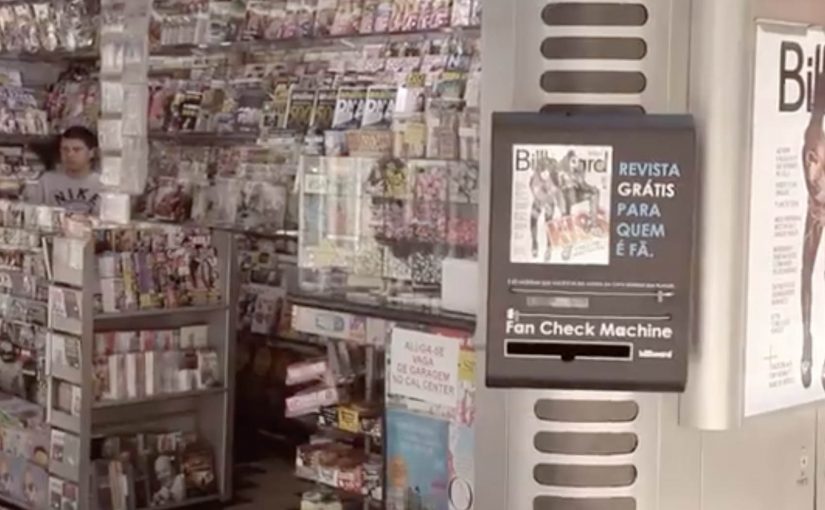
Billboard Fan Check Machine

Billboard Fan Check Machine

You walk up to a Billboard Magazine dispenser, plug in your iPhone, and let the machine scan your music library. If it finds more than 20 songs by the artist on the cover, it dispenses a free copy of the magazine.

How the Fan Check Machine works

Not every music fan reads Billboard Magazine, but every music fan has music on their phone. Ogilvy & Mather Brazil turns that into a simple proof-of-fandom mechanic. Here, “proof of fandom” means using your existing listening history as the credential. Because the verification happens in the moment, the reward feels earned instead of arbitrary. The real question is how you turn an existing behavior into a self-serve credential people understand instantly.

In retail and live-event environments, this kind of “prove it, then get it” interaction creates participation without staff explaining the rules.

Why this format feels fair to fans

The exchange is transparent. You do not enter a sweepstake or fill a form. You prove you are genuinely into the artist on the cover, and you get rewarded immediately. That immediacy makes the activation memorable, and the “fan verified” moment becomes the story people share.

Extractable takeaway: When access is gated by a behavior people already do, the reward feels fair, and the activation becomes easy to retell.

What this teaches about shopper activations

This is a strong pattern for retail and event environments. Use an existing behaviour as the credential, keep the threshold clear, and make the reward instant. This is a better giveaway pattern than generic sampling when you care about perceived fairness and the story people retell. When the rule is simple and the payoff is immediate, participation scales without staff explaining it over and over.

Steal this pattern for your next giveaway

  • Credential: Use an existing behavior as the proof, not a form-fill or “enter to win.”
  • Threshold: Make the requirement unmissable, with one clear pass or fail rule.
  • Payoff: Deliver the reward instantly, so the moment becomes the story.
  • Friction: Remove staff dependence so participation scales on its own.

A few fast answers before you act

What is the Billboard Fan Check Machine?

It is a magazine dispenser that gives away a free Billboard issue if you can prove you are a fan of the cover artist by plugging in your iPhone and scanning your music library.

What is the “fan” threshold in this activation?

If the machine finds more than 20 songs by the artist on the cover of Billboard Magazine, you get the magazine for free.

Why does “proof of fandom” beat generic giveaways?

Because it targets real fans and makes the reward feel earned. That increases perceived fairness, reduces waste, and creates a stronger story than a random handout.

What should you keep simple if you replicate this pattern?

The rule, the verification step, and the payoff. People should understand the requirement instantly, complete it in seconds, and receive the reward without friction.
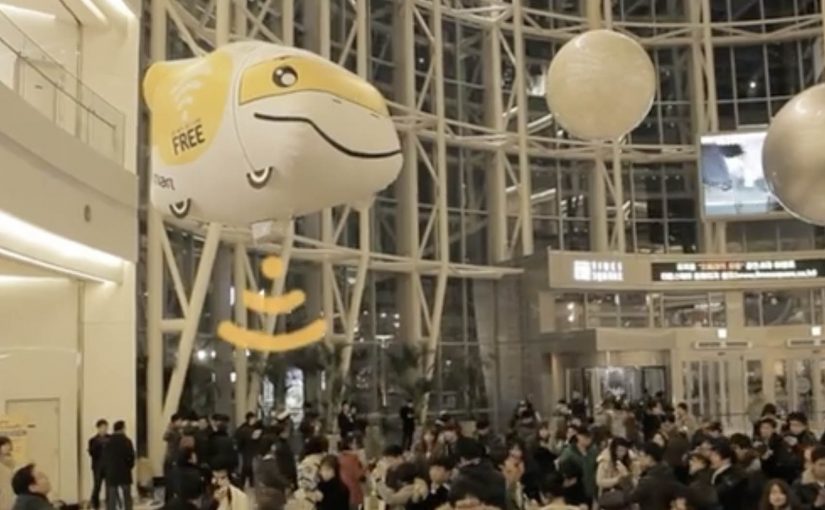
eMart: Flying Store Wi-Fi Balloons

eMart: Flying Store Wi-Fi Balloons

In May 2012, eMart created the Sunny Sale campaign, distributing coupons through a sun-activated QR code.

Now, in its latest campaign, eMart creates “Flying Stores”. These are truck-shaped balloons fitted with a Wi-Fi router. These balloon stores float across Seoul, and people who cannot get to an eMart store during the day can connect to the balloon’s Wi-Fi signal and order directly online.

Wi-Fi as the storefront

The mechanism is a mobile commerce shortcut disguised as outdoor media. The balloon is the attention object, but the real call-to-action is the hotspot. Connect. Land inside the eMart mobile experience. Buy now, while you are in transit or between errands. Because joining a Wi-Fi network is a familiar, low-friction action, the hotspot makes the “store comes to you” promise feel immediate.

In dense urban retail markets, removing distance and time as barriers is often the fastest route to incremental mobile conversion.

The real question is whether your activation builds a functional shortcut into the customer journey, not just a spectacle around it.

Why it lands

It targets a real constraint, not a demographic. People are time-poor, and “accessibility” often decides which retailer wins repeat behavior. The balloon flips accessibility from “go to the store” to “the store comes to you,” with Wi-Fi as the bridge.

Extractable takeaway: When your growth problem is “people can’t get to us,” do not just advertise harder. Create a literal on-ramp that collapses the journey from attention to transaction into one simple action that feels native, like joining a Wi-Fi network.

What to steal for your next retail activation

  • Make the trigger physical, then make the conversion digital. The balloon earns attention. The phone closes the sale.
  • Design for commuters. Transit corridors are full of intent, but short on time. Your flow must be fast.
  • Give the audience a reason to connect. Free Wi-Fi is a utility. Utility beats persuasion in the first 10 seconds.
  • Measure beyond views. If it is meant to drive commerce, track app installs, orders, and repeat usage, not just impressions.
  • Reinforce the pattern with a related example. See the 2011 flying fish balloons campaign for the Sea Life park in Speyer, Germany.

A few fast answers before you act

What is an eMart “Flying Store”?

A truck-shaped balloon equipped with a Wi-Fi router that people can connect to, then use to enter eMart’s mobile experience and shop online.

Why use Wi-Fi instead of a QR code this time?

Wi-Fi turns the activation into a utility, not just a scan. It creates a direct, immediate pathway into mobile shopping, especially for people on the move.

What makes this more than a PR stunt?

The hotspot is a functional distribution layer. If the mobile flow is good, the activation can produce measurable installs and transactions, not only buzz.

What should you measure to judge success?

Track connects to the hotspot and the downstream actions you care about, like app installs (if required), orders, and repeat usage, not just media impressions.

What is the biggest risk in copying this idea?

If the connection experience is unreliable, slow, or confusing, the novelty becomes frustration. Utility-led activations only work when the utility works.

Heineken: UEFA Giveaway

Heineken: UEFA Giveaway

Here are two campaigns that Heineken created in Europe to give away seats for the UEFA Champions League finals in London last month.

Heineken: The Negotiation

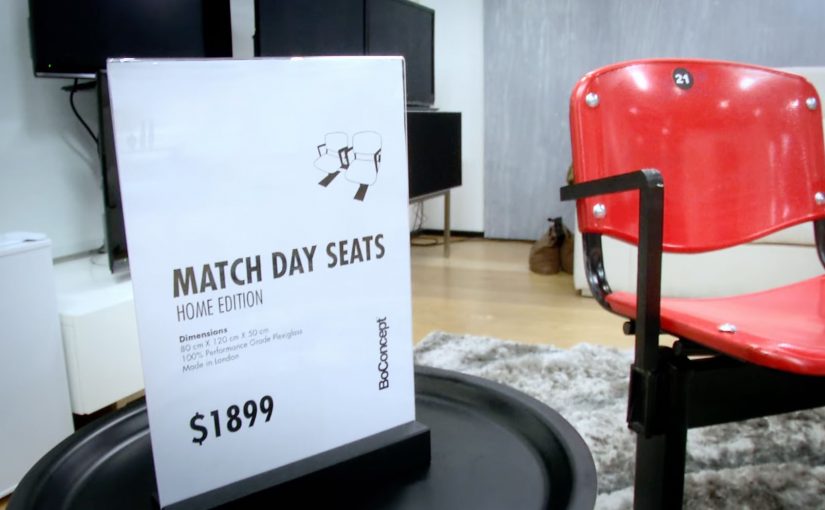
Heineken challenged football fans at a furniture store in the Netherlands to convince their ladies to buy a $1899 set of plastic stadium chairs for their home. If they managed to pull it off, they would win a trip to the final. The result:

Heineken: The Seat

In Italy, Heineken hid 20 tickets under 20 Wembley seats and spread them around Rome and Milan. Fans then had only one hour to find them and secure their place at the final. The result:

Two different mechanics, one sponsorship objective

Both ideas do the same strategic job. They make the sponsorship feel like something you can play, not just something you watch. Here, a mechanic is the simple set of rules that turns a giveaway into a game.

In European consumer brands, the cleanest giveaway mechanics turn sponsorship into something fans do, not just something they see.

The real question is how you turn a scarce prize into a story people repeat without you paying for distribution.

In European football sponsorship, ticket scarcity is a powerful emotion. Brands win when they turn that emotion into participation that fans can retell in one breath.

Why these promos travel so easily

Both promos travel because the giveaway is inseparable from the story. You do not share “I won tickets”. You share the rule that made winning possible.

Extractable takeaway: If the prize is scarce, design the giveaway so the mechanic is the headline, and the brand is the quiet sponsor of the moment.

The Negotiation works because it stages a recognisable domestic conflict and turns it into a public challenge. You do not have to care about Heineken to enjoy the tension. You just need to recognise the situation.

The Seat works because it feels like a real-world game with an unfair advantage for the most alert fans. A one-hour window and a physical search turns “tickets” into a quest, and the city becomes the interface.

Giveaway mechanics worth copying

  • Do not just “give away”. Build a mechanic that proves fandom or commitment in a fun way.
  • Make it legible in five seconds. If people cannot explain the rules instantly, the idea will not spread.
  • Use time pressure carefully. A short window creates urgency, but it must still feel fair.
  • Let the prize stay pure. The reward is the story. The brand should be the enabler, not the gatekeeper.

A few fast answers before you act

What is the core mechanic in Heineken’s Negotiation?

A persuasion challenge staged in a real retail environment. The couple dynamic is the entertainment engine, and the prize converts the tension into a payoff.

Why does a scavenger hunt work for high-demand tickets?

Because it turns passive desire into active effort. The search itself becomes the content, and the winners feel like they earned the prize rather than being randomly selected.

What is the main sponsorship benefit of campaigns like these?

They convert a sponsorship from branding to experience. The brand becomes part of how fans remember the final, not just a logo around it.

What is the biggest risk with “race” mechanics?

Perceived unfairness. By “race mechanics” here, I mean time-boxed contests where speed and timing determine winners. If the rules, locations, or timing feel stacked, the conversation flips from excitement to frustration.

What should you measure beyond video views?

Look for participation rate, speed of uptake, earned media pickup, and how often people retell the mechanic in social posts. Those indicate whether the idea actually travelled.