
Faktum Hotels: Book a Night Outside

Faktum Hotels: Book a Night Outside

Gothenburg in Sweden is reported to have about 3,400 homeless people. Most find a roof over their heads with a friend or at a refuge, but some even sleep in the open air.

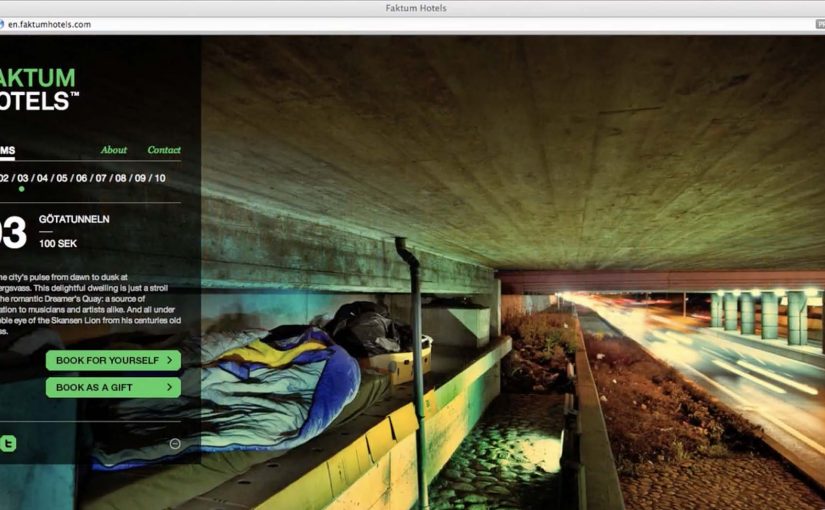
So in a charity campaign that tries to harness the spirit of giving and consideration, Forsman & Bodenfors chose ten places where people might spend the night and made it possible for any one of us to book them, just like any hotel. All the money raised through this www.faktumhotels.com project is then directed towards Faktum’s work for the homeless.

A hotel with no walls

The mechanism is brutally literal. Take locations that are normally ignored, photograph them like “rooms”, write the descriptions in the familiar language of travel booking, and put a price on the night. The booking flow becomes the donation flow, and the “inventory” is a list of public places that should not be inventory at all.

In European cities, social impact campaigns often struggle to turn sympathy into a concrete action that is simple, immediate, and shareable.

Why the idea hits so quickly

It works because it steals a format people trust. A hotel booking interface is a comfort ritual, full of predictable signals. Then it swaps the comfort for cold reality. That contrast creates instant moral clarity without a lecture, and it invites action without asking people to research charities or navigate guilt.

Extractable takeaway: When awareness is not the problem but inertia is, borrow a mainstream interface people already know, and map your desired behaviour onto it. Reduce the action to one familiar choice and one familiar transaction.

What the “booking” really means

Because these are public places, the booking is best understood as symbolic support, not a guaranteed reservation. In this case, symbolic support means paying to fund Faktum’s work, not claiming the place for personal use. The point is not to encourage tourism-by-hardship. The point is to make the hidden visible, and to route money to Faktum’s work through a frictionless, culturally legible mechanic.

The real question is how to turn a familiar commercial action into an ethical act of support without diluting the reality behind it.

This is not about selling the experience of homelessness. It is about converting recognition into support.

Proof, not a promise

The concept is also a craft statement. The photography and the deadpan hotel language do the persuasion work. The campaign received major industry recognition, including a Guldägg and a One Show Gold Pencil for its craft, which underlines how well the execution carries the idea.

What to steal from the booking mechanic

  • Hijack a trusted format. Use an interface or ritual your audience already understands, then subvert it with purpose.
  • Make the donation feel like a normal purchase. Familiar steps reduce hesitation and increase completion.
  • Let craft do the arguing. Straight photography and restrained copy can outperform emotive pleas when the concept is strong.
  • Design for sharing without adding share buttons. If the mechanic is surprising, people share it naturally.

A few fast answers before you act

What is Faktum Hotels?

It is a fundraising concept that presents outdoor sleeping locations as “hotel rooms” you can book online. The payment functions as a donation to support Faktum’s work related to homelessness.

Why use a hotel booking mechanic?

Because it is familiar and low-friction. The contrast between a comfortable interface and uncomfortable reality creates attention and makes the next step obvious.

Is the booking a real reservation?

No. The locations are public, so the booking is best treated as symbolic support rather than a guaranteed spot.

Who created the campaign?

It was created for Faktum with Forsman & Bodenfors credited as the agency behind the idea and execution.

What is the transferable lesson for other causes?

Turn support into a simple, recognisable transaction. Borrow a mainstream choice model, then route the payment directly into impact.
Canadian Tire: Christmas Spirit Tree

Canadian Tire: Christmas Spirit Tree

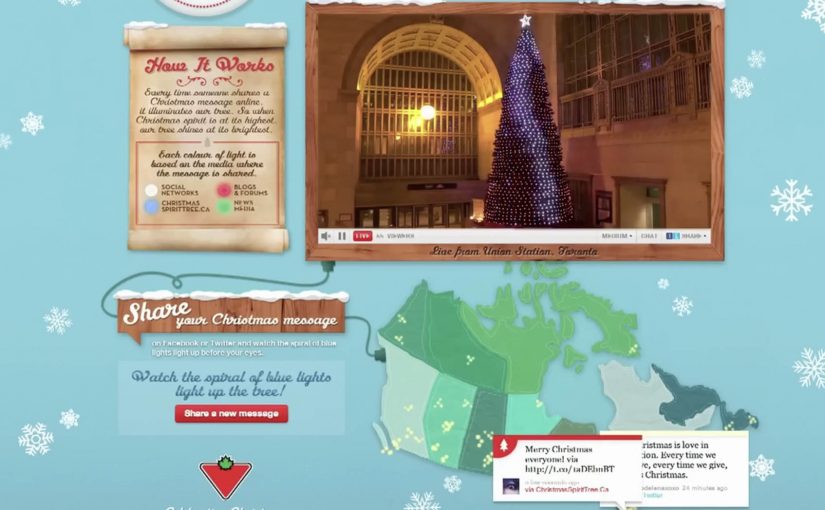
Canadian Tire wanted to re-energize Christmas spirit and reinforce its position as Canada’s leading Christmas store. So they built a public symbol of the season that behaves like a live dashboard for holiday cheer.

The result was a 30-foot Christmas tree wrapped with 3,000 individually programmed LED lights, powered by the nation’s collective online Christmas spirit. Social monitoring tools scanned blogs, forums, social networks, and news sites for Christmas keywords, then software translated that data into real-time light patterns on the tree.

Turning sentiment into a light show

The mechanic is a clean loop. Capture real-world language at scale. Reduce it to signals a system can interpret. Visualize those signals instantly as a physical experience people can gather around. That translation layer is the whole idea, because it makes something intangible, “spirit”, visible and shared. Here, the translation layer is the software bridge that converts online holiday language into visible light behavior.

In large-scale retail brands, public installations like this can turn social chatter into a measurable, collective ritual that reinforces seasonal ownership.

Why it lands

It gives people a role that feels meaningful without feeling like work. You do not have to download an app or learn a new behavior. You just post a message the way you already would, and the tree responds. That cause-and-effect is what makes the story travel, because the installation feels like it is listening, not just broadcasting.

Extractable takeaway: If you want “community” to feel real, build a visible feedback loop where everyday audience behavior directly changes a shared public object. Then make the transformation obvious enough that people can connect their action to the outcome.

What the campaign is really optimizing for

The objective is not only brand warmth. It is reclaiming seasonal leadership by creating a national-scale proof point that Canadian Tire can own, film, and redistribute. The real question is how to make seasonal sentiment visible in a way only Canadian Tire can own. The tree becomes a repeatable centerpiece for earned media, social sharing, and store association without having to lead with price.

What to steal for your own seasonal playbook

  • Make the idea self-explanatory. “Messages make lights” is a one-sentence mechanic people can repeat.
  • Turn digital into physical. Physical experiences feel more “real” than dashboards or microsites, even when the inputs are purely online.
  • Design for spectators and participants. The best public work rewards both the person who posts and the person who just watches.
  • Build a content engine. If the installation produces fresh patterns continuously, you get ongoing footage and reasons to talk about it.

A few fast answers before you act

What is the core idea of the Christmas Spirit Tree?

A large LED Christmas tree that lights up in response to holiday messages detected online, turning seasonal sentiment into a live public experience.

Why use social monitoring as the “power source”?

Because it makes the audience feel like the energy behind the display. The installation becomes a collective mirror, not a one-way broadcast.

What makes this more effective than a standard Christmas film?

The live feedback loop. People can influence the outcome, and that influence creates participation, talk value, and repeat attention.

Why does the physical tree matter more than a digital counter?

Because a public object turns online sentiment into something people can gather around, film, and talk about. The physical response makes the mechanism feel shared rather than abstract.

What is the biggest execution risk?

If the response feels delayed, random, or unconnected to real posts, the magic breaks. The system must feel immediate and believable.

ASICS: Run With Me at the Gold Coast Marathon

ASICS: Run With Me at the Gold Coast Marathon

ASICS has a fine history not just in running sports, but also in the innovative use of technology. So at the Gold Coast Airport Marathon, a grueling 42km run, they created a powerful demonstration of running and technology by connecting runners with their supporters like never before.

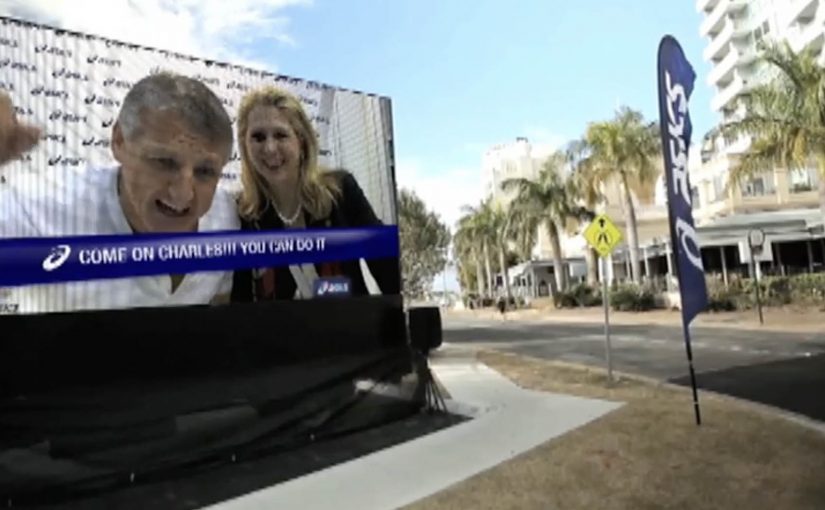
Runners were given RFID timing chips to connect their run with Facebook. RFID, or radio-frequency identification, lets a small chip be detected automatically at checkpoints. This allowed them to automatically post pre-written messages at checkpoints, along with distance run and remaining, live timing, and location data plotted on Google Maps. At the same time, friends and loved ones were able to upload video messages of support, which were triggered and played as runners approached giant screens along the course.

A marathon that posts for you, at the moments that matter

The clever part is not “Facebook integration.” It is the timing. Checkpoints are already emotional beats in a race. Effort spikes. Doubt kicks in. Motivation dips. By tying updates to those exact points, the campaign makes every status feel earned, and every reply from friends feel relevant. The real question is whether you can make that support arrive inside the effort, not after the finish.

Extractable takeaway: Automate sharing only at moments participants already care about, so updates feel like earned progress and support can land at the exact point it matters.

RFID is doing quiet work here. It removes manual posting friction, and it makes the updates feel live rather than staged, because the data is anchored to race progress.

In large-scale sports events, real-time data and social signals can turn spectators into an active support system that changes how the race feels while it is happening.

Support that shows up on the course, not just in the comments

Most event social campaigns keep encouragement on a screen at home. This one brings encouragement into the race environment. The supporter uploads become on-course content, triggered when the runner is near, so the message arrives in the body, not just in the feed.

That shift matters. It turns “cheering” from a passive gesture into an intervention, and it gives runners a reason to care about the system mid-race, not only after finishing. This kind of activation is worth building only when the trigger system is reliable enough to feel invisible to the runner.

Reported outcomes, and what they imply

The campaign reported that 2,000 runners, described as 15%, connected their run with Facebook. It also reported 6,000 messages of support uploaded, 1,000 video messages created at the event, and 35% of runners receiving video support. Additionally, it reported thousands of unique status updates from inside the race, 25,850 unique visitors to the microsite, and tens of thousands of return comments from friends and family.

Even if you strip the numbers back, the strategic takeaway is clear. When you connect performance data to social response, you create a loop. Effort generates updates. Updates generate support. Support reinforces effort.

Steal this support-loop pattern for your next event

  • Attach the experience to natural moments. Checkpoints, milestones, and thresholds beat “post whenever you want.”
  • Automate the boring part. If the participant must manually publish, most will not.
  • Bring support into the physical environment. On-course screens, audio, or wearable prompts outperform distant encouragement.
  • Give supporters a real role. Uploading a message is simple, but it feels meaningful when it is triggered at the right time.

A few fast answers before you act

What is the core mechanic of “Run With Me”?

RFID-triggered race checkpoints publish pre-written social updates, while supporter videos are triggered on giant screens as runners approach.

Why does RFID matter here?

It makes the experience hands-free. The system captures progress automatically, so runners do not have to stop or think about posting.

What makes the supporter videos more powerful than normal social comments?

They appear in the runner’s world during the effort, not after it. Timing plus proximity turns a message into motivation.

What is the biggest risk when building this kind of live experience?

Reliability. If triggers misfire or content appears late, the emotional payoff collapses. The tech has to feel invisible and dependable.

How do you measure success beyond impressions?

Opt-in rate, supporter participation rate, trigger completion rate, and whether the loop changes behavior, for example more mid-race engagement and higher repeat participation intent.