
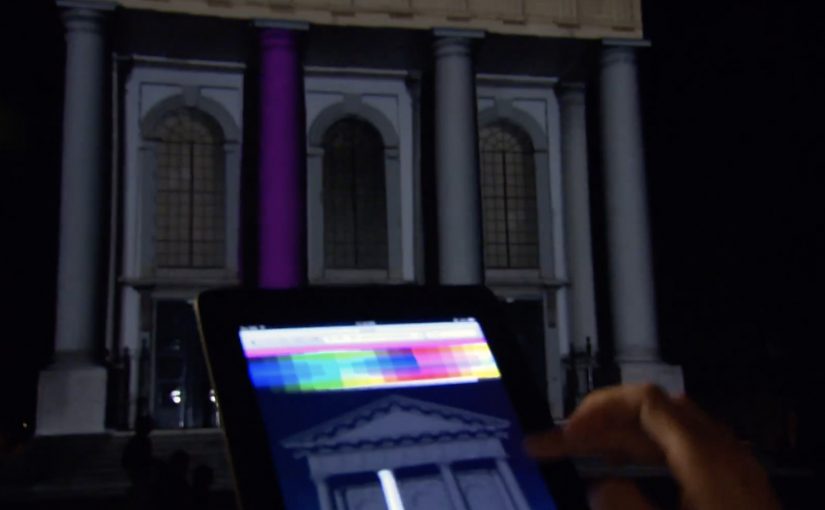
NuFormer: Interactive 3D video mapping test

NuFormer: Interactive 3D video mapping test

NuFormer, after executing 3D video mapping projections onto objects and buildings worldwide, adds interactivity to the mix in this test.

Here the spectators become the controller and interact with the building in real time using gesture-based tracking (Kinect). People influence the projected content using an iPad, iPhone, or a web-based application available on both mobile and desktop. For this test, Facebook interactivity is used, but the idea is that other social media signals can also be incorporated.

From mapped surface to live interface

Projection mapping usually works like a film played on architecture. This flips it into a live system. The building is still the canvas, but the audience becomes an input layer. Gesture tracking drives the scene changes, and second-screen control, meaning a phone or browser used as a remote, extends participation beyond the people standing closest to the sensor.

Extractable takeaway: Interactive mapping is most compelling when the control model, the set of simple inputs people can learn instantly (wave, move, tap), is legible at a glance and the projection responds quickly enough that people trust the cause-and-effect.

In large-scale public brand experiences, projection mapping becomes more than spectacle when it gives the crowd meaningful viewer control instead of a one-way show.

Why the “crowd as controller” move matters

Interactivity changes what people remember. A passive crowd remembers visuals. An active crowd remembers ownership. The moment someone realises their movement, phone, or social input changes the facade, the projection stops being “content” and becomes “play.”

The real question is whether your interaction model makes people feel in control within seconds, or confused for minutes.

Because the facade responds immediately to a person’s input, the crowd shifts from watching to experimenting, which keeps people around long enough to teach each other and try again.

That also changes the social dynamics around the installation. People look for rules, teach each other controls, and stick around to try again. The result is longer dwell time and more organic filming, because participation is the story.

What brands can do with this, beyond a tech demo

As described in coverage and in NuFormer’s own positioning, branded content, logos, or product placement can be incorporated into interactive projection applications. The strategic upside is that you can design a brand moment that is co-created by the crowd, rather than merely watched.

When social signals are part of the input (Facebook in this case), the experience can also create a bridge between the physical venue and online participation. That hybrid loop is where campaigns can scale.

Patterns for your next mapping brief

  • Pick one primary control. Gesture, phone, or web. Then add a secondary layer only if it increases participation rather than confusion.
  • Make feedback immediate. The projection must respond fast or people assume it is fake or broken.
  • Design for “spectator comprehension.” Bystanders should understand what changed and why, from a distance.
  • Use social inputs carefully. Keep the mapping between input and output obvious so it feels fair, not random.
  • Plan for crowd flow. Interactive mapping is choreography. Sensors, sightlines, and safe space matter as much as visuals.

A few fast answers before you act

What is “interactive projection mapping” in this NuFormer test?

It is 3D projection mapping where the projected content changes in real time based on audience input. Here that input includes Kinect gesture tracking plus control via iPad, iPhone, and web interfaces.

Why add phones and web control when you already have gesture tracking?

Gesture tracking usually limits control to people near the sensor. Second-screen control expands participation to more people and enables a clearer “turn-taking” interaction model.

How does Facebook interactivity fit into a projection experience?

It acts as an additional input stream, letting social actions influence what appears on the building. The key is to make the mapping from social action to visual change understandable.

What is the biggest failure mode for interactive mapping?

Latency and ambiguity. If the response is slow or the control rules are unclear, crowds disengage quickly because they cannot tell whether their input matters.

What should a brand measure in an interactive mapping activation?

Dwell time, participation rate (people who trigger changes), repeat interaction, crowd size over time, and the volume and quality of user-captured video shared during the event window.
Miami Ad School: Three Student Concepts

Miami Ad School: Three Student Concepts

Three student concepts that show their thinking in one move

This year Miami Ad School has produced a run of strong conceptual projects from current students. Here are three that stand out because each one has a clear mechanic and a crisp “why this brand” fit. Here, the mechanic means the one user action and system response that make the concept work.

What makes these concepts travel

Each idea takes a familiar behavior. Choosing food, correcting spelling, inviting friends. Then it adds a single interaction rule that turns the behavior into a branded moment. It is not “advertising about a thing”. It is an experience that demonstrates the thing.

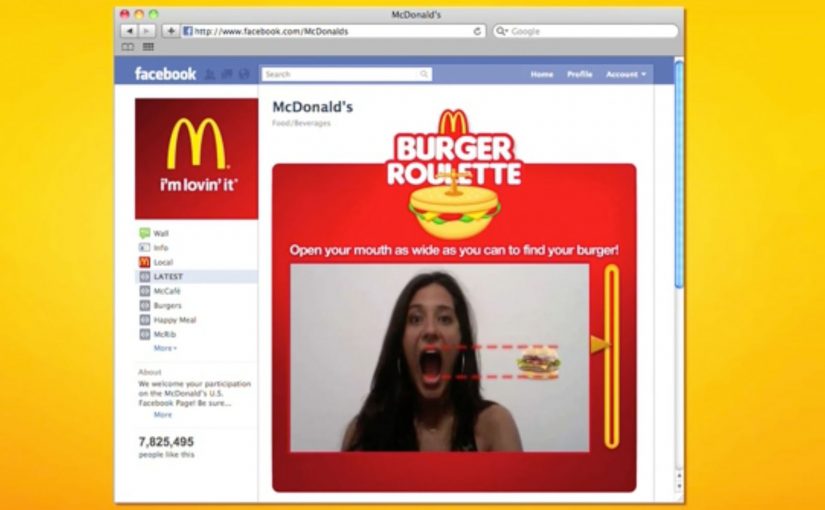
McDonald’s Burger Roulette App

This student concept is designed as a Facebook app that helps you find the “perfect” McDonald’s burger for your mouth. The premise is playful decision support. You answer a few prompts, the system narrows your choice, and the brand becomes the helpful guide instead of a menu you skim and forget.

UNICEF Donate A Word

This student concept proposes a new way to donate for child education by using the spelling feature inside Google Chrome. When a misspelled word is flagged, the prompt becomes a donation trigger, turning a small everyday friction into a small everyday contribution.

In portfolio-driven creative education, concepts like these matter because they show whether a student can turn brand strategy into a usable interaction, not just a line of copy.

Heineken Invite

This student concept uses a social-media-connected bottle opener that invites friends over for a beer. The social mechanic is competitive. Whoever has the most friends attending earns a free case of Heineken, turning “opening a beer” into an invitation ritual and a reason to gather.

Why it lands

All three ideas share the same advantage. They make the brand useful inside a moment people already have, rather than interrupting people to talk about the brand. The mechanic is the message, and the interaction is simple enough that you can explain it in one sentence without killing the effect. That works because a visible rule lets people grasp the idea instantly and connect the payoff to the brand.

Extractable takeaway: Build concepts around one native behavior and one immediate response. If the “rule” is explainable in a sentence and demonstrable in a clip, the idea will be remembered, and repeated.

The real question is whether the interaction makes the brand promise visible without extra explanation. The strongest student concepts are the ones where the interaction itself carries the branding work.

What brand builders can take from these student concepts

  • One behavior, one rule. Keep the mechanic tight. Complexity kills concept believability.
  • Make the brand the enabler. The best student concepts position the brand as the thing that makes the moment better, not the logo that arrives at the end.
  • Design for quick demonstration. If you cannot show it in 10 seconds, it will not spread beyond the pitch.
  • Payoff matters. Personal recommendation, effortless giving, or a social reward. The user needs a reason to do the action.

A few fast answers before you act

What is the common pattern across these three concepts?

Each turns a familiar action into a branded interaction rule with an immediate payoff, making the experience feel like proof rather than promotion.

Why are student concepts often framed around apps or gadgets?

Because interfaces make mechanics visible. You can show input, response, and reward quickly, which makes the idea easy to understand and easy to share.

What makes a concept like “Donate a Word” compelling?

It piggybacks on an existing habit and converts a tiny, repeated behavior into a tiny, repeated donation moment, which feels effortless and scalable.

What is the main risk when brands try to build ideas like this for real?

Friction. If the mechanic is not instant and obvious, people will not complete it in the real world, even if it looks great in a concept film.

What’s the single best takeaway for marketers reviewing student work?

Look for concepts where the mechanic expresses the brand promise without extra explanation. If the interaction itself makes the point, the idea is strong.

Royal Copenhagen: Hand painted billboard

Royal Copenhagen: Hand painted billboard

A giant porcelain plate appears on a billboard, completely blank. Then, over the course of the day, painters slowly build the familiar Royal Copenhagen decoration in public, stroke by stroke, until the finished pattern looks like it has come straight from the workshop.

That is the core move in this Royal Copenhagen work with Uncle Grey. If the product is handmade and unique, the advertising has to behave the same way. So the “ad” becomes a craft demonstration on an outdoor canvas.

The result is a simple proof mechanism, meaning the audience can verify “handmade and unique” just by watching the work happen. Mass-produced porcelain cannot do this. It cannot show its human hand in real time. This can.

A billboard that performs the brand promise

Most outdoor work is finished before you ever see it. This one unfolds in front of you. The billboard starts as an empty plate and ends as a completed piece, creating a living before-and-after story that pedestrians can witness at any point in the day.

In heritage premium brands, the fastest way to defend value is to make the making visible.

That pacing matters because it turns a static placement into a timed event, and it gives people a reason to look twice. The craft is not described. It is staged.

Why “unique” needs more than a tagline

When a category is full of cheaper alternatives, “quality” becomes a noisy claim. The smarter route is evidence. A hand-painted billboard is evidence because it is expensive, slow, and visibly human. Those traits map directly onto the message Royal Copenhagen wants to protect. Premium brands should default to observable proof over polished slogans. The real question is whether your premium claim can be witnessed, not merely asserted.

Extractable takeaway: If “craft” is part of your margin, design a proof people can watch unfold, not a line they have to trust.

What the business intent looks like in plain terms

The intent is to justify premium pricing without talking about price. By demonstrating labour and skill at scale, the campaign anchors the idea that the products are not interchangeable with mass-manufactured porcelain. Some coverage at the time described significant sales impact, including one report that framed results as a sharp uplift within 24 hours.

Stealable moves for a “craft” narrative

  • Turn a value claim into a process. If you say “handmade,” show the hand.
  • Use time as a creative device. Progression creates curiosity and repeat attention.
  • Make the proof uncheatable. The point is not novelty. The point is credibility.
  • Scale the detail. When a small craft becomes a large public act, people notice the effort.

A few fast answers before you act

What is the Royal Copenhagen hand-painted billboard?

It is an outdoor execution where a large “porcelain plate” billboard starts blank and is hand-painted live over time, mirroring how Royal Copenhagen porcelain decoration is applied by hand.

Why does painting it live make the message stronger?

Because it converts “handmade” from a statement into observable proof. People can see the labour, time, and human touch that cheaper mass production cannot replicate.

What is the key mechanism that makes it work?

Progression. The billboard changes throughout the day, so the ad becomes an event. That creates curiosity, repeat looks, and word-of-mouth.

What kind of brands benefit most from this approach?

Brands selling premium products where craft, tradition, and human skill are central to the value proposition. Especially when cheaper substitutes make category claims feel generic.

What is the main risk with “craft as advertising” ideas?

If the execution is not visibly authentic, it backfires. The audience needs to clearly see the human work, otherwise it reads like staged theatre without proof.