
Reporters Without Borders: QR Codes That Speak

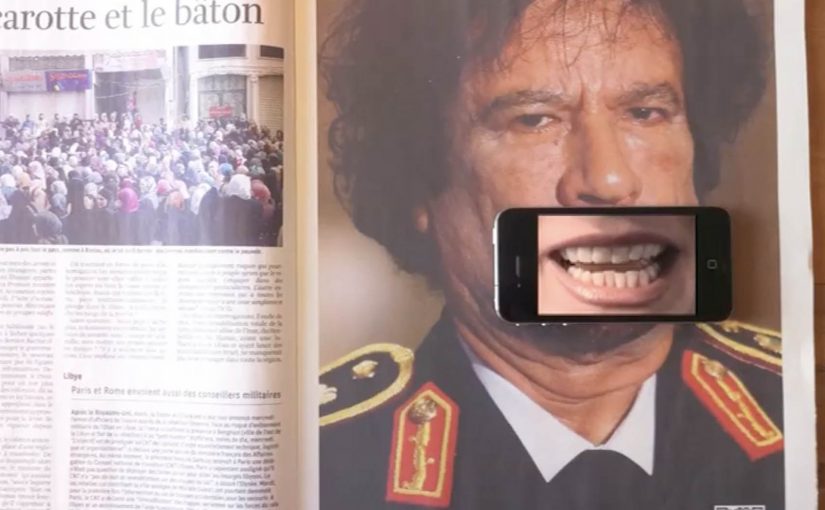
You scan a QR code in a magazine ad, then hold your iPhone over a leader’s mouth. A QR code, short for Quick Response code, is a printed shortcut that opens a mobile destination. The mouth starts talking. But it is not the leader’s voice. It is a journalist explaining what censorship looks like in that country.

Print ads are hitting above their weight lately. Recently, you could test-drive a Volkswagen right inside a print ad, thanks to a special app. Now, QR codes are used to get dictators talking in a set of print ads created by Publicis Brussels for the free-press advocacy group Reporters Without Borders (RWB).

In the ads for RWB you scan the QR code with your iPhone and then place the phone over the leader’s mouth. The mouth starts talking, but it turns out to be the voice of a journalist discussing media censorship in that particular country.

Currently there are Gaddafi, Ahmadinejad and Putin versions.

In public-interest and advocacy communication, this kind of print-to-phone interaction works because it turns a static message into a lived moment of contradiction. The “authoritarian voice” is visually present, but the truth comes from someone who is usually silenced.

How the ad “speaks”

The mechanism is a simple overlay. The printed QR code launches a mobile experience, and the phone screen becomes the animated mouth layer when you align it with the face in the ad.

QR codes act as a bridge from paper to a mobile destination. The ad uses that bridge to deliver audio and motion, without needing the page itself to be electronic.

In advocacy and public-interest communication, print-to-phone interactivity works best when it creates a moment of moral contrast, not a tech demo.

The real question is whether the interaction changes what the message means, or just adds motion.

Why this lands harder than a normal poster

The interaction forces you to participate in the message. You physically place your device over the mouth, so you are complicit in “giving a voice”. Then the reveal flips expectations and reframes the act as a statement about censorship. Because the phone screen becomes the moving mouth layer, the reveal is immediate and hard to dismiss. This is a strong pattern for interactive print: make the overlay carry meaning, not novelty.

Extractable takeaway: If the mobile layer can be removed without changing the message, the interaction is optional. Design the overlay so the meaning only exists when the viewer lines it up and activates it.

What to steal for interactive print

  • Make the overlay do meaning work. The phone is not a gimmick. It is the message delivery device.
  • Engineer a single, clear reveal. The twist needs to land in seconds.
  • Design for alignment and clarity. If the user cannot line it up easily, they quit.
  • Keep the outcome unmistakable. Audio plus a visible mouth movement makes the payoff obvious.

A few fast answers before you act

What is the core idea of these Reporters Without Borders print ads?

They use a QR code and a phone overlay to make a leader’s mouth appear to speak, then reveal a journalist’s voice explaining censorship in that country.

Why use QR codes in a print campaign like this?

QR codes create a fast bridge from paper to mobile audio and motion, which lets print deliver a message that feels alive rather than static.

What makes this more than a tech trick?

The interaction supports the meaning. You “activate” speech, then hear the voice of journalism instead of power, which reinforces the theme of suppressed information.

What are the main execution risks?

Poor alignment, slow loading, or unclear instructions. Any friction can break the moment before the reveal lands.

How can brands apply the pattern without copying the politics?

Use print as the stage and mobile as the moving layer. Make the overlay essential to the message, and build toward one clean, immediate reveal.

Budweiser: Poolball, football on a pool table

Coming to a Buenos Aires pub near you is the newly minted sport of Poolball, created by Ogilvy Argentina for Budweiser.

Two teams meet on a giant 7×3 meter pool table. Fifteen soccer balls are reskinned to look like pool balls. The competitors use their feet instead of cues to score.

A new bar sport with a brand stitched into it

Poolball takes two things that already belong in the same evening. Football and beer. Then it adds a third. The “I could play that” simplicity of pool. The result feels less like a stunt and more like a playable product.

Extractable takeaway: Poolball is a brand activation that fuses two familiar games into one instantly understandable format, so people stop watching and start participating without needing instructions.

The mechanic: one rulebook, two rituals

The mechanic is the entire idea. A pool table scaled up to human size. Pool-ball visuals on footballs. Pool rules translated into foot play. When the mechanic is this legible, the content is self-explaining and the crowd becomes the amplification layer.

BTL is often used as shorthand for below-the-line activity. In practice, it means a brand experience designed to be felt in the real world, then shared because it is worth retelling.

In busy city bars and event spaces, the formats that spread fastest are the ones everyone can read at a glance.

Why it works in a pub

Bar-friendly activations win when they create quick status moments. You either played it, you watched someone nail a shot, or you filmed the chaos. Poolball naturally creates all three, because every “pocket” attempt is a mini highlight.

It also lowers the risk of participation. You are not learning a new sport. You are remixing two you already know, with rules you can copy by watching one play.

The intent behind the fun

The real question is whether your activation is a game people still want to play when the camera is off.

Budweiser is not selling a feature here. It is selling association. Big-game energy. Competitive banter. Social proof that the brand belongs in the centre of group nights out.

When the game is branded but not fragile, the brand becomes the host of the experience rather than the interruption inside it.

Poolball patterns worth stealing

  • Fuse, don’t invent. Combine two known behaviours so the audience understands the format instantly.
  • Make the object the media. A giant playable artefact beats a screen when your goal is participation.
  • Design for highlights. Build in repeatable “shot” moments people want to film and replay.
  • Keep rules visible. If someone can learn it by watching one round, you have the right complexity level.
  • Let branding be structural. Brand the experience itself, not every surface area with logos.

A few fast answers before you act

What is Poolball?

Poolball is a branded game format that combines football and pool. Players kick footballs designed like pool balls on a giant pool table and score using pool-style goals.

Why does this kind of activation travel well across venues?

Because it is easy to understand, easy to spectate, and it produces repeatable highlight moments. Venues like it because it creates crowd energy. Brands like it because the crowd documents it.

What makes the mechanic “shareable” without forcing sharing?

The visual contrast does the work. A human-scale pool table and “pool ball” footballs create an immediate “what is that” reaction, so filming feels natural rather than incentivised.

How do you keep a branded game from feeling like a gimmick?

Make it genuinely playable. Simple rules. Clear scoring. Quick rounds. If the experience is fun without the brand name, the brand credit comes for free.

What’s the minimum viable version of this idea?

A single hybrid rule, one striking physical cue, and one repeatable scoring moment. If people can explain it in one sentence, you have the right foundation.

Sea Life: Rain Ads That Appear When It Rains

An octopus that only shows up in the rain

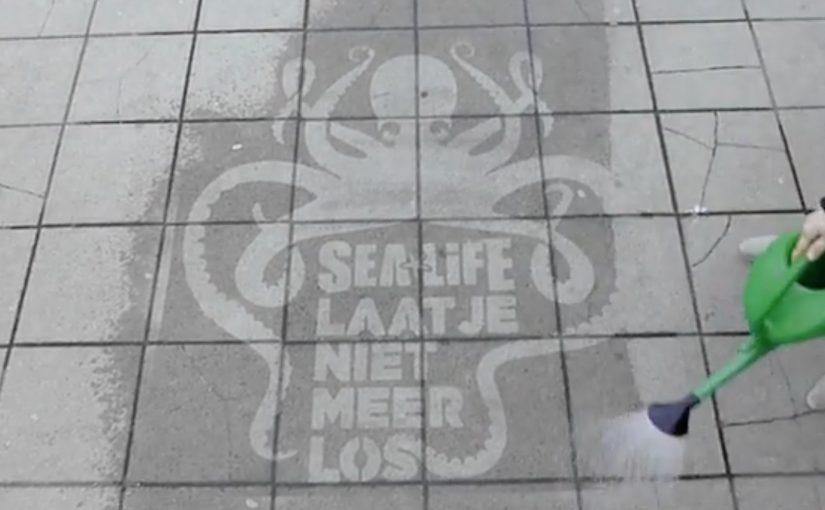
Fresh Green Ads is a green media agency from Amsterdam that developed a Rain Campaign, a street-message activation that appears only when pavement is wet, for Sea Life Scheveningen.

Every time it rains the octopus of Sea Life Scheveningen appears on the streets with its tentacles holding the text: “Sea Life laat je niet meer los” (Sea Life never lets you go). When the streets dry up the Rain Campaign disappears. The striking and environmentally friendly message remains visible for up to eight weeks.

The weather trigger is the headline

The campaign is not just placed outdoors. It is activated by the outdoors. Rain becomes the on-switch, which makes the appearance feel like a small surprise rather than an imposed ad.

In outdoor and ambient media, context-triggered visibility works best when the environment itself becomes the activation switch.

Why it fits Sea Life perfectly

Water is not a backdrop here. It is the medium. The octopus “arrives” with rain and disappears when the street dries. That behavior mirrors the theme and makes the line “never lets you go” feel playful instead of pushy.

Extractable takeaway: When your activation trigger is the same element your brand is about, the visibility feels earned and the message can stay playful instead of pushy.

The quiet business logic

The real question is whether your activation can earn repeated attention by showing up only when conditions are right.

Create repeated moments of attention without constant visual clutter. You get spikes of visibility exactly when conditions are right, and then the street returns to normal.

This is the better pattern when you want outdoor attention without turning every day into an ad.

Tactics to borrow from rain-triggered OOH

  • Use context as a trigger. Weather can be a switch, not just a backdrop.
  • Let the idea control visibility. Appear. Disappear. Create surprise.
  • Build sustainability into the execution. Make sure the cleverness is not wasteful.

A few fast answers before you act

What is the Sea Life Scheveningen Rain Campaign?

A street-message activation that appears when it rains, showing a Sea Life octopus and the line “Sea Life laat je niet meer los” (Sea Life never lets you go).

Who developed it?

The post credits Fresh Green Ads, a green media agency from Amsterdam.

What happens when the streets dry?

The rain-activated message disappears as the street dries.

Why does weather-triggered visibility feel less intrusive?

Because rain acts as the on-switch, the message arrives as a surprise rather than a constant presence.

How long can the message remain visible overall?

The post says the environmentally friendly message can remain visible for up to eight weeks.