
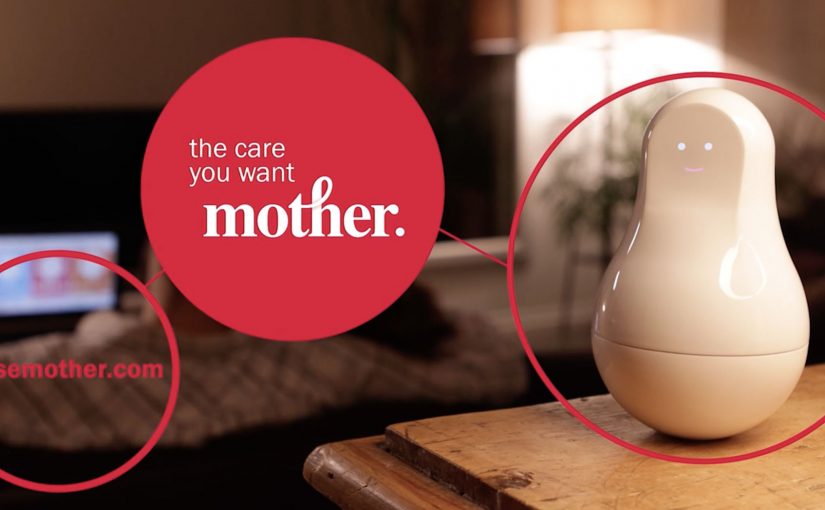
Sen.se: Mother and the Motion Cookies

Sensors are showing up everywhere, from wrist wearables like Jawbone UP and Fitbit to the first wave of “smart home” kits. The promise is always the same. Data that helps you understand your day, then nudges you when something matters.

Mother and the Motion Cookies, from connected-objects startup Sen.se, is positioned as a more flexible take on that idea. Instead of buying a single-purpose gadget for each habit, you get one “Mother” hub and a set of small sensor tags. The Motion Cookies. You decide what you want to track, attach a Cookie to the relevant object, and set alerts for the moments you care about.

Definition tightening: A Motion Cookie is a small sensor you can stick to an object. The “Mother” device is the home base that receives the signals and turns them into simple dashboards and notifications.

If you strip away the friendly character design, this is a configurable rules engine for everyday life. The sensors stay the same. The meaning changes based on what you attach them to and what you tell the app to watch for.

Watch the demo video for more.

A sensor kit that behaves like a toolkit

The smart move here is that the hardware is deliberately generic. One sensor type can be repurposed across dozens of “jobs”, depending on where you place it. Toothbrush, medication box, door, bag, water bottle. The product is less about owning the perfect device, and more about reassigning the same device as your priorities change.

In consumer IoT, products only survive if setup friction stays low and the data translates into a simple action.

Why the “Mother” framing makes the tech feel usable

Smart home products often fail at the handoff between capability and comprehension. Mother softens that gap by packaging sensing as caregiving. The real question is whether a sensor system can feel understandable enough that people actually try it. That emotional framing reduces the intimidation factor and makes experimentation feel normal.

Extractable takeaway: When your product is technically broad, give users a friendly mental model and a small first win, then let reconfiguration become the habit that unlocks the long tail of use cases.

What connected-product teams should copy

  • Design for reassignment, not perfection. People’s routines change. Your hardware should survive those changes.
  • Make “setup” the product. If a user cannot get to value in minutes, they will not get to value at all.
  • Translate sensing into verbs. “Brush”, “open”, “arrive”, “drink”, “take”. Verbs beat metrics.
  • Alert sparingly. The fastest way to kill trust is to spam people with “insights” they did not ask for.

A few fast answers before you act

What is Mother and the Motion Cookies?

It is a smart home kit with one central hub and multiple small sensor tags. You attach a sensor to an object, choose what you want to track, and get updates or alerts based on that behaviour.

What is the core idea compared to a single-purpose wearable?

Reconfigurability. The same sensors can be reassigned to different objects and routines, so the system adapts to what you want to measure this week, not what the device designer assumed forever.

What problem is it trying to solve?

Turning ambient behaviour into something actionable, without requiring you to buy a new gadget for every habit or household scenario.

Why does the “Mother” framing matter?

It makes a technically broad sensor system feel more understandable and less intimidating. That framing helps users see the product as practical support, not just instrumentation.

What makes this kind of product hard to sustain?

Reliance on companion apps and backend services, plus the challenge of keeping alerts useful rather than noisy. If the system becomes high-maintenance, it stops feeling like help.
Peruvian League Against Cancer: Shadow WiFi

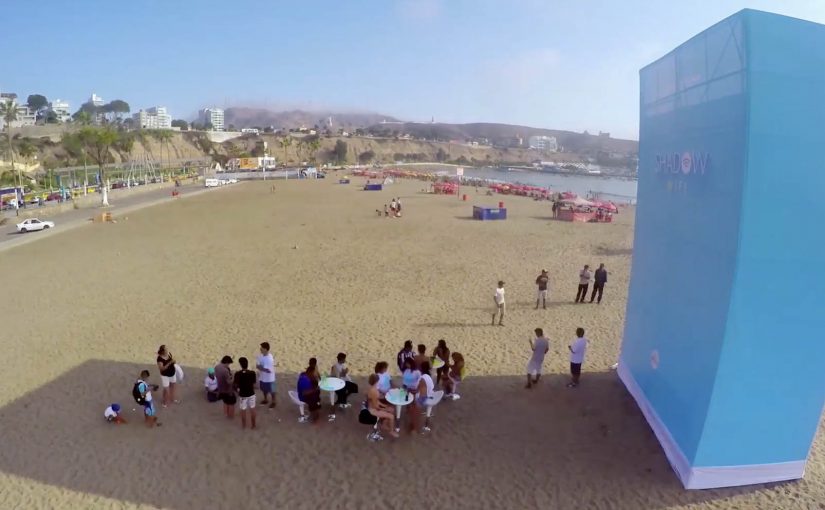
You are on a beach, the sun is out, and your phone wants a signal. Then you notice a large blue structure casting a patch of shade. Step into that shade, and you get free WiFi. Step out into the sun, and the WiFi disappears.

Instead of simply warning people about UV rays, the Peruvian League Against Cancer and Happiness Brussels create “Shadow WiFi”. A directional antenna delivers WiFi only to the shadow area of the structure. A sensor tracks the sun’s movement and rotates the antenna, so as the shadow shifts through the day, the WiFi access shifts with it, and people follow.

The mechanism is the message

The mechanic does not just communicate “stay in the shade”. It enforces it gently. The reward is instantly understood. Connectivity. The rule is equally clear. Shade equals access. Sun equals nothing. The result is prevention education delivered through interactivity, not through guilt. This is the right kind of nudge because it rewards the safer choice instead of lecturing people into it.

The real question is whether you can make the protective choice feel more useful than the risky one in the moment.

In public health behavior-change campaigns, trading immediate utility for safer choices is often more effective than warnings alone.

Why it lands

It targets the real friction. On a beach, the problem is not awareness. It is motivation and habit in the moment. Shadow WiFi turns shade into a social and practical hotspot, so safer behavior feels like the default choice rather than a sacrifice.

Extractable takeaway: If you want people to adopt a protective habit, attach it to a reward they already seek in that environment, and make the “safe zone” tangible, not theoretical.

Guerrilla activation moves worth copying

  • Pay people in utility, not slogans. Free WiFi is a real benefit that beats reminders and posters.
  • Make the rule physical. When the benefit is literally bounded by shade, the behavior is self-explaining.
  • Design for movement. The rotating antenna turns a static installation into a living experience that keeps working all day.
  • Teach inside the experience. Use the login or landing step to deliver prevention guidance while intent is high.

A few fast answers before you act

What is Shadow WiFi in one sentence?

A beach WiFi network that only works in the shade, encouraging people to avoid direct sun exposure while learning about skin cancer prevention.

Why does restricting WiFi to shade change behavior?

Because it makes the safer choice immediately rewarding. People move for a benefit they already want, and the health message rides along.

What is the key technical trick?

A directional antenna limits the WiFi coverage to the shadow zone, and a sun-tracking sensor adjusts the antenna as the shadow moves.

How do you translate this idea without using WiFi?

Keep the same pattern. Put a desired utility behind a clear, physical boundary that represents the safer behavior, so the experience teaches the rule without needing explanation.

What can make this fail?

If the WiFi is unreliable or the shaded area is too small, the utility collapses and the activation becomes a novelty object instead of a habit shaper.

Powerade: Workout Billboards in Berlin

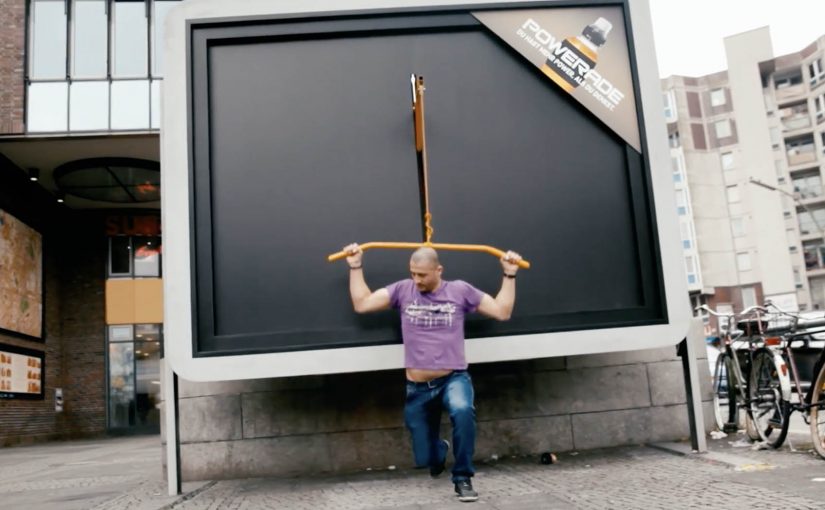
A billboard does not just tell you to train. It invites you to climb it, lift it, or punch it, right there on the street, then hands you a Powerade when you are done.

Powerade, with the help of Ogilvy & Mather, set up several workout billboards in Berlin that, apart from advertising the product, also doubled up as workout equipment to emphasize the brand’s attitude, “You have more power than you think”. Here, “workout billboards” means the billboard structure is built to be used as simple exercise equipment.

People practicing their rock climbing, weight lifting, and boxing skills on the unique billboards were also rewarded with some free Powerade to help replenish their electrolytes.

Why this works as outdoor advertising

The mechanism is a clean value exchange. The brand offers an activity that creates immediate proof of effort. The participant gets a short challenge and a visible outcome. The product then shows up as the natural next step, not as an interruption. Because effort comes first, the product feels like a reward rather than an ad.

Extractable takeaway: When outdoor media gives people a small, safe task to complete, the brand message lands as earned proof, not as a claim.

In sports and performance brands competing for attention in dense urban spaces, turning an ad surface into a usable experience is a direct way to earn participation instead of only impressions.

What Powerade is really buying

This is not mainly about reach. It is about association. The ad makes the brand feel like a training partner, not a poster. It also turns physical engagement into a public spectacle, which draws more people in and makes the moment more memorable than a standard billboard.

The real question is whether your activation gives people something they can do in public, not just something they can look at.

Steal-worthy moves for participatory OOH

  • Make the product a logical reward. The drink lands because effort comes first.
  • Design for participation, not just viewing. If people can do something, they will stop and watch others do it too.
  • Keep the idea explainable in one line. “Billboard that is also a workout” travels fast.
  • Let the environment do the distribution. Public performance creates its own audience.

A few fast answers before you act

What is a “workout billboard” in this campaign?

A billboard installation that doubles as real workout equipment, so people can climb, lift, or punch as part of the brand experience.

Why does turning a billboard into equipment change behavior?

It shifts the role from passive viewing to active participation, which increases time spent, memorability, and the likelihood people talk about it.

What is the main value exchange for the audience?

A quick public challenge plus a tangible reward. Free Powerade after effort makes the product feel earned and relevant.

What is the biggest execution risk?

If it looks unsafe, complicated, or embarrassing, people will not try it. The interaction has to feel obvious and low-risk at first glance.

What is the simplest way to apply this idea without building hardware?

Create a participatory moment that produces visible effort and a clear reward, even if the “equipment” is replaced by a simpler challenge format.