
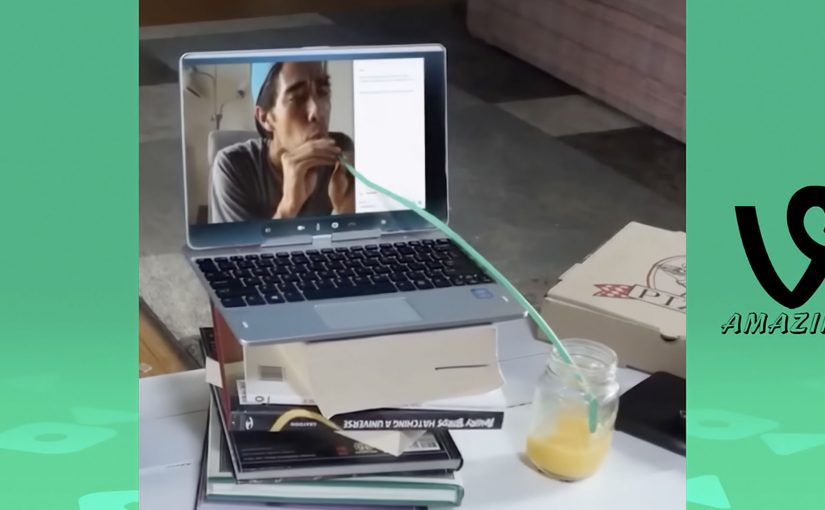
Zach King: The Vine Magician

Zach King: The Vine Magician

Filmmaker Zach King uses video editing to create six-second Vine clips that give the viewer the illusion of real magic. The charm is that the “trick” feels physical. Someone walks through a door that should not exist. Objects swap places mid-motion. Reality behaves like it has a hidden shortcut.

Here is a Vine compilation of some of Zach’s most mind-bending videos.

How the “magic” works

The mechanism is not supernatural, it is editorial craft. Most of these illusions rely on precise cut points, clean match movement, and staging that hides the seam. Here, the seam is the hidden join between two shots that the edit tries to conceal. A hand passes in front of the lens. A body turns. A prop blocks the frame for a split second. Then the edit swaps the world underneath. Because the hidden cut preserves the sense of continuous physical movement, the illusion feels real instead of purely digital.

In short-form social video, attention is measured in seconds, so the craft has to read instantly without explanation.

Why it lands

It works because the viewer gets a complete story in a tiny runtime. Each clip has a setup, a turn, and a payoff that you can replay immediately. The loop is the distribution mechanic. You rewatch to understand, you share to test whether others can spot the seam.

Extractable takeaway: When your format is ultra-short, stop thinking in “content minutes” and start thinking in “repeat value”. Build a moment that rewards a second view, because the second view is where sharing usually happens.

What this teaches about creative constraints

Six seconds is not a limitation, it is a design brief. You cannot waste frames on context, so the idea has to be visual and the reveal has to be unmissable. That forces discipline. One illusion, one beat, one clean exit.

The real question is how to turn a six-second constraint into a visual idea people want to replay and share.

What to steal from Vine-era illusion design

  • Use motion as cover. If something moves across the frame, it can hide a transition.
  • Design the loop. End on a pose or frame that makes the replay feel natural.
  • Keep the rule simple. The best clips can be explained in one sentence, even if the execution is hard.
  • Make the seam the curiosity. Viewers enjoy not knowing, as long as the payoff is satisfying.

A few fast answers before you act

What is a “Vine magic” video in this context?

A six-second clip that feels like real-world magic, but is achieved through precise editing, staging, and hidden transitions.

Why do these clips get replayed so often?

Because the viewer wants to spot the seam. Rewatching is part of the fun, and that behavior increases sharing.

What is the core creative structure behind most of these illusions?

A fast visual setup, a single impossible change, then a clean frame that lands the joke or surprise.

What should brands learn from this format?

Design for repeat value. A short clip that people replay and forward can outperform longer content that gets watched once.

How do you adapt this without copying the style?

Pick one visual transformation that expresses your message, then execute it with a clean transition that viewers instinctively want to replay.


Ikea Social Catalogue

Ikea Social Catalogue

IKEA has been innovating every year with their classic paper catalog. In Norway they decide to take this classic paper catalog and make a social media version of it. With zero budget, they ask their 130,000 Facebook and Instagram fans to post the page of their favourite product on Instagram and add the hashtag #ikeakatalogen, for the chance of winning that product.

How the Social Catalogue works

The mechanic is intentionally lightweight. Here, “mechanic” means the single action IKEA asks for. One public photo of a catalogue page plus one hashtag. IKEA asks fans to pick their favourite item from the catalogue, photograph the page, and post it publicly so the product becomes discoverable through personal networks. Over time, more and more items get documented and shared by real people, effectively recreating the catalogue as a social feed.

In retail and consumer brands with large owned distribution like catalogues, the cheapest growth loops come from turning existing browsing moments into public signals.

The real question is whether your owned channel can become a prompt people want to publicly share, instead of a one-way broadcast they only consume.

Why print is the trigger, not the limitation

Most brands treat print as a one-way broadcast. Here, print is the starting gun. The physical catalogue becomes the prompt that drives people online, and the content that fuels sharing is already in consumers’ hands. Print is not the limitation. It is the trigger when you design the handoff into social indexing.

Extractable takeaway: If you can turn an owned, offline touchpoint into a simple public posting behaviour, you get both social proof and a self-building product index without paying for equivalent distribution.

The growth loop is built into social behaviour

The “social” part is not a slogan. It is distribution mechanics. The hashtag makes individual posts browsable beyond the poster’s own network, so every new post increases discoverability for the next one. When someone posts their chosen page, their network sees it. That drives curiosity, repeats the behaviour, and compounds reach without buying equivalent media.

What to steal

  • Use an owned asset as the trigger. The catalogue is already shipped. The campaign rides that distribution.
  • Make participation effortless. One photo and one hashtag, then you are in.
  • Let the audience do the indexing. Fans effectively organise and surface products through what they choose to share.
  • Reward desire, not trivia. The prize is the exact thing the person already wants.

A few fast answers before you act

What is the IKEA Social Catalogue?

A campaign that turns the printed IKEA catalogue into a social feed by asking people to photograph and share their favourite pages with #ikeakatalogen for a chance to win the featured product.

What is the core behaviour it uses?

People naturally share things they want. The campaign turns that impulse into distribution and product discovery.

What does the hashtag do in this mechanic?

It collects individual posts into one browsable stream, so products stay discoverable beyond the original poster’s friends and followers.

Why is this effective for retail?

Because it turns product browsing into social proof, and social proof into incremental reach, without asking people to learn a new behaviour.

What is the simplest version to replicate?

Pick one existing owned channel, define one shareable action, and reward the exact item the person publicly chooses.

Happy Holiday Videos 2013: Agency Stunts

Happy Holiday Videos 2013: Agency Stunts

Welcome back. Hope everyone had a great holiday season. Now for a great start to 2014.

Taking off from my last post, here are a series of holiday action videos created by agencies around the world in their lead up to Christmas 2013. By “holiday action videos” I mean greetings built around a single visible action or interaction, not a passive message.

Holiday greetings that behave like products

The mechanism across this set is simple. Use the “holiday card” moment as permission to ship a stunt, an installation, or an interactive video that people can experience rather than merely watch.

In global agency culture, holiday cards are a low-stakes sandbox for experimentation that teams can ship fast and share widely.

The real question is whether your greeting can demonstrate something people can experience, not just a sentiment you can post.

This format is worth copying because it turns a seasonal hello into proof of craft.

Why this format keeps working

These pieces earn attention because they trade greeting-card sentiment for an observable action. Put in a coin. Click a button. Gather people in front of a webcam. One clear trigger, one visible result.

Extractable takeaway: If you want something to travel during peak-season noise, design a one-step interaction that produces a visible payoff, and make the payoff easy for someone else to describe in a sentence.

Christmas Chocolate Coin Factory by W+K London

Wieden+Kennedy London turned their Hanbury Street office window into a Christmas installation. Passers-by who inserted a 1 pound coin into Dan & Dave’s Chocolate Coin Factory activated the machine on display which then dispensed a special gold Belgian chocolate coin at the other end. All the money collected from this coin factory was donated towards building a new playground for Millfields Community School in Hackney, East London.

Disrupted Christmas by Holler

Holler, an agency from Sydney, created a live interactive installation that gave the general public a chance to disrupt the agency as it worked throughout the day. Electric Muscle Stimulation (EMS) units were hacked and hooked up to the Internet via IP cameras. Then key members of the agency were connected to the EMS units, and the Internet via a live stream. The public could then watch the agency staff online and instantaneously zap them at will with the click of a button.

For each disruption the agency donated $1 to The Factory, a local community centre with a long history of supporting socially and economically disadvantaged local residents.

The More the Merrier by Publicis Groupe

The Publicis Groupe was back again with another Maurice Lévy holiday video. This time they worked with DigitasLBi to create a video that uses your webcam to detect how many faces are watching together, and then adapts the video based on the number of viewers.

The Epic Christmas Split by Delov Digital

Delov Digital from Hungary used Chuck Norris to top Jean-Claude Van Damme’s epic Volvo split with the help of some serious digital enhancement.

A repeatable structure for next year’s greeting

  • Give the audience one trigger. A single action that anyone can explain and repeat.
  • Make the payoff visible. Something that changes on-screen or in the real world, immediately.
  • Design for retellability. If the idea cannot be summarized in one sentence, it will not spread.
  • Let craft do the selling. Use the holiday excuse to demonstrate what you can build, not just what you can say.

A few fast answers before you act

What makes “holiday action videos” different from normal holiday ads?

They are built around a visible action or interaction. The greeting is the excuse. The experience is the asset that people talk about and share.

Why do agencies use holiday cards as a playground for experimentation?

The stakes are lower and the audience is receptive. That creates room to try unusual formats, technical tricks, and interactive mechanics that would be harder to justify in a client campaign.

What is the common mechanism across the best ones?

One clear trigger and one clear payoff. Insert a coin and get a coin back. Click a button and something happens. Add more people and the video changes.

How do you choose a mechanic that people will actually try?

Pick a one-step trigger that feels effortless, then make the payoff obvious within seconds. If someone cannot explain both in one sentence, the interaction will not travel.

How do you keep it from feeling like a gimmick?

Anchor the interaction in a simple human reward. Delight, togetherness, surprise, or a small act of good. Then keep the mechanic effortless so the idea does not collapse under friction.