Heineken Departure Roulette En Route

Heineken Departure Roulette En Route

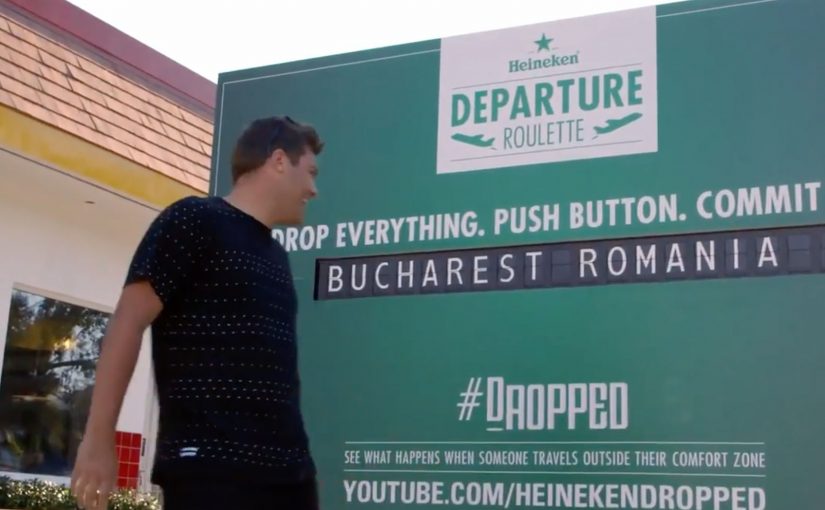
Heineken spots the tweets. Then they make them real. People watch the original Departure Roulette stunt and post the inevitable line on Twitter: “I’d press the button.” Heineken takes that public intent seriously. They track down a few of the people who tweet about wanting to play. Then they offer them the chance to play Departure Roulette on the spot. Real time, real commitment, no rehearsal.

If you want the backstory first, the original Departure Roulette activation sets the frame: a physical roulette board at JFK Terminal 8. One red button. Press it and you accept a new destination immediately. Read about the original here.

What “En Route” gets right: it turns social intent into action

The smartest part of this follow-up is not the surprise. It is the mechanism. Heineken treats social conversation as a live signal of willingness, not just commentary. Here, “social intent” means an explicit public statement like “I’d press the button,” not passive engagement. By acting on that signal fast enough to feel connected, the brand turns curiosity into a credible story of commitment.

Extractable takeaway: When people declare intent in public, treat it as an opt-in trigger. Respond fast with a real commitment moment, and make the decision itself the content.

The real question is whether you can turn “I’d do that” intent into a real commitment fast enough to feel causal, while keeping consent and safety airtight.

If you cannot deliver the commitment reliably in real time, you should not run this pattern.

It rewards declared intent in public

A tweet is a lightweight commitment. Heineken upgrades it into a real decision. The gap between “I would” and “I did” becomes the content.

It closes the loop from earned media to owned experience

The original stunt earns attention. The follow-up re-enters the stream where that attention lives. Social becomes a trigger for a real-world activation, not just a distribution channel.

It stays consistent with the campaign’s core promise

Departure Roulette is about spontaneity and courage. The follow-up keeps the same proposition, just delivered to a different moment and audience.

In global consumer brands running real-time social and experience programs, the advantage comes from turning explicit public intent into a safe, opt-in moment of commitment.

What to measure beyond views

  • Intent volume. How many people explicitly say they would do it.
  • Conversion rate. Percentage of selected participants who actually commit when approached.
  • Time-to-response. How quickly you move from trigger to activation.
  • Amplification quality. Replies and quote-posts that debate “would you do it,” not just “nice video.”
  • Brand linkage. Whether the audience repeats the core idea (spontaneity, adventure), not just the prank.

Risks and guardrails that matter

  • Consent and privacy. Do not approach people in a way that feels extractive. Keep it clearly opt-in.
  • Safety and duty of care. High-stakes travel stunts need hard boundaries, support, and contingencies.
  • Credibility. The offer must be unquestionably real, or the story collapses into suspicion.
  • Operational readiness. The logistics are the product. If ops fail, the story turns.

How to reuse this pattern without copying the stunt

  1. Define the “press the button” moment. Pick one unmistakable action that proves intent.
  2. Listen for explicit triggers, not vague sentiment. Look for “I would,” “I want,” or “If you did this I’d…” rather than likes alone.
  3. Respond fast enough that it feels connected. If the follow-up arrives too late, it reads like a promotion, not a story.
  4. Make the commitment real, but safe. Build constraints on timing, eligibility, logistics, and consent.
  5. Capture the decision, not just the reward. The moment of choice is the asset. The prize is the justification.

A few fast answers before you act

What is Departure Roulette En Route in one line?

It is a social-powered follow-up where Heineken turns “I’d press the button” tweets into a real-world chance to do exactly that.

Why does it spread?

Because it stages a high-stakes, relatable decision in public: keep your plan, or choose the unknown.

What is the reusable strategy?

Treat public intent as a trigger for action. Then deliver a real experience that proves the brand promise.

What is the minimum viable version for a brand without travel budgets?

Reward declared intent with an immediate upgrade: surprise access, exclusive drop, instant appointment, or fast-track service.

Where does this go wrong fastest?

When it feels like surveillance, or when the logistics do not deliver on the promise.

Cornetto: Love Plane

Cornetto: Love Plane

A couple tweets a love message with a hashtag, and a few minutes later it appears on a banner flying over the beach. Cornetto’s Love Plane turns summer flirting into public media, with the sky as the timeline.

A Twitter feed you can read in the air

Summer is the season of crazy, unexplainable romances. Cornetto launches the Love Plane in Spain and attaches a Twitter-based banner feed to it.

The mechanism: hashtag in, banner out

People who want to declare their love both online and in the sky tweet using the hashtag #cornettoskytweet. The most popular tweets are then painted on the banner and flown over the beach. To keep things moving, the banner creative is changed every 15 minutes.

In European FMCG summer activations, a simple real-time mechanic can turn social posting into a shared public moment that people notice even if they are not online.

Why this lands

This works because it upgrades a small, personal gesture into something you cannot ignore. A tweet becomes physical, scarce, and time-bound, which raises the perceived stakes and makes participation feel like a mini event rather than just another post.

Extractable takeaway: If you want social participation at scale, convert digital inputs into a visible, time-boxed output in the real world, so the reward is public and immediate, not buried in a feed.

What Cornetto is really doing

Cornetto is smart to make participation public instead of leaving the interaction inside Twitter. The brand is borrowing the emotional energy of summer romance and using it to create a repeatable content loop. By a repeatable content loop, this means each new tweet can create another visible banner moment and another round of attention.

The real question is how a brand turns disposable social chatter into a public moment people want to trigger and watch.

People supply messages. The campaign outputs spectacle. Onlookers become an audience. Participants become distributors.

What summer activation teams should steal

  • Make the reward unmistakably public. Participation feels bigger when others can witness it.
  • Use a simple popularity rule. “Most popular tweets win” is easy to understand and easy to compete in.
  • Keep the cadence fast. Refreshing every 15 minutes creates urgency and repeat attention.
  • Match channel to emotion. Romance works when the output feels bold, not subtle.

A few fast answers before you act

What is the Cornetto Love Plane?

It is a plane flying over beaches with a banner that displays selected tweets, turning social posts into a public sky message.

How do people participate?

They tweet a message using the hashtag #cornettoskytweet. The most popular tweets are selected to appear on the banner.

Why change the banner every 15 minutes?

Frequent updates create urgency and make the activation feel live, which encourages repeated participation and attention.

What does this communicate about the brand?

That Cornetto “owns” summer romance moments, and that the brand can turn small gestures into shared experiences.

What is the main operational risk with this idea?

Moderation and logistics. You need tight filtering for messages, plus reliable production timing so the “real-time” promise holds.

Tooth Fairy: Pneumatic Transport

Tooth Fairy: Pneumatic Transport

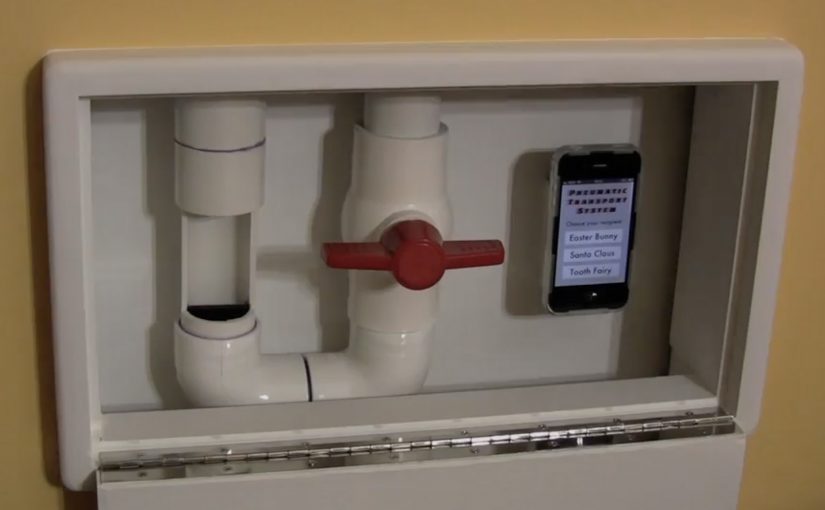
A child loses a tooth, drops it into a capsule, and sends it away through a pneumatic tube. A moment later, a second capsule arrives back with the Tooth Fairy’s payment.

Jeff Highsmith, a father of two, decided to re-write the Tooth Fairy routine with a pneumatic transport system built into his house. He set it up with 1.5" PVC pipes, a central vacuum in the attic, and two endpoint stations, one in each child’s room. When a tooth came out, it went into a small plastic bottle that travelled through the system, while a parent loaded money into another bottle at the other station and sent it back.

A ritual redesigned as a “send and return” loop

The mechanism is a closed-loop exchange. Tooth goes in. Capsule moves. Payment comes back. This matters because visible movement turns an invisible promise into something kids can witness, which makes the ritual feel more credible. The stations make the experience legible and ceremonial, while the vacuum-driven transport makes it feel like the Tooth Fairy is “on the other end” even though the system stays entirely within the home.

In maker households, the quickest way to modernize a family ritual is to turn it into a tangible, repeatable system that feels magical to kids and practical for parents.

Why it lands as modern folklore

This works because it preserves the core emotion of the Tooth Fairy. Anticipation, mystery, reward. Here, “modern folklore” means a familiar family story made credible through a repeatable household ritual. The real question is not how to digitize the Tooth Fairy, but how to make the ritual feel more believable without making it feel less magical. This is a smarter update than adding more screens or complexity, because the physical loop strengthens the illusion while simplifying the parent job. The build also lets the story scale across siblings, since each child has their own station and repeatable moment.

Extractable takeaway: If you want to update a tradition without losing its charm, keep the same emotional arc, then redesign only the delivery mechanism so the magic feels more believable, not more complicated.

More details about the pneumatic system and the Python code for the mobile web interface can be found here.

What to steal for playful “systems thinking” at home

  • Make the interface physical. A station or ritual object matters more than hidden automation.
  • Design for repeatability. If it can run the same way every time, kids trust it and look forward to it.
  • Separate mystery from maintenance. Keep the “magic side” visible and the parent side easy to operate.
  • Document the build. A clear write-up turns a one-off family project into something others can replicate.

A few fast answers before you act

What is the core idea of the pneumatic Tooth Fairy system?

A home pneumatic tube loop that lets kids send teeth in a capsule and receive the Tooth Fairy’s payment back through a return capsule.

What materials and layout does the build use?

1.5" PVC pipes, a central vacuum in the attic, and endpoint stations in each child’s room, with small bottles used as capsules.

Why is this better than the traditional “money under the pillow” routine?

It keeps the same reward moment but makes the exchange visible and immediate, while reducing the need for parents to sneak around at night.

What makes the experience feel magical rather than mechanical?

The station ritual and the movement of the capsule. The child can see the “sending” happen, which reinforces the story.

Who should build something like this?

Anyone comfortable with a basic DIY project involving PVC piping and a vacuum-driven transport loop, and who wants to create a repeatable family ritual.