
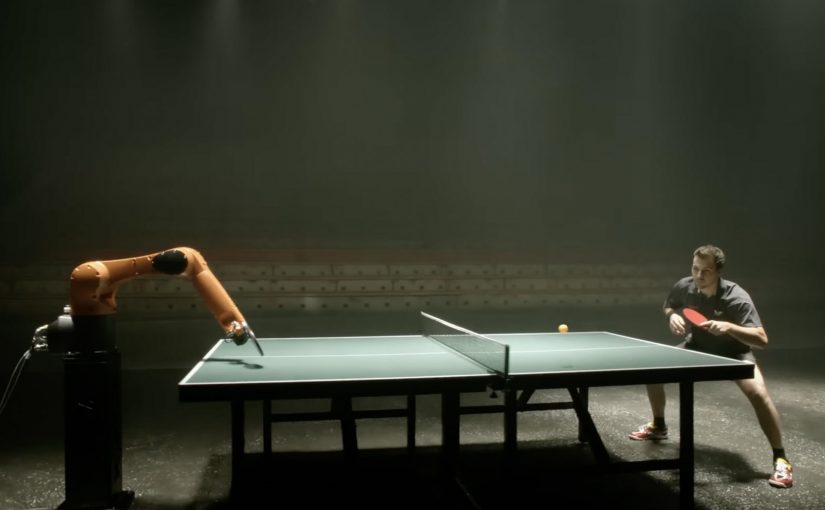
KUKA: The Duel – Timo Boll vs Robot Arm

KUKA is a market leader in industrial robotics. To provide a realistic vision of what robots can be capable of in the future and at the same time celebrate the opening of their new robotics factory in Shanghai, they got German table tennis champion and former world number one Timo Boll to take on a KUKA robot in what was billed as the first ever man versus robot (arm) table tennis match.

The match took place on March 11th in Sofia, Bulgaria. Since then the results of the match have been sliced and diced into the below final cut video that celebrates the inherent speed, precision, and flexibility of KUKA’s industrial robots in tandem with Boll’s electrifying and tactical prowess in competition.

A sports duel as an industrial demo

The mechanism is straightforward. Put a world-class human performer in a constrained arena. Put a robot arm in the same arena. Then shoot it like a movie. Tight angles, slow motion, dramatic beats, and a clear scoreboard narrative. The engineering message rides inside the entertainment.

In B2B industrial categories, cinematic demonstration is often the fastest way to translate engineering attributes into mainstream attention.

Why it lands

Extractable takeaway: If your product advantage is “invisible” to most people, stage a head-to-head scenario where the advantage becomes legible in seconds, then edit the story so the viewer can feel the difference.

Table tennis is a smart choice because it compresses the value proposition into a single frame. Reaction time, repeatable precision, and control are all visible without a technical explanation. You do not need to understand robotics to understand a rally that never misses its mark.

The intent behind the “first ever” framing

The “man vs. machine” line is a distribution strategy as much as a claim. It gives journalists, employees, and customers a simple hook. It also lets a factory opening travel beyond trade press, because the asset is watchable even if you have no interest in industrial automation.

What to steal

  • Turn specs into a duel: pick one human benchmark and make your performance measurable against it.
  • Choose a sport that explains you: the activity should naturally map to your differentiators.
  • Make the first 10 seconds self-explanatory: the premise should land without narration.
  • Edit for story, not documentation: the cut should create tension and release, not just show footage.
  • Provide a “making-of” layer: give engineers and buyers a deeper track once the headline video has earned attention.

A few fast answers before you act

What is “The Duel”?

It is a KUKA campaign video built around a staged table tennis match. Timo Boll plays against a KUKA robot arm, with the story edited like a cinematic showdown.

What is the campaign trying to prove?

Not that a robot “plays sport” like a human. The point is to make speed, repeatability, and precision feel real, fast, and memorable.

Why table tennis specifically?

Because the action is compact and readable. You can see reaction time and accuracy in a rally without needing technical context.

Is “man vs robot” the important part?

It is the packaging. The more transferable lesson is how the format turns complex capability into a simple, shareable demonstration.

What should B2B marketers copy from this?

Engineer a single, high-contrast scenario where your advantage is visible immediately, then ship both a headline cut for attention and a deeper “behind the scenes” layer for credibility.
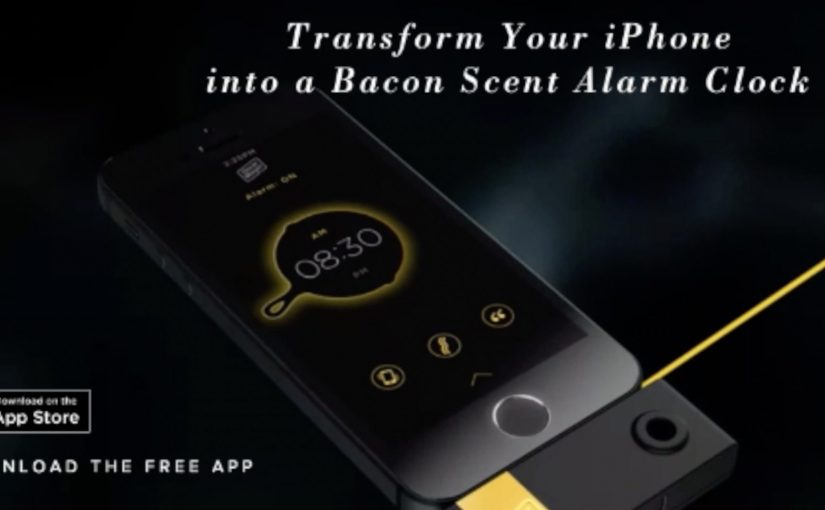

Oscar Mayer: Wake Up and Smell the Bacon

If you would like to wake up to the sound of sizzling bacon on the stove and its aroma drawing you out of bed, then head over to www.wakeupandsmellthebacon.com and answer three questions for a chance to win the special bacon-scented iPhone attachment.

The contest is being run by Oscar Mayer, and they are giving away 4700 bacon-scented iPhone attachments over the next month. Winners can then use a custom Oscar Mayer alarm app to automatically activate the iPhone attachment every morning.

How the stunt is engineered

The mechanism is a neat combination of utility and theatre: a giveaway device plus a dedicated alarm app. Instead of only telling you “bacon smells great”, the brand designs a repeatable moment where smell is the message and the morning routine is the media.

In FMCG marketing, a physical add-on that turns a brand promise into a daily ritual can outperform a one-off ad because it creates repetition without feeling like repetition.

Why it lands

It turns a product truth into a sensory demo. Oscar Mayer does not need to persuade you that bacon is appealing. It just recreates the cue that already does the persuading.

It makes the call-to-action playful. “Enter to win” is normally forgettable. Here it is a gateway to a story-worthy object, so the contest itself becomes shareable.

It upgrades branded content into branded utility. The alarm is not only entertainment. It is a behavior change, because the phone becomes part of a new wake-up routine.

Extractable takeaway. Scent and sound work as marketing when they are attached to an existing habit. If the brand can own a repeatable moment in the day, the campaign shifts from impression to ritual.

Borrowable moves

  • Pair a simple app with a tangible artifact. Physical wins feel rarer than digital, which increases talk value.
  • Design for daily replay. The strongest “stunts” are the ones that can be re-experienced without needing a second ad.
  • Make the entry mechanic frictionless. Fewer questions, faster entry, and the prize does the marketing.

A few fast answers before you act

What is being promoted here?

A contest for a bacon-scented iPhone attachment, supported by an alarm app that triggers the attachment in the morning.

Why does this qualify as more than a gimmick?

Because it converts a brand promise into a repeatable experience. The “demo” happens in the user’s real life, not just on screen.

What is the main behavior change the campaign creates?

It pulls the brand into a daily wake-up habit, which creates repeated exposure without needing repeated media placements.

What makes it shareable?

The object is inherently story-worthy. People can describe it instantly, and the idea is unusual enough to travel as a headline.

What is the key risk?

Link rot and platform change. If the app link, device compatibility, or contest site stops working, the core mechanic collapses.

Pepsi Max: Test Drive

Last year in March, Pepsi Max along with professional stock car racing driver Jeff Gordon performed a prank on an unsuspecting car salesman by taking him on a test drive of his life…

The video since then got over 41 Million views on YouTube. Despite its viral success, automotive journalist Travis Okulski was not impressed and was pretty vocal in pointing out inconsistencies in the viral ad and calling it a fake.

So Jeff Gordon teamed up again with Pepsi Max to pull a similar prank on unsuspecting Travis Okulski, just to prove the authenticity of the original test drive video…

But even after all of that Travis Okulski is still not convinced and the video since its release last week has already gotten over 13 Million views on YouTube.

Why this became a two-part story

The first video worked because the premise is simple, the escalation feels real, and the payoff is pure reaction. But the moment it went viral, it also invited scrutiny. That is what makes the follow-up so interesting. The brand turned criticism into content by making the skeptic part of the narrative.

  • Viral hook. A familiar setting, then a sudden reveal of unexpected capability.
  • Credibility challenge. A public critique that reframed the conversation as “real or staged”.
  • Response as sequel. A second execution aimed at the critic to re-earn belief.

What to learn from the backlash

When stunts travel, authenticity becomes part of the product. If the audience starts debating “is it real”, the brand can either go silent or lean in. Pepsi Max leaned in and used the debate as fuel, which extended the lifecycle and kept attention anchored to the same brand platform.


A few fast answers before you act

What is Pepsi Max “Test Drive” with Jeff Gordon?

It is a prank-style stunt video where Jeff Gordon takes an unsuspecting car salesman on an extreme test drive, created as part of Pepsi Max’s viral entertainment approach.

Why was there controversy around the first video?

An automotive journalist publicly pointed out inconsistencies and argued it was staged, which sparked debate about authenticity.

Why did Pepsi Max do a second video?

To address the credibility debate directly by repeating a similar stunt and making the outspoken critic part of the execution.

What is the transferable pattern for viral campaigns?

Expect scrutiny, especially when the content looks “too good”. If doubt becomes the story, design a credible sequel that engages the criticism rather than ignoring it.