Qantas Out Of Office Travelogue

Qantas Out Of Office Travelogue

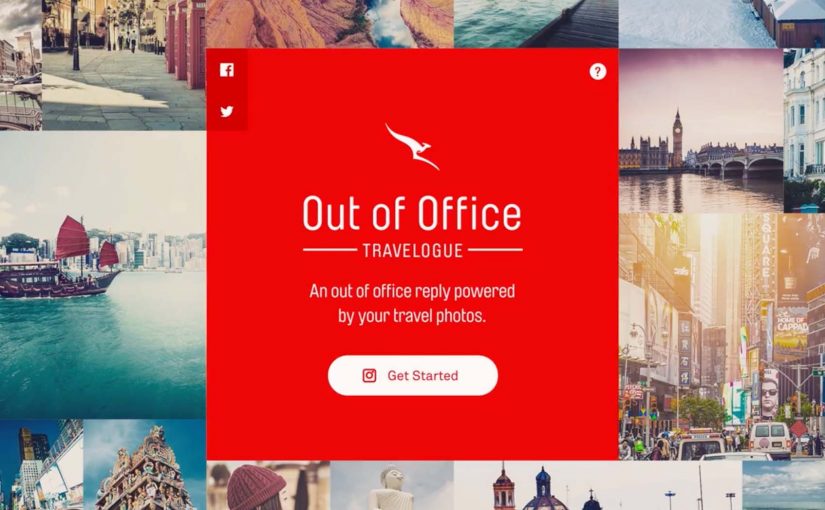
Qantas, Australia’s national airline, wants a new way to inspire travel with an increasingly younger audience. Their answer is a smart twist on a familiar behaviour. The out-of-office email. Instead of the usual “I’m away” message, Qantas turns it into a personalised travelogue powered by the user’s Instagram photos.

The mechanism is simple and effective. Qantas’ research shows that tips from friends and colleagues are a major driver for choosing the next holiday. So the brand uses Instagram’s API to transform a mundane autoresponder into something people actually want to read. A short visual story of where you are, what you are doing, and why it might be worth visiting.

What elevates the idea is the commercial bridge. The email does not just inspire. It incentivises recipients to book flights directly from the out-of-office message. This is social proof plus direct response, built into a format people already accept as normal workplace etiquette. The business intent is clear. Convert social inspiration into attributable flight demand inside the same interaction.

As a result, users created over 10,000 Out of Office Travelogues. The activity generated 100 million media impressions worldwide for Qantas.

Why this works as modern email strategy

Most marketing emails fight for attention in an overcrowded inbox. This one arrives with a built-in reason to be opened and read. It is a message you expect when you email someone who is travelling.

Extractable takeaway: When a brand can place a commercial message inside a communication people already expect, the marketing feels useful before it feels promotional.

It also uses the strongest distribution channel many brands overlook. People’s real networks. When your colleague shares their trip, even passively via an autoresponder, it carries more credibility than a brand-led destination ad.

This is one of the smarter ways to turn routine email behaviour into demand generation because it adds commerce without breaking the social norm that makes the message welcome.

The real innovation is the data-to-story pipeline

At a tactical level, the campaign is “just” an API integration. In practice, it is a reusable pattern. Here, data-to-story pipeline means turning user-owned content and simple signals into a coherent, bookable story unit.

  • Pull customer-owned content from a platform they already use.
  • Convert it into a lightweight narrative unit that fits a communication norm.
  • Add a clear, transactional next step without breaking the tone.

If you can operationalise that pattern, you can treat email not as static creative, but as a dynamic surface where personal context becomes relevant storytelling. Because the story is generated from a person’s real context, it feels more relevant and more trustworthy than static promotional creative.

In travel and hospitality categories where peer recommendation shapes intent, that makes email a distribution surface, not just a notification channel.

The real question is how far a brand can turn trusted everyday communication into measurable distribution without damaging the trust that makes it work.

What to watch if you replicate this pattern

The moment you use personal photos and automated messaging, the trust layer matters.

  • Permissioning and transparency. Make it obvious what is being pulled and why.
  • Control. Users need an easy way to curate what appears.
  • Brand safety. You need guardrails so the travelogue stays on-message without becoming intrusive.

What to steal for email-powered demand generation

  • Hijack a legitimate email type. Out-of-office replies get opened because the recipient expects them.
  • Turn personal content into a controlled story unit. User photos feel authentic, but only work when users can curate the output.
  • Embed the commercial action inside the narrative. Inspiration and booking sit in the same interaction, so intent has no time to cool down.
  • Use networks as distribution, not “audiences”. Colleagues and friends are higher trust than any destination banner.

A few fast answers before you act

What is the Qantas Out of Office Travelogue?

A personalised out-of-office email reply powered by the user’s Instagram photos, designed to inspire travel and drive bookings.

Why is the out-of-office format such a good carrier?

It arrives with intent and legitimacy. People expect it, and it is naturally tied to travel.

What is the core growth loop?

One person travels. Their network sees the travelogue via everyday email behaviour. The recipient gets inspired, and is pushed toward booking directly from the message.

What has to be true for this to scale?

Users need clear permissioning, easy curation, and a direct booking path that feels like a natural next step rather than a hard sell.

What results does Qantas report?

Over 10,000 travelogues created and 100 million media impressions worldwide.

Ford: Max Motor Dreams Cot

Ford: Max Motor Dreams Cot

It is the middle of the night. A baby will not settle. So a parent reaches for the only reliable hack. Strap in, start the engine, and drive until the motion and hum finally do their work.

Ford Spain’s Max Motor Dreams takes that behaviour and recreates it at home. The cot uses a smartphone app to record the characteristics of a specific journey, then reproduces them back in the crib. Gentle rocking to mimic the car’s movement. A soft engine rumble for background noise. A flowing glow to imitate street lighting passing by outside a window.

In family-focused European automotive brand marketing, the most believable innovation stories take a known behaviour and remove the pain from it without changing the outcome.

Max Motor Dreams is presented as a one-off pilot for now, built as a proof-of-concept rather than a mass product. Ford says that after receiving enquiries, it is considering what full-scale production could look like.

A car-ride simulating cot is a crib concept that captures the motion, sound, and ambient light patterns of driving, then replays them so parents can trigger the same soothing effect without leaving the house.

Why this lands with exhausted parents

The value is not novelty. It is relief. The idea does not ask parents to learn a new sleep philosophy. It simply automates a routine they already know works, then gives them their night back.

Extractable takeaway: If your “innovation” replaces a workaround people already trust, belief comes from preserving the outcome and removing the friction.

What makes the mechanism feel credible

The concept is grounded in a specific recording and replay loop, not a generic “white noise” gadget. Recording an actual route, then replaying that exact motion and sound profile, makes the experience feel personal and less like a toy.

What Ford is really signalling

This is not a sales brochure for a model line. It is a brand move that positions Ford as a company that applies mobility thinking to everyday life problems, and does it with a prototype you can understand in one sentence. That is a smart brand move even if the cot never ships.

The real question is whether you can make a complex capability feel like a bedtime story in one demo.

How to translate mobility tech into a human story

  • Start with a behaviour everyone recognises. Night drives for baby sleep are a universal parent anecdote.
  • Make the loop demonstrable. Record. Replay. Repeat. Simple beats build belief.
  • Show the “one-off” honestly. A pilot can still be powerful if it proves intent and capability.
  • Let the product idea carry the message. When the concept is clear, you do not need heavy copy.

A few fast answers before you act

What is Ford’s Max Motor Dreams?

It is an app-controlled cot concept from Ford Spain that recreates the soothing effects of a night-time car ride by replaying recorded motion, sound, and ambient lighting.

How does the cot know what to reproduce?

Parents use a smartphone app to record a specific journey, then the cot uses that data to reproduce the movement, engine-like sound, and streetlight-style glow.

Is Max Motor Dreams a real product you can buy?

Ford presents it as a one-off pilot concept. It is described as not being in full production, though Ford says it is considering options after enquiries.

Why does this work as a brand story for an automaker?

It reframes automotive expertise as problem-solving beyond the car. The idea borrows the credibility of mobility engineering and applies it to a relatable home problem.

What is the main risk with concepts like this?

If the mechanism looks like a gimmick or cannot be explained quickly, people dismiss it as PR. The concept has to feel technically plausible and emotionally necessary.

Volvo Concierge Services

Volvo Concierge Services

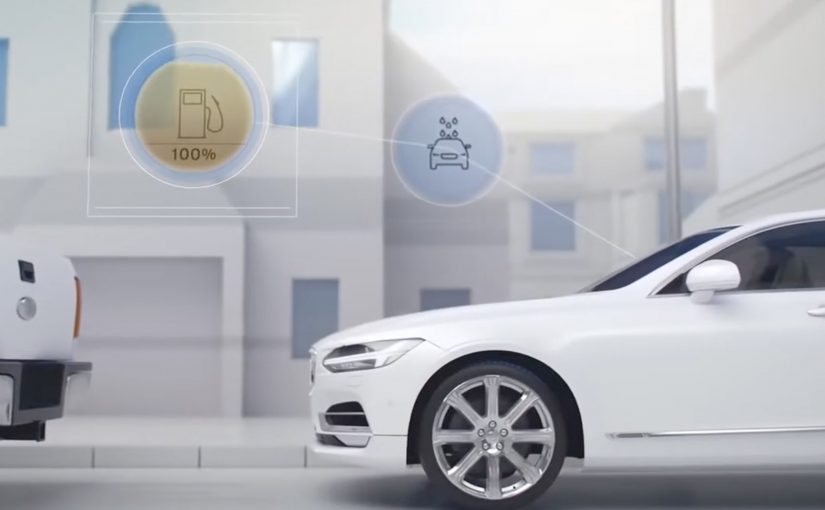
Volvo is actively experimenting with moving beyond simply building and selling cars. With Volvo Keyless Cars and Volvo In-Car Delivery, the direction is clear. Build a service layer around the vehicle. Volvo’s latest effort creates a concierge-style service ecosystem that gives customers access to third-party service providers who can remotely refuel the car, run a car wash, handle servicing, and more. Here, “concierge” means services happen while the car is parked, without the owner being present.

The heart of Volvo Concierge Services is the digital key. A one-time-use, location- and time-specific key that gives an approved service provider access to the vehicle. That matters because it keeps the car secure and removes the need for the owner to meet someone and physically hand over keys. Whether the supplier is a refuelling company, a valet parking attendant, or Volvo itself for maintenance, the provider uses an app to remotely unlock the car and allow the engine to turn on.

The Volvo Concierge Services are currently being tested in the San Francisco Bay Area with owners of the new Volvo XC90 SUVs and S90 sedans.

The digital key is the unlock. The services are the business model

This is not just about convenience. It is a structural shift. Once access becomes software, it can be controlled precisely. Who gets access. For how long. Where. For what purpose. Because access can be time-bound, location-bound, and single-use, you can reduce handover friction without opening the vehicle to broad, persistent access. That is the foundation you need to turn a connected car into a platform for partners and post-sale services.

In connected-car programs, the hardest step is making third-party access both permissioned and low-friction for owners.

The real question is whether you treat the digital key as a convenience feature, or as the control plane for a partner service layer.

Why “remote access without handover” changes behaviour

Traditional servicing and add-on services create friction. Scheduling. Meeting. Waiting. Key logistics. Concierge Services reduces that friction by making the car addressable when it is parked, and by making access safe enough to involve third parties.

Extractable takeaway: If you can grant narrowly scoped, auditable access without coordination, a parked asset becomes an addressable surface for services.

What to pressure-test before you scale a service ecosystem

  • Trust and governance. Who qualifies as an approved provider. What is logged. What can be revoked instantly.
  • Edge cases. What happens if something goes wrong mid-service. What support paths exist for customer and provider.
  • Consistency of experience. If third-party services vary in quality, the brand still owns the perception.
  • Security by design. One-time, time-bound, location-bound access is powerful. It has to be implemented rigorously.

A few fast answers before you act

What is Volvo Concierge Services?

A service ecosystem around Volvo cars that enables approved third-party providers to refuel, wash, service, and handle other tasks with controlled remote access to the vehicle.

What enables the service providers to access the car?

A one-time-use, location- and time-specific digital key that unlocks the vehicle through an app without physical key handover.

Where is it being tested?

The service is being tested in the San Francisco Bay Area, with owners of Volvo XC90 SUVs and S90 sedans.

What is the core strategic takeaway?

When access becomes software, the car can support a partner service layer that keeps creating value after purchase.