

Chery M11: Road M11

Chery M11: Road M11

Hundreds of people design their own “dream roads” online. Then one of those roads gets built in the real world, and the person who created it ends up navigating a rally run alongside a professional driver.

That is the core idea behind Chery M11’s “Road M11” project by Voskhod, built to tackle a real market perception problem. In Russia, Chinese cars were widely seen as unreliable and unpleasant to drive, so the campaign had to create proof, not promises.

Instead of leading with specs, the brand launches an internet game where anyone can create roads and drive them using a computer model of the Chery M11. People race against the clock and vote on the best road. After a month and more than 800 submitted roads, a winner is selected. The winning road is then constructed in reality for a rally-style event, journalists are invited, a Russian rally champion is chosen as driver, and the road’s creator becomes the navigator.

Turning “prove it” into a participation loop

The mechanic is not just gamification. It is co-creation with consequences. The audience builds roads, competes, and votes. The brand takes the best idea and commits to building it at full scale, then lets independent observers experience the car on a course the public designed rather than a track the brand curated.

In automotive categories where trust is the main barrier, converting digital participation into a real-world test creates credibility that advertising claims cannot buy.

Why it lands

The campaign reframes skepticism as a challenge the audience can test. That matters because the negative belief is about performance and reliability, and those beliefs tend to change only through experience or trusted proxy experience. The road-building game gives people viewer control over what the car is “asked to do”, and the real rally event creates a clean narrative of proof. If the car cannot handle it, the idea collapses publicly. That risk is what makes the demonstration persuasive.

Extractable takeaway: When a category suffers from “untrusted origin” bias, meaning buyers discount the product because they distrust where it comes from, move the claim from messaging into a public test. Let the audience help define the test, then invite credible witnesses to validate the outcome.

What the business intent really is

The obvious goal is traffic and attention. The deeper goal is to earn test drives and journalist coverage by making the car’s capabilities feel observed rather than asserted. The legacy write-up reports strong site visitation and sales impact, which fits the logic of the mechanism. Participation creates investment, investment creates trial, trial creates conversion.

The real question is whether the brand can turn skepticism into a public proof event that feels harder to dismiss than an ad.

What to borrow from Road M11

  • Design a proof that scales. Digital participation can scale fast, but the proof moment must be simple enough to summarize.
  • Let the public set the challenge. Co-creation increases trust because it reduces suspicion of “staged conditions”.
  • Bridge online to offline. The handoff from game to real-world event is where credibility is minted.
  • Invite credible witnesses. Journalists, experts, or known practitioners make the proof travel beyond your owned channels.

A few fast answers before you act

What is “Road M11” in one sentence?

An online road-building game for the Chery M11 where the winning user-created road is built in real life for a rally-style demonstration with journalists and a pro driver.

Why use a game instead of a traditional test-drive campaign?

Because the barrier is trust. A participatory mechanic creates investment, and the game-to-real-world conversion creates a visible proof story that journalists and viewers can follow.

What perception problem is this designed to solve?

That Chinese cars in the Russian market were seen as unreliable and poor to drive, so performance had to be demonstrated rather than claimed.

What results did the legacy write-up claim?

It reported more than 340,000 visitors in three months, sales exceeding plan by 76%, and annual sales growth of 186% versus market averages. Treat these as campaign-reported figures unless you have primary reporting to validate them.

What is the biggest risk in this approach?

If the real-world build and rally experience does not match the promise, the proof flips into a public counter-proof. The execution has to be operationally strong, not just creatively strong.

The Swedish Post: The Sound of Green

The Swedish Post: The Sound of Green

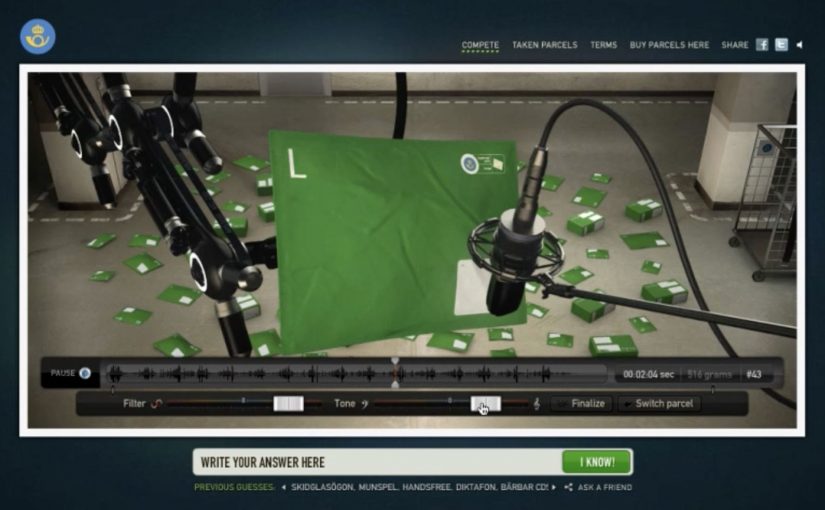
The Swedish Post has a collection of pre-stamped parcels that makes it easy to send things. The task for ad agency Åkestam Holst was to tell people that it was possible to send almost anything overnight with these pre-stamped parcels.

So they packed 80 parcels with all sorts of stuff and recorded 80 specific sounds. Those sounds powered “The Sound of Green” competition. Users picked a parcel, listened closely, and guessed what was inside. If they got it right, the Swedish Post sent the same parcel to the winner the very same day.

After a reported 140,240 guesses, the competition finally came to an end.

When proof beats promise

The mechanism is a neat translation of capability into play. Instead of listing what you can ship, you create 80 mystery parcels, record what they sound like, and let the public test their attention. The prize is not a voucher or a discount. The prize is the actual thing, delivered fast, which quietly demonstrates the core promise.

In consumer postal markets where “overnight delivery” sounds like a commodity claim, capability stories land better when they are demonstrated through a simple, repeatable experience.

The real question is whether the brand can make overnight delivery felt before someone ever ships a parcel.

Why it lands

This works because it turns logistics into curiosity. Sound is intimate and surprisingly hard to fake, so the listener leans in. The guessing format also creates a low-friction reason to spend time with the brand, and the same-day fulfilment makes the payoff feel real, not promotional.

Extractable takeaway: If you are selling an invisible service, build a public game that forces the benefit to show up as evidence, not copy.

What service brands can borrow

  • Demonstrate the promise. Replace “we can do anything” with proof people can experience.
  • Use a constraint to create focus. 80 sounds is large enough to feel rich, small enough to feel curated.
  • Make the prize the product. Shipping the parcel is the cleanest way to validate shipping.
  • Design for repeat attempts. A guessing mechanic naturally invites “one more try”.

A few fast answers before you act

What is “The Sound of Green”?

An online competition by the Swedish Post and Åkestam Holst where people listen to recorded parcel sounds, guess the contents, and winners receive the same parcel delivered the same day.

What is the core mechanism?

Pack real parcels, record the sounds they make, then let users choose a parcel sound and submit a guess. Correct guesses trigger real fulfilment.

Why use sound instead of photos?

Sound forces attention. It is less immediately obvious than visuals, and it creates a stronger sense of discovery when you finally figure it out.

What does this teach about marketing service businesses?

Claims are easy to ignore. Demonstrations are harder to dismiss, especially when the demonstration is interactive and ends in real delivery.

How do you keep a contest like this from feeling gimmicky?

Make the payoff identical to the promise. In this case, the reward is the service itself, delivered fast.

Royal Dutch Army: #Question Recruitment

Royal Dutch Army: #Question Recruitment

The Royal Dutch Army has only a few specific job openings this year, and the challenge is to get qualified candidates to the website.

Turning Twitter questions into a recruitment filter

The “Qualified / Not Qualified” theme is already well known in the Netherlands. Here it is reused as a live judging mechanic on Twitter. People post questions using a designated hashtag, and the campaign replies by rating the answers as qualified or not qualified, then routes the right people toward the Army’s recruitment site.

In specialist public-sector recruitment, the hardest part is earning the first click from people who already have a stable job.

Why it lands: it hijacks attention that already exists

The smartest part is distribution. Instead of building a follower base from scratch, the concept leans on the fact that many Twitter users already track question hashtags. That means the campaign can show up in an existing stream of intent, where people are already in “answer mode”.

Extractable takeaway: If you have limited openings and strict qualification needs, design a public screening mechanic that lives inside an existing behavior. You get fewer clicks, but the clicks you get are self-selected and easier to convert.

What the brand is really doing

This is not about being funny on social. It is about pre-qualification in public. The Qualified or Not Qualified response turns the brand into an assessor, and the assessor role is exactly what a military employer needs to signal when roles are scarce and standards are real.

The real question is how to turn public participation into a credible first-stage filter that attracts fewer, better applicants.

What to steal for your own hard-to-hire role

  • Recruit inside an existing intent stream: go where people are already asking, answering, or problem-solving.
  • Make the filter visible: a simple rating frame can do more than a long job spec.
  • Keep the response format consistent: repetition builds recognition fast.
  • Route immediately: when someone looks qualified, give a clear next step to the right page.
  • Stay disciplined on tone: the format can be playful, but the standards must feel credible.

A few fast answers before you act

What is the #Question idea in one sentence?

It uses a Twitter question hashtag to attract answers, then labels them “Qualified” or “Not Qualified” to steer the right candidates to recruitment information.

Why does a hashtag mechanic help without a follower base?

Because people discover the content through the hashtag stream itself, not through the campaign account’s followers.

What makes this a recruitment campaign rather than brand social posting?

The public rating acts as a screening signal, and the interaction is designed to drive candidates toward a concrete next step on the recruitment site.

What is the key risk with public “qualified” judgments?

Misclassification or tone-deafness. If the criteria feel arbitrary or disrespectful, the campaign can discourage exactly the audience it wants.

What should you measure if you copy this approach?

Click-through to role pages, application starts, application completion rate, and the quality of applicants compared to baseline channels.