
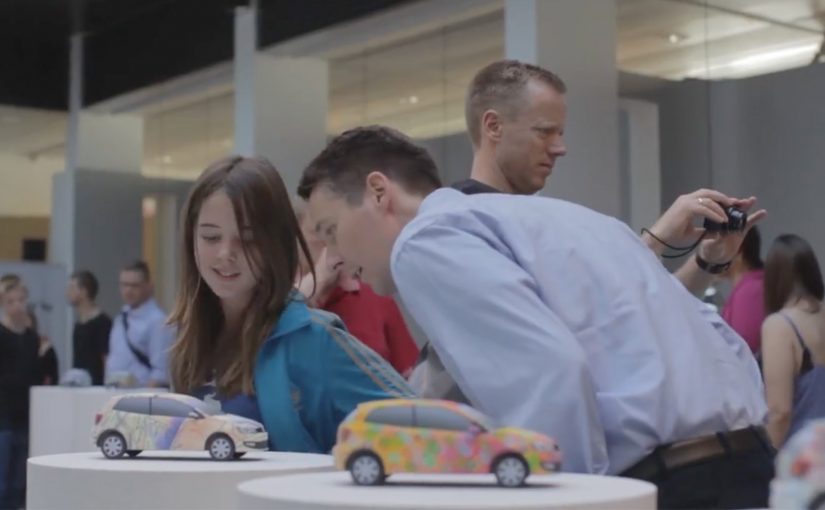
VW Polo Principle: Crowdsourced 3D Prints

Volkswagen last year launched “The Polo Principle” ad campaign to convey the message that high-end innovations were now available to Polo drivers.

Then, to democratize the innovation process, they allowed people to actually design their very own 3D Volkswagen mock ups. The top 40 designs were chosen by a panel of judges and then put on display in Copenhagen, with the entrants receiving their (mini) 3D printed Volkswagens in the mail.

From innovation message to innovation participation

The mechanism is a neat escalation. The campaign starts with a claim: premium innovation is no longer reserved for premium models. Then it turns that claim into an action: if innovation is being “democratised,” people should be able to shape it. A 3D design tool becomes the interface for participation.

Instead of asking audiences to agree with the brand message, Volkswagen invites them to contribute to it, visually and playfully.

In co-creation campaigns, participation becomes persuasion when people can make something that physically proves the brand promise.

In enterprise marketing teams, co-creation only scales when the participation interface is simple and the payoff is concrete.

Why it lands: ownership beats persuasion

This works because creating something triggers a different level of engagement than watching something. Designing a mock up requires time, intent, and taste. Once you invest that effort, you become emotionally tied to the campaign. And when your design is selected, the brand is no longer a distant manufacturer. It is a platform that amplified you. Co-creation is most persuasive when the act of making produces an object people can keep or show.

Extractable takeaway: When you claim “innovation for everyone,” turn the claim into something people can make, so the audience owns a proof of the promise.

The Copenhagen display adds a public payoff. It moves the work out of the browser and into a real space, which signals seriousness and status.

The intent: make “accessible innovation” feel real

The business intent is to attach innovation to the Polo brand without sounding like advertising. Here, “accessible innovation” means making premium innovation cues feel reachable for everyday Polo drivers, not only for flagship models. The real question is whether your “innovation” story can be experienced, not just believed. User-generated designs create social proof. The 3D printed mini cars make the campaign tangible. “Innovation is available to you” becomes “here is something you made, and here is a physical object that proves it.”

Make co-creation tangible

  • Turn a message into a mechanism. If you claim democracy, build a democratic action people can take.
  • Reward with something physical. A mailed 3D print is a memorable artefact, not a forgettable badge.
  • Curate publicly. Exhibiting the top designs creates status and raises the perceived value of participation.
  • Use judges plus community. A panel can signal craft and quality, not just popularity.
  • Design for shareability. People naturally share what they created, especially when it looks good.

For more examples on brands using 3D printing click here.


A few fast answers before you act

What was the core idea behind the Polo Principle extension?

To move from talking about “innovation for everyone” to letting people participate by designing their own 3D Volkswagen mock ups.

Why add 3D printing to a campaign?

It creates a physical proof point. A printed mini model makes the experience feel real, personal, and worth keeping.

What role did the Copenhagen display play?

It gave public status to the best designs and signalled that the brand took the contributions seriously, beyond a digital stunt.

Is co-creation mainly an awareness play?

It can drive awareness, but its deeper value is emotional ownership. People remember what they helped create.

What is the main takeaway for brands claiming “democratisation”?

If you want the message to stick, build a mechanism that lets people experience the claim directly, and reward participation in a tangible way.

Chery M11: Road M11

Hundreds of people design their own “dream roads” online. Then one of those roads gets built in the real world, and the person who created it ends up navigating a rally run alongside a professional driver.

That is the core idea behind Chery M11’s “Road M11” project by Voskhod, built to tackle a real market perception problem. In Russia, Chinese cars were widely seen as unreliable and unpleasant to drive, so the campaign had to create proof, not promises.

Instead of leading with specs, the brand launches an internet game where anyone can create roads and drive them using a computer model of the Chery M11. People race against the clock and vote on the best road. After a month and more than 800 submitted roads, a winner is selected. The winning road is then constructed in reality for a rally-style event, journalists are invited, a Russian rally champion is chosen as driver, and the road’s creator becomes the navigator.

Turning “prove it” into a participation loop

The mechanic is not just gamification. It is co-creation with consequences. The audience builds roads, competes, and votes. The brand takes the best idea and commits to building it at full scale, then lets independent observers experience the car on a course the public designed rather than a track the brand curated.

In automotive categories where trust is the main barrier, converting digital participation into a real-world test creates credibility that advertising claims cannot buy.

Why it lands

The campaign reframes skepticism as a challenge the audience can test. That matters because the negative belief is about performance and reliability, and those beliefs tend to change only through experience or trusted proxy experience. The road-building game gives people viewer control over what the car is “asked to do”, and the real rally event creates a clean narrative of proof. If the car cannot handle it, the idea collapses publicly. That risk is what makes the demonstration persuasive.

Extractable takeaway: When a category suffers from “untrusted origin” bias, meaning buyers discount the product because they distrust where it comes from, move the claim from messaging into a public test. Let the audience help define the test, then invite credible witnesses to validate the outcome.

What the business intent really is

The obvious goal is traffic and attention. The deeper goal is to earn test drives and journalist coverage by making the car’s capabilities feel observed rather than asserted. The legacy write-up reports strong site visitation and sales impact, which fits the logic of the mechanism. Participation creates investment, investment creates trial, trial creates conversion.

The real question is whether the brand can turn skepticism into a public proof event that feels harder to dismiss than an ad.

What to borrow from Road M11

  • Design a proof that scales. Digital participation can scale fast, but the proof moment must be simple enough to summarize.
  • Let the public set the challenge. Co-creation increases trust because it reduces suspicion of “staged conditions”.
  • Bridge online to offline. The handoff from game to real-world event is where credibility is minted.
  • Invite credible witnesses. Journalists, experts, or known practitioners make the proof travel beyond your owned channels.

A few fast answers before you act

What is “Road M11” in one sentence?

An online road-building game for the Chery M11 where the winning user-created road is built in real life for a rally-style demonstration with journalists and a pro driver.

Why use a game instead of a traditional test-drive campaign?

Because the barrier is trust. A participatory mechanic creates investment, and the game-to-real-world conversion creates a visible proof story that journalists and viewers can follow.

What perception problem is this designed to solve?

That Chinese cars in the Russian market were seen as unreliable and poor to drive, so performance had to be demonstrated rather than claimed.

What results did the legacy write-up claim?

It reported more than 340,000 visitors in three months, sales exceeding plan by 76%, and annual sales growth of 186% versus market averages. Treat these as campaign-reported figures unless you have primary reporting to validate them.

What is the biggest risk in this approach?

If the real-world build and rally experience does not match the promise, the proof flips into a public counter-proof. The execution has to be operationally strong, not just creatively strong.