
ActionAid: Donate Your Profile

ActionAid: Donate Your Profile

ActionAid is an organisation committed to many projects, like fighting hunger and poverty. But in Italy it is known primarily for sponsoring children.

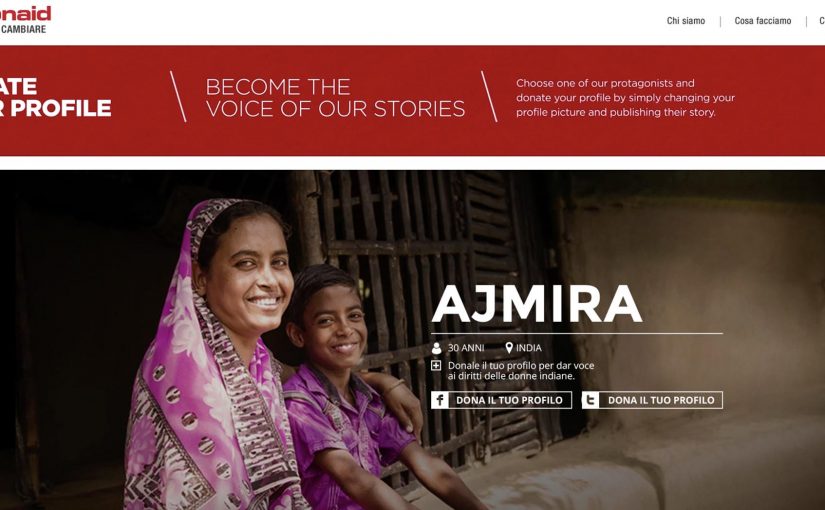
To communicate the broader work of ActionAid with a small media and production budget, DLV BBDO created “Donate Your Profile”. Participants donated their Facebook and Twitter profile pictures so that awareness could be generated for the stories of people ActionAid helped.

How “Donate Your Profile” worked

The mechanism is a simple identity swap. People hand over the most visible square in their social presence. Their profile photo. In return, they display a campaign image tied to a real person’s story, so every comment, like, and share carries that story into everyday social traffic.

Support from Radio 105, Radio Deejay, La Stampa, Marc Marquez and other Italian celebrities and brands helps normalise the behaviour. Once well-known accounts participate, the “donate your picture” action looks safe, easy, and socially endorsed.

In Italian cause marketing, borrowing social identity can outperform paid media when budgets are tight, because it turns personal networks into distribution.

The real question is how to turn a low-budget act of support into something people carry through their normal social behaviour.

Why the profile swap spreads

This works because it converts passive support into a visible, persistent signal. A profile picture is not a post that disappears in a feed. It is a durable badge that travels wherever you show up online, and it prompts questions that naturally lead to explanation and sharing.

Extractable takeaway: If you need earned reach without heavy spend, move the call to action from “share a post” to “change a default”. When people change a default surface, the campaign rides along with their normal behaviour.

The reported impact

The project was described as becoming the 5th most trending topic on Twitter and generating over 79 million media impressions, with more people joining in as the support network grew.

What to borrow from the profile-swap pattern

  • Pick a high-frequency surface. Defaults like profile photos travel more than one-off posts.
  • Make the action reversible. People participate faster when the commitment feels temporary.
  • Seed with credible partners. Media brands and recognisable faces reduce hesitation.
  • Turn participation into a conversation starter. The best mechanics invite questions, not just clicks.

A few fast answers before you act

What is “Donate Your Profile”?

It is a campaign where people replace their Facebook and Twitter profile pictures with a campaign image, so ActionAid stories gain awareness through everyday social interactions.

Why use profile pictures instead of posts?

A profile picture is persistent and high-visibility. It shows up repeatedly across comments and interactions, so the message travels without requiring constant re-posting.

How did the campaign scale beyond early participants?

Reportedly through support from media brands and celebrities, which makes the behaviour feel normal and increases follow-on participation.

What results were reported?

Reported results included reaching the 5th most trending topic on Twitter and generating over 79 million media impressions.

What is the main risk with this pattern?

Trust. If people are unclear about what is being changed, for how long, and what they are authorising, participation drops. The exchange must be transparent and easy to undo.

Starbucks: Tweet a Coffee

Starbucks: Tweet a Coffee

In March 2012, Amex card members could sync their credit cards with their Twitter account, then re-tweet offers to load them onto their card. Fast forward to 2013 and Starbucks USA is allowing customers to “Tweet a Coffee”.

In the current beta version, the first 100,000 US-based customers can tweet $5 Starbucks Card eGifts to Twitter friends and followers. All it takes is linking your Starbucks and Twitter accounts, then tweeting @tweetacoffee to @TheirNameHere.

A checkout moment that looks like a message

The mechanism is account linking plus a structured tweet. The tweet becomes the purchase trigger, and the recipient receives a redemption flow that feels like a social interaction rather than an ecommerce checkout. Because the purchase trigger lives inside a normal message action, it reduces steps, which is why the gifting moment feels unusually low-friction.

In US consumer retail and payments ecosystems, this kind of channel integration turns gifting into a low-friction habit that rides on existing identity and loyalty rails (the linked accounts and stored-value programs customers already use).

The real question is whether your payment flow can hide the transaction inside a native social action without losing control of redemption and risk.

Why it lands

It compresses generosity into a familiar behavior. You do not have to open an app, browse, or remember an email address. You just use the interface you already use to talk to people. The “$5” constraint also matters. It is small enough to be spontaneous, but concrete enough to feel real. This is the better starting pattern for social payments because it keeps the action familiar while keeping the value transfer explicit.

Extractable takeaway: If you want social commerce to scale, make the transaction look like native social behavior, then constrain the first use case to one simple, giftable unit with an obvious price point.

Patterns to borrow for social payment experiments

  • Start with gifting, not buying. Gifting has a built-in emotional reason to happen, which reduces the need for persuasion.
  • Make the trigger public, keep the redemption controlled. The tweet creates visibility. The redemption link manages fraud, fulfillment, and policy.
  • Use a single, repeatable format. One command pattern makes it easy to learn and easy to copy.
  • Design for “small yes” transactions. Low-value, high-frequency gifts teach the habit without asking for big trust on day one.

A few fast answers before you act

What is “Tweet a Coffee” in one line?

It lets eligible Starbucks US customers send a $5 Starbucks Card eGift to someone on Twitter using a structured tweet after linking accounts.

Why is gifting the right first use case for social payments?

Because it has a clear social motive and a clear recipient. That reduces friction compared to asking people to buy something for themselves in a new way.

What makes this different from a promo code tweet?

The tweet is not just marketing. It triggers a real value transfer, and the recipient experiences it as a personal gift rather than an offer broadcast.

What is the minimum pattern to copy without relying on Twitter?

Use an identity-linked account, a simple public trigger that looks native to the channel, and a controlled redemption step that protects fulfillment and policy.

What is the biggest risk when brands copy this idea?

Trust breakdown. If account linking feels heavy, or if redemption feels spammy or unreliable, users will abandon the flow and may blame the brand rather than the platform.

KPT/CPT: Smileball

KPT/CPT: Smileball

Since June 2010, I had seen smile detection technology used in vending machines and Facebook apps to create innovative engagement with target audiences.

Now, in this example, KPT in Switzerland decides to show that it has the happiest health insurance clients. To demonstrate that, they create Smileball, a pinball machine controlled by smiles.

Unlike normal pinball machines where the two paddles are controlled by buttons on either side, Smileball uses motion sensing technology to detect changes in a person’s smile and map that input to the respective paddles. By playing the game, participants get a chance to win a trip to a comedy show in New York.

A pinball machine that rewards the emotion it wants

The twist is that the game cannot be mastered by tense concentration. You need to keep smiling. That forces the behavior the brand wants to claim, and it makes the proof visible to anyone watching, because the input is literally on the player’s face.

How the mechanism works

The machine replaces buttons with a camera-based smile input. Smile more on one side and the corresponding flipper becomes easier to trigger. Relax your face and you lose precision. The interface quietly trains you into the brand message through play, not persuasion.

In Swiss health insurance marketing, turning an intangible promise like “happier customers” into a visible, shared moment can outperform any satisfaction statistic.

The real question is whether the interface makes a soft brand claim believable in public.

Why it lands

It is self-explaining, socially contagious, and it creates a public demonstration loop. People walk up because it is a pinball machine. They stay because it behaves differently. The crowd laughs because the control method is human and slightly absurd. In the end, the player’s smile becomes the performance, and the brand gets credit for orchestrating it.

Extractable takeaway: If your proof point is an emotion, design an interaction where that emotion is the input. When the audience can see the input in real time, the claim stops sounding like marketing.

What health brands can steal from Smileball

  • Make the proof visible to bystanders. Spectators are your free distribution channel.
  • Replace a standard control with a brand-relevant one. The control method is the message.
  • Keep the first 10 seconds obvious. If people do not “get it” instantly, they will not try.
  • Add a lightweight reward. A prize gives hesitant people a reason to step up.

A few fast answers before you act

What is Smileball?

A pinball machine where the flippers are controlled by changes in the player’s smile instead of physical buttons.

Why is smile-based control a strong branding choice for a health insurer?

Because it turns “happy customers” into a visible behavior. The player’s smile becomes proof in the moment, not a claim in copy.

Does this store or profile people’s faces?

The campaign is presented as in-the-moment smile detection used only to control the game interface. No storage or profiling is described in the original framing.

What is the biggest risk in executions like this?

Calibration. If the smile detection feels inconsistent, people assume the game is rigged and the experience collapses.

How could a brand apply this pattern without face-based input?

Keep the principle. Make the brand’s desired behavior the control input, then make that input visible so the claim proves itself in public.