
Go Vote: Or You Let Others Decide

Go Vote: Or You Let Others Decide

An integrated experience-based campaign was created by DDB Budapest on behalf of the Hungarian Democracy to support the 2010 Hungarian elections.

Instead of relying only on posters and TV spots, the idea is built around lived moments that make one point unavoidable: if you do not vote, you still get an outcome. You just did not choose it.

When “apathy” becomes something you can feel

The line “go vote, or you let others decide for you” is easy to agree with in theory, and easy to ignore in practice. The creative move here is to stop arguing and start staging: put people into situations where “someone else decides” is no longer an abstract civic warning, but an immediate, personal experience.

The mechanic: make the consequence tangible

The campaign uses real-world experiences as the delivery system. The experience is the message: you lose control when you opt out. That emotional truth lands faster than any rational explanation of why voting matters.

In public-interest communication, experience-led campaigns often work best when they translate a distant consequence into a simple, physical moment.

Why it lands: it reframes voting as self-protection

Many turnout messages talk about duty. This approach talks about ownership. The real question is not whether people agree that voting matters, but whether the campaign makes the cost of opting out feel personal enough to trigger action. The stronger strategy is to make non-participation feel immediate, not just irresponsible. It positions voting less as a moral obligation, and more as the minimum action required to keep your right to choose.

Extractable takeaway: If you need mass behavior change, do not just explain the benefit. Stage a short, memorable moment that lets people experience the cost of inaction. When the cost feels personal, the call-to-action becomes easier to act on.

The intent: turnout through a stronger trigger than guilt

The business of any election participation push is motivation. This work is a reminder that motivation does not need to be inspirational. It can be visceral. A compact experience can achieve what a long message cannot: it creates a story people retell, and that story carries the prompt forward.

What to steal for your own participation campaign

  • Start with a single, sharp sentence: one idea, no debate, no footnotes.
  • Translate the idea into an experience: let people feel the message before you ask them to act.
  • Keep it non-partisan by design: focus on participation, not outcomes or parties.
  • Make it retellable: if someone can describe it in one line, it will travel further.
  • Reduce the distance to action: the closer the experience sits to the voting moment, the stronger the conversion.

A few fast answers before you act

What kind of campaign is this?

It is a get-out-the-vote public awareness campaign that uses real-world experiences to dramatize the idea that non-participation still produces outcomes.

Why use experiences instead of just ads?

Because experiences create emotion, memory, and conversation quickly. They can make an abstract civic point feel immediate and personal.

How do you keep a turnout campaign non-partisan?

Keep the message focused on participation, avoid references to parties or policies, and design the experience around the universal right to choose.

What should you measure for effectiveness?

Reach and recall are basics. More useful are participation rates in the experience, social sharing, earned media pickup, and any localized uplift signals available near the activation footprint.

When can this approach backfire?

If the experience feels humiliating, unsafe, or coercive, it can trigger resentment. The best versions create urgency without disrespecting the audience.
Germanwings: Planemob at 30,000 Feet

Germanwings: Planemob at 30,000 Feet

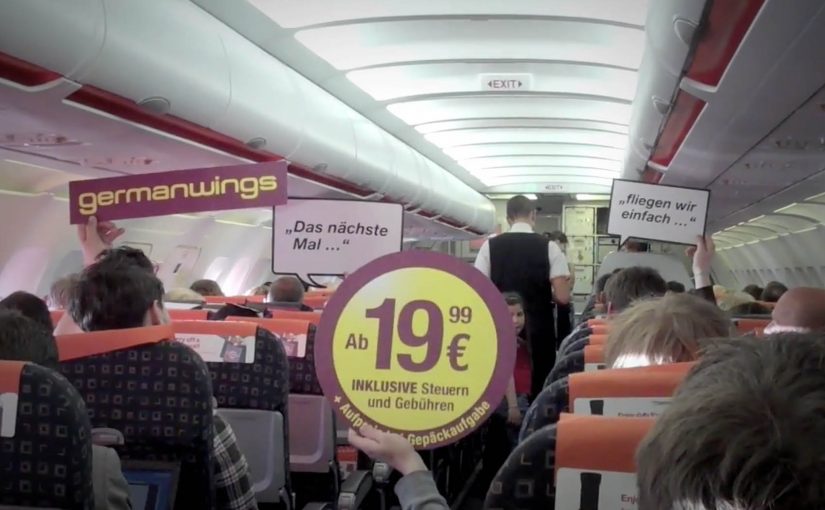
Five creatives board a competitor’s flight with nothing but cardboard signs, a camera, and a plan. At cruising altitude, they run a “planemob” in the aisle. In practice, that means a flashmob-style brand stunt staged on a plane and filmed to travel later as content. The cabin becomes the set, and the passengers become the audience.

A brand comparison staged where the problem happens

The idea is credited to Lukas Lindemann Rosinski in Hamburg. The stunt is described as taking place on a rival low-cost carrier flight, and it uses the rival’s own boarding and seating dynamics as the backdrop for the message.

The execution is deliberately low-tech. A small group reveals a sequence of placards that make a simple point about “quality” versus the small annoyances of no-frills flying, especially the chaos that comes with free seating when groups try to sit together.

The mechanic: hijack the moment, not the media

This is guerrilla advertising in the literal sense. Instead of buying more airtime, the campaign borrows a moment that already has full attention: passengers strapped in, phones out, and nothing else to do.

That works because the stunt captures attention at the exact moment the irritation is most legible, so the comparison feels less like copy and more like proof.

Filming the stunt is not an afterthought. It is the distribution strategy. The onboard moment creates the story, and the video carries it to everyone who was not on the plane.

In European low-cost aviation, brand promises live or die on small frictions that frequent flyers feel immediately.

Why it lands: it turns irritation into proof

Most airline positioning stays abstract because the product is hard to “show” in a single line. Planemob goes the other way. It demonstrates the promise by contrasting it against a situation passengers recognize without explanation. This is smart brand theatre because the proof arrives inside the passenger experience instead of sitting above it as a slogan.

Extractable takeaway: If your differentiator is a reduction of friction, stage the proof inside the friction. Do it in a setting where the audience is already feeling the problem, and keep the message simple enough to travel as a clip.

The business intent: earned attention that outlives the flight

The immediate audience is small. The real audience is everyone who sees the video afterwards. That’s the trade. A short, high-constraint performance buys a longer, shareable narrative, and it tends to get discussed precisely because it happens “in real life” rather than inside a media slot.

The real question is whether a tiny live audience can trigger a much larger story once the moment is filmed and shared.

Award listings also suggest the work gained industry recognition, including a Spotlight Festival Gold in web & mobile categories for “Planemob”.

What to steal for your next guerrilla moment

  • Exploit a captive moment ethically: pick a context where attention is naturally high and interruption is minimal.
  • Use props that read instantly: big typography, one point per beat, no cleverness that needs a caption.
  • Build the distribution into the idea: if it does not work as a video, it does not scale.
  • Anchor the claim in a felt pain point: “quality” lands when it maps to a concrete irritation people already know.
  • Keep the crew small: constraints make it believable, and believability is the fuel for sharing.

A few fast answers before you act

What is a “planemob”?

A planemob is a flashmob-style stunt staged on an aircraft, designed to create an attention-grabbing in-flight moment that can be filmed and shared as a campaign video.

Why does this count as guerrilla marketing?

Because it uses a real-world environment and a minimal set of materials to generate earned attention, rather than relying primarily on paid media placements.

What is the core persuasive trick in this execution?

It connects the brand claim to a situation passengers have experienced. The message feels like evidence because it is delivered inside a recognizable pain point.

What should you watch out for if you copy this approach?

Operational risk and brand risk. You need a concept that is safe, respectful to bystanders, and strong enough to survive without heavy explanation. If it needs a long caption, it will not travel.

How do you measure success for this kind of stunt?

Video reach and completion rates are the baseline. More meaningful signals include press pickup, share-to-view ratio, branded search lift, and whether the stunt strengthens a specific product attribute in brand tracking.