Augmented toys and games from Toy Fair 2013

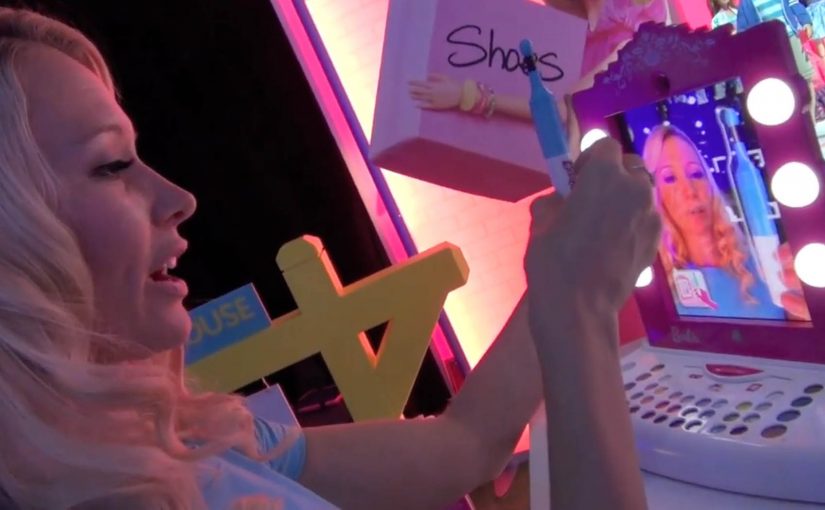
A Barbie vanity frame turns an iPad into a make-up mirror, then “virtual lipstick” stays aligned to a moving face in real time. That single mechanic explains why Toy Fair in New York suddenly feels like a preview of hybrid play, where the screen becomes a window and the physical object remains the star.

Most of the standout demos share the same blueprint. A physical toy, book, or playset provides the anchor. The iPad app provides the content layer. The camera feed stitches the two together so kids can touch, move, build, and explore while the digital layer reacts.

In consumer product innovation, the most scalable mixed reality experiences treat the device as a lens onto the room, not the destination.

Augmented reality (AR) toys are physical products that use a phone or tablet camera to overlay digital characters, effects, or instructions onto the real-world toy. The toy stays central. The app adds feedback, rules, and story without replacing hands-on play.

Why these “phygital” toys land

Parents get a familiar promise. Less passive viewing and more active play. Kids get something that feels like magic because it responds to the real world, not just taps on glass.

From a design perspective, the winning pattern is low-friction onboarding and immediate payoff. Put the device in the frame, scan the page, point at the ball, then something delightful happens fast.

The Toy Fair shortlist

Barbie Digital Makeover Mirror

Lets kids try out make up while avoiding all the mess. The iPad camera tracks a face in real time so the “makeover” sticks as the head moves.

Mattel Disney Princess Ultimate Dream Castle

Billed as a first mass-market doll house to support augmented reality, with app-triggered activities layered onto the physical rooms.

Popar 3D Books

A line of children’s books that use AR to make pages “come alive” with virtual 3D objects and animations that appear to pop off the paper.

Sphero Ball and Sharky the Beaver

Billed as the first app ever to let you take a virtual 3D character for a walk around your house. The physical ball becomes the anchor for an on-screen creature you “walk” around the room.

Imaginext Apptivity Fortress

Combines playset and app play in one, with the iPad physically inserted into the fortress so the device becomes part of the toy and the adventures unfold around it.

NeuroSky

Brain waves control furry ears.

Lego Mindstorms EV3

User-created robots that can be controlled by various sensors and smartphones.

Cubelets

Magnetic blocks that snap together to make an endless variety of robots with no programming and no wires. The “logic” is in how you combine the cubes.

Sifteo Cubes

A magical interactive game system built on the timeless play patterns of LEGO, building blocks, and domino tiles, but with screens and sensors inside each cube.

What to steal if you are designing interactive products

  • Make the physical object the controller. When hands are busy, attention stays in the room.
  • Design for instant delight. The first 10 seconds should prove the concept without instructions.
  • Use the camera as a sensor. Anchors, markers, and recognizable shapes are a simple bridge between atoms and pixels.
  • Plan for replay. New levels, new stories, and collectible content keep the “magic” from wearing off after day one.

A few fast answers before you act

What is an AR toy in simple terms?

An AR toy is a physical toy, book, or playset that becomes more interactive when viewed through a phone or tablet. The camera feed shows the real object, and the app overlays digital characters, effects, or instructions on top.

Do these experiences replace “screen time”?

Not really. They redirect it. The screen becomes a lens onto physical play, so the child is moving, building, and exploring while the digital layer reacts.

What is the most repeatable pattern across the examples?

A physical anchor plus an app-based content layer. The physical piece gives tactile play and structure. The app provides animation, rules, progression, and feedback.

What should a brand learn from this wave of toy innovation?

Interactivity scales when the physical product is useful on its own, and the digital layer adds meaning rather than acting as a required destination. The best experiences feel like an upgrade, not a dependency.

What is a common failure mode for “phygital” concepts?

Too much setup and too little payoff. If the experience needs long instructions, special lighting, or frequent recalibration, the magic breaks fast and replay drops.
Track My Macca’s: Supply Chain Transparency

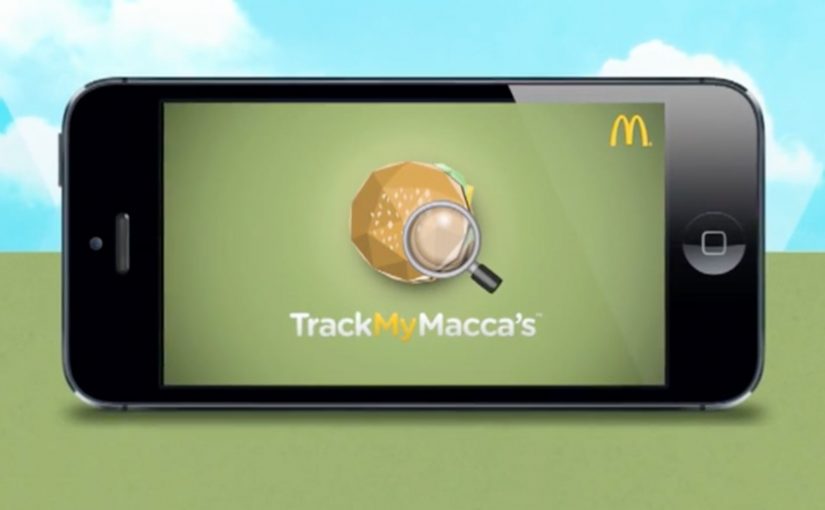
McDonald’s in Australia decided to use technology to tackle one of its biggest problems, the disbelief that its ingredients are fresh, locally sourced and of decent quality. So with image recognition, GPS, augmented reality and some serious integration with its supply chain, they put together a full story behind every ingredient people came across while buying food at McDonald’s.

The real challenge: trust, not awareness

This is not a campaign built to shout louder. It is built to answer the skeptical question that sits in the customer’s head at the moment of choice: “Is this actually fresh, and where did it come from”.

Instead of responding with claims, it responds with traceable context. Ingredient by ingredient.

Why the tech stack matters only if it is integrated

Image recognition, GPS, and augmented reality are the attention layer. The credibility layer is the supply chain integration. Without that, the experience would be a glossy story. With it, the experience becomes proof.

  • Image recognition. Identify what the customer is looking at or buying.
  • GPS. Connect the experience to location and local sourcing claims.
  • Augmented reality. Make information feel immediate and tangible in the buying moment.
  • Supply chain integration. Ensure the “story” maps to real sourcing and logistics data.

What makes this a strong model for brand transparency

Transparency only works when it is easy. People will not dig through PDFs or corporate sustainability pages while they are ordering lunch.

This approach brings the information to the moment and to the object. It reduces friction and increases believability.

What to take from this if you run CX, MarTech, or operations

  1. Start with the objection. The customer’s doubt defines the experience.
  2. Proof beats promise. If you want trust, show traceability, not slogans.
  3. Integrate the system of record. Experiences that depend on trust must connect to operational data.
  4. Design for the moment of choice. The best transparency is delivered exactly when people need it.

A few fast answers before you act

What is “Track My Macca’s”?

It is a McDonald’s Australia initiative that uses mobile technology to show a story behind ingredients, aiming to build trust in freshness, local sourcing, and quality.

Which technologies were used?

Image recognition, GPS, augmented reality, and strong integration with McDonald’s supply chain to connect the experience to real sourcing and logistics.

Why is supply chain integration the critical piece?

Because the experience depends on credibility. Without operational data behind it, the story would feel like marketing. With it, it can function as proof.

What customer problem does this solve?

It addresses disbelief about ingredient freshness and quality by making provenance and context visible at the point of purchase.

What is the transferable lesson for other brands?

If trust is your barrier, design transparency into the customer journey and connect it to your systems of record, so the experience can stand up to scrutiny.

Jameson Irish Whiskey: Blippar Space Invaders

Outdoor ads that turn into a game

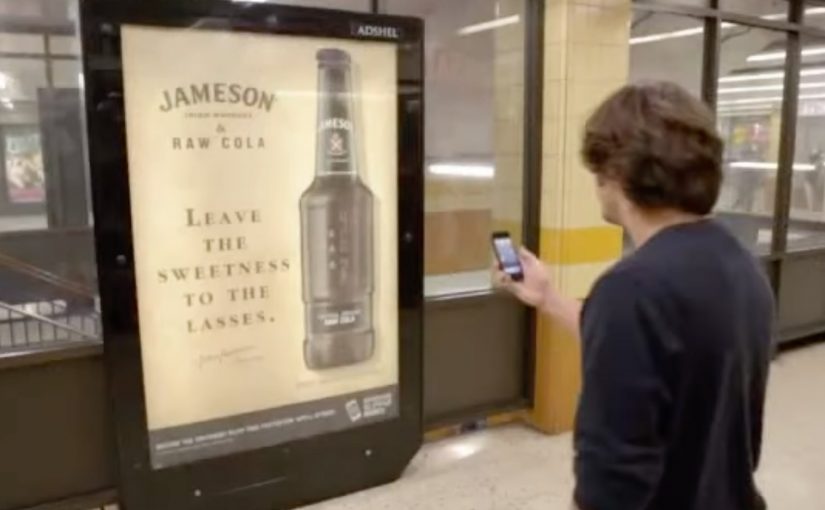
Jameson Irish Whiskey recently launched a huge outdoor campaign, teaming up with augmented reality specialist Blippar for image recognition technology.

People with the Blippar app could scan any Jameson Irish Whiskey ad or bottle and immediately get immersed in a Jameson Irish Whiskey version of Space Invaders.

How the Blippar scan-to-play mechanic worked

The mechanism was straightforward. A phone camera scan triggered Blippar’s image recognition. That recognition launched an interactive AR experience on the device.

In practice, the physical media became the “portal”. The ad or bottle was the entry point. The phone was the display and controller. The game was the reward.

Why it landed, and where the interaction could be smoother

The win is immediacy. Scan and you are inside the brand world without a long setup. That kind of instant payoff makes an outdoor poster feel alive rather than static.

After playing the game myself, I found it would have been a better experience if they had allowed viewer control through tilting the phone around, instead of non stop tapping at the screen. However, it is still good to see more brands innovating like this.

What the brand was really buying

This was not just about novelty. It was about extending an outdoor campaign into a personal, interactive moment that people could not get from a standard print execution.

The intent was clear. Increase attention time. Add talk value. Create a reason to engage with the bottle and the ads beyond the first glance.

What to steal for your next AR activation

  • Make the entry point universal. “Scan any ad or bottle” reduces friction and increases participation.
  • Reward immediately. If the scan does not pay off fast, the experience loses the environment it depends on.
  • Design the controls for comfort. Favor natural motion and simple gestures over repetitive tapping when sessions run longer than a few seconds.
  • Use AR to earn time, not impressions. The value is the extra seconds of focused attention, not the novelty headline.

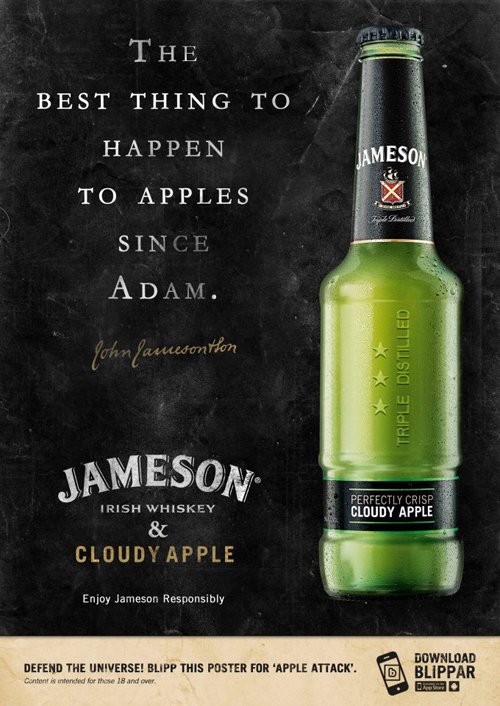
If you would like to give it a try, download the Blippar app on your smartphone and scan the below bottle to start playing.

Jameson Irish Whiskey


A few fast answers before you act

What was Jameson doing with Blippar?

They used Blippar’s image recognition so people could scan Jameson ads or bottles and launch an interactive AR game experience on a smartphone.

What was the core mechanic?

Scan the physical creative with the Blippar app. The scan triggers recognition. The phone immediately launches the game.

Why does scan-to-play work well for outdoor advertising?

It turns a passive glance into an active moment. The ad becomes a portal to content that holds attention longer than print.

What interaction improvement could make this smoother?

More natural viewer control, such as tilting the phone, can reduce fatigue compared to continuous tapping during gameplay.

What is the main takeaway for brands?

Use AR to earn time and engagement by delivering an immediate reward, and make the control scheme comfortable enough to sustain play.