
Budweiser: Poolball, football on a pool table

Coming to a Buenos Aires pub near you is the newly minted sport of Poolball, created by Ogilvy Argentina for Budweiser.

Two teams meet on a giant 7×3 meter pool table. Fifteen soccer balls are reskinned to look like pool balls. The competitors use their feet instead of cues to score.

A new bar sport with a brand stitched into it

Poolball takes two things that already belong in the same evening. Football and beer. Then it adds a third. The “I could play that” simplicity of pool. The result feels less like a stunt and more like a playable product.

Extractable takeaway: Poolball is a brand activation that fuses two familiar games into one instantly understandable format, so people stop watching and start participating without needing instructions.

The mechanic: one rulebook, two rituals

The mechanic is the entire idea. A pool table scaled up to human size. Pool-ball visuals on footballs. Pool rules translated into foot play. When the mechanic is this legible, the content is self-explaining and the crowd becomes the amplification layer.

BTL is often used as shorthand for below-the-line activity. In practice, it means a brand experience designed to be felt in the real world, then shared because it is worth retelling.

In busy city bars and event spaces, the formats that spread fastest are the ones everyone can read at a glance.

Why it works in a pub

Bar-friendly activations win when they create quick status moments. You either played it, you watched someone nail a shot, or you filmed the chaos. Poolball naturally creates all three, because every “pocket” attempt is a mini highlight.

It also lowers the risk of participation. You are not learning a new sport. You are remixing two you already know, with rules you can copy by watching one play.

The intent behind the fun

The real question is whether your activation is a game people still want to play when the camera is off.

Budweiser is not selling a feature here. It is selling association. Big-game energy. Competitive banter. Social proof that the brand belongs in the centre of group nights out.

When the game is branded but not fragile, the brand becomes the host of the experience rather than the interruption inside it.

Poolball patterns worth stealing

  • Fuse, don’t invent. Combine two known behaviours so the audience understands the format instantly.
  • Make the object the media. A giant playable artefact beats a screen when your goal is participation.
  • Design for highlights. Build in repeatable “shot” moments people want to film and replay.
  • Keep rules visible. If someone can learn it by watching one round, you have the right complexity level.
  • Let branding be structural. Brand the experience itself, not every surface area with logos.

A few fast answers before you act

What is Poolball?

Poolball is a branded game format that combines football and pool. Players kick footballs designed like pool balls on a giant pool table and score using pool-style goals.

Why does this kind of activation travel well across venues?

Because it is easy to understand, easy to spectate, and it produces repeatable highlight moments. Venues like it because it creates crowd energy. Brands like it because the crowd documents it.

What makes the mechanic “shareable” without forcing sharing?

The visual contrast does the work. A human-scale pool table and “pool ball” footballs create an immediate “what is that” reaction, so filming feels natural rather than incentivised.

How do you keep a branded game from feeling like a gimmick?

Make it genuinely playable. Simple rules. Clear scoring. Quick rounds. If the experience is fun without the brand name, the brand credit comes for free.

What’s the minimum viable version of this idea?

A single hybrid rule, one striking physical cue, and one repeatable scoring moment. If people can explain it in one sentence, you have the right foundation.
Andes Beer: Friend Recovery

Following the success of the Andes Teletransporter in 2009, and its reported Grand Prix win at the 2010 Cannes Lions festival, Andes, the No. 1 beer from Argentina’s Andean region, is back with another invention designed to keep friends together for longer.

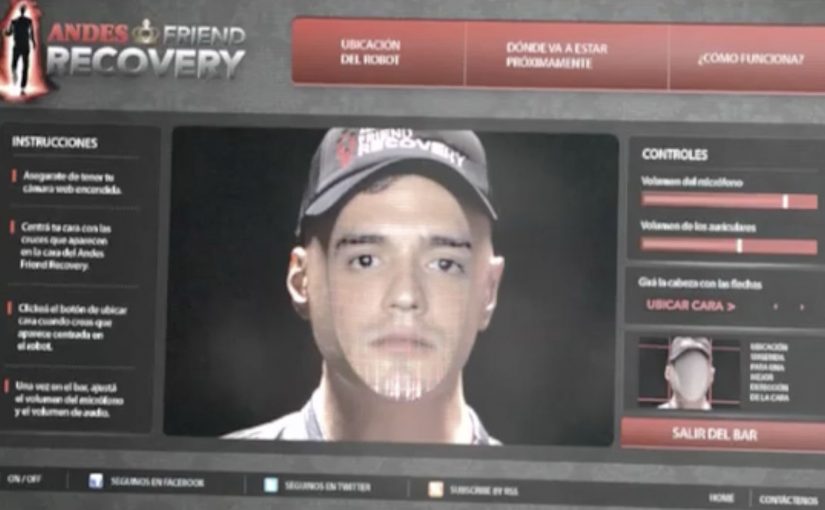
Andes Friend Recovery (AFR) is a telepresence robot with human features, installed in key bars in Mendoza. The pitch is deliberately simple. You can be “present” at the bar with your friends while still being physically somewhere else, taking care of whatever obligations pulled you away.

A bar table that comes with a remote seat

The mechanism is a dedicated AFR table in a bar, plus a robot that becomes your stand-in. Your friends start the session at the table. You authenticate remotely, map your face via webcam, and your live presence appears at the bar through the robot.

This is a physical version of “status update.” Instead of telling friends you will join later, you join now, with viewer control over a real viewpoint and a real conversation happening in real time.

In social, venue-led categories, the easiest growth lever is reducing the friction that ends the occasion early.

The real question is whether you can make “I can’t make it” feel like a solvable problem at the table, not a polite apology in a text thread.

Why the trick works

The appeal is not robotics. It is social continuity. AFR treats friendship as an appointment you should not have to cancel just because you are temporarily stuck elsewhere, and it makes the solution tangible enough to demo in one minute. Because the mechanism turns absence into a visible, physical stand-in, the group gets a concrete reason to keep the occasion going instead of wrapping it up.

Extractable takeaway: When your brand benefit is “more time together,” do not talk about it in slogans. Build a mechanism that removes the one blocker that ends the moment, then make that mechanism visible and easy to explain so people spread it for you.

How it works

  1. Your friends go to a bar and sit at the Andes Friend Recovery table.
  2. They ask for a password which is sent to you via an SMS, while you fulfil your boyfriend duties.
  3. Wherever you are you log in to the AFR page and use the webcam to map your face.
  4. Then you appear at the bar via the Andes Friend Recovery robot.

The numbers the case story leans on

AFR is described as being installed across major bars in Mendoza during October and November 2010. In that period, the campaign is reported to have driven over 2 million website visits, with around 5,000 “recovered” friends.

Friend Recovery moves worth borrowing

  • Remove the exit friction. Target the one blocker that ends the occasion early, then design the experience to neutralize it.
  • Make the mechanism instantly demoable. If the benefit is “more time together,” a visible, one-minute explanation travels further than a slogan.
  • Keep the framing playful. Anchor the joke in friendship and social continuity, not in teaching deception, so the stunt does not backfire.

A few fast answers before you act

What is Andes Friend Recovery?

It is a bar activation using a telepresence robot so a person can appear at a bar table remotely via webcam while being physically somewhere else.

What is the core mechanic that makes it feel “real”?

Two-way presence. Your face and voice show up at the table, and your friends interact with a physical avatar in the bar, not just a chat window.

Why does this count as experiential marketing, not just a film idea?

Because the primary value is delivered by a real installation in real bars. The video is the distribution layer, but the product is the experience.

What makes a stunt like this risky for the brand?

Tone and social framing. If it feels like a “how to lie” tutorial, it can backfire. It works best when it stays in playful exaggeration and focuses on friendship, not deception.

What should you measure if you try a “remote seat” activation?

Track whether the mechanism extends time together (session length and repeat use) and whether the demo travels (views, shares, and visits), then compare results to normal nights without the installation.

TyC Sports: Argentinos

As the 2010 World Cup kicks off, this TyC Sports film by Young & Rubicam Buenos Aires is built to do one thing fast: stir up Argentine fans everywhere with a burst of identity, memory, and belief.

A World Cup rally film is a piece of sports storytelling designed to compress national pride into a repeatable emotional cue. It is less about information and more about turning viewers into a synchronized audience.

A simple mechanism: recognition, then escalation

The structure is familiar and effective. Start with the small details only insiders recognize. Then scale up into a collective “we”. The film keeps pulling the viewer from personal belonging into shared momentum, so the emotion arrives before the rational brain asks what is being sold.

In global sports media and broadcaster marketing, pre-tournament films like this work best when they feel like culture, not advertising.

Why it lands for Argentine fans worldwide

The spot trades on lived cues. The way people speak about football. The intensity. The inevitability of hope. You do not need to explain Argentina’s relationship with the game. You only need to trigger it, and let the audience do the rest. That is also why the film travels. Fans abroad are exactly the audience most hungry for a cultural tether during a tournament, so the message plays as connection as much as hype.

Extractable takeaway: If you can trigger a specific shared-identity cue, the audience will supply the meaning and momentum without you having to over-explain it.

The business intent behind the emotion

For TyC Sports, the goal is not to educate. It is to concentrate attention and loyalty at the moment the tournament starts, when viewing habits and media choices are being formed. The film frames the channel as the emotional home for the campaign, not just the place that carries matches.

The real question is whether you can earn the role of emotional home at kickoff, not just distribute the content.

Steal the rally structure for your next fan-led campaign

  • Build from insider truth. Specificity creates belonging faster than generic patriotism.
  • Make it chantable. The best sports films reduce to a line or feeling people can repeat.
  • Escalate from personal to collective. Start in the individual, end in the crowd.
  • Keep the brand role clean. If you are a broadcaster, act like a rally point, not a sponsor.

A few fast answers before you act

What is this film doing in one sentence?

It rallies Argentine fans worldwide by turning cultural recognition into shared tournament momentum for TyC Sports.

Why do pre-tournament films outperform match promos?

They create emotional commitment before viewing decisions harden. They make people choose a “home” for the tournament.

What makes sports patriotism feel authentic instead of generic?

Specific cultural cues and language that insiders recognize. The more precise the truth, the less it feels like advertising.

Who is the most valuable audience for this type of spot?

Fans who are not physically in the country. They are most likely to share, and most likely to use the film as a cultural tether.

What is the biggest creative risk with rally films?

Drifting into clichés. If the cues are too broad, it becomes interchangeable with any other team’s hype video.