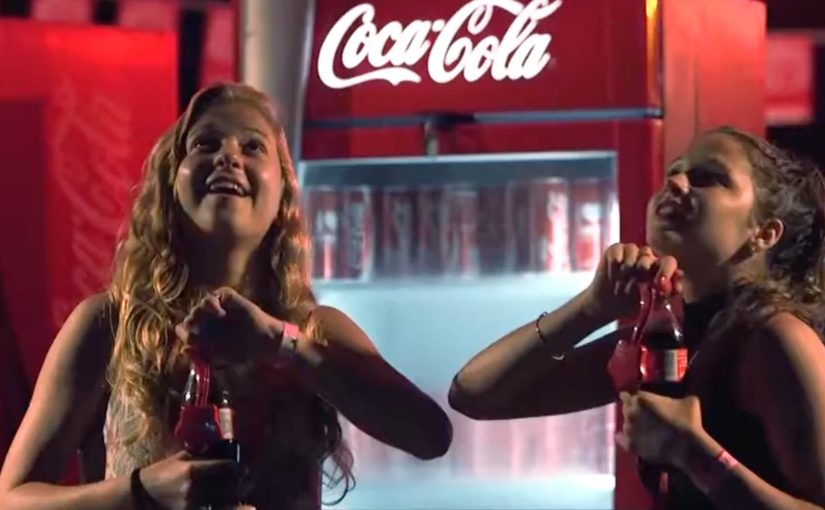
At Coca-Cola Summer Love 2015, a camp-like teen event held each year in Ganei Huga, Israel, Coca-Cola creates a moment that feels like magic. A teenager opens a special bottle, and a shooting star appears in the sky.
The mechanism is built into the packaging. Working with Gefen Team and Qdigital, Coca-Cola equips special bottles so that opening one sends a Wi-Fi signal to one of three drones. The selected drone flies up to around 1,000 feet and releases a firework that resembles a shooting star.
In live brand experiences for consumer brands, connected packaging works best when the trigger and the payoff happen in the same moment and the same place.
Why this is more than a stunt
This is a clean example of connected packaging used as an experience trigger. Here, “connected packaging” means the pack can detect a real action and trigger a response beyond the product itself. The bottle is not a container for a message. It is the switch that activates the experience. That makes the brand action feel causal and personal, because the spectacle happens at the exact moment of interaction. Connected packaging is worth doing when the payoff is instantly visible. The real question is whether the product can trigger a moment people would still want to share without needing an explanation.
Extractable takeaway: If you want a tech-enabled brand moment to feel personal, put the trigger in a familiar gesture and make the consequence show up immediately in the environment.
The pattern to steal
- Put the trigger in the product. The experience starts when the customer does something real, not when they scan a poster.
- Make the payoff visible. A shooting star in the sky is instantly understood, even without explanation.
- Design for shared proof. Spectacle that happens above a crowd is naturally recorded, talked about, and replayed.
A few fast answers before you act
What is Coca-Cola “Wish in a Bottle”?
A Coca-Cola Israel activation where opening specially made bottles triggers drones to launch fireworks that resemble shooting stars.
Where does it take place?
During Coca-Cola Summer Love 2015, a teen event held in Ganei Huga, Israel.
How does the trigger work?
Opening a bottle sends a Wi-Fi signal to one of three drones, which then flies up and releases a shooting-star-style firework.
What is the core experience design idea?
Use connected packaging to turn a normal consumption moment into a visible, shareable experience that feels personally triggered.
Why does it feel personal instead of promotional?
The spectacle happens exactly when someone opens the bottle, so the crowd reads it as a consequence of a real action, not a timed show.
When is connected packaging the wrong approach?
If the trigger is unreliable or the payoff is delayed, invisible, or hard to explain, the tech becomes a distraction instead of a meaningfully triggered moment.