
VW GTI Banner Race: Chase a Car Across the Web

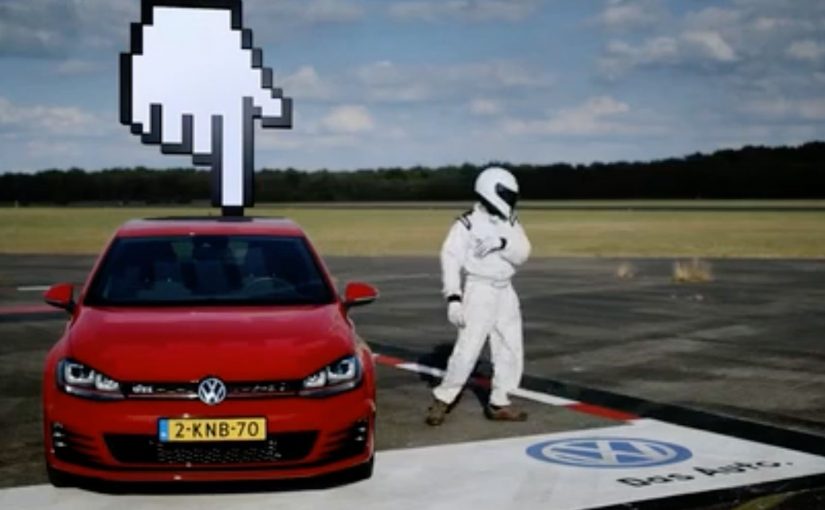
Volkswagen Netherlands set out to launch the new GTI in a way that feels fast before anyone even touches the accelerator. The result is an online race staged inside banner advertising, but mapped onto the physical logic of the real world.

Four popular Dutch websites are painted as the runway of an airport, each banner space measuring 20 metres wide and 25 metres long. On race day, 13th September, participants chase the GTI as it speeds through the banner spaces of each site. The person fast enough to catch the new GTI wins the car in real life.

When banners stop being static and start behaving like space

The mechanism is a reframing of banner advertising. Instead of isolated rectangles, the banners become connected terrain. Each site represents a segment of runway. Movement between banners creates the illusion of distance, speed, and progression.

The GTI does not just appear. It moves. And because it moves, the user has a reason to stay alert, react quickly, and treat the banner as something to engage with rather than ignore.

In European automotive launches, turning passive media into an environment with rules is often the fastest way to earn attention without buying more impressions.

Why speed and scarcity do the heavy lifting

This works because it borrows from racing psychology. There is a single target. There is a clear win condition. And there is scarcity. Only one person catches the GTI. That tension transforms passive browsing into a moment of competition.

Extractable takeaway: When you can make a product trait playable, set one clear target, one win condition, and one scarce outcome so attention becomes a self-sustaining loop.

The prize is not symbolic. Winning the actual car anchors the experience in reality, which prevents the activation from feeling like a disposable digital trick.

The intent: make the GTI feel alive online

The business intent is to translate the GTI’s performance DNA into a digital format. Speed, responsiveness, and thrill are not explained. They are simulated. The banner becomes a proxy for the car’s character. By “performance DNA” here, I mean the cues of speed, responsiveness, and thrill that people associate with a GTI.

The real question is whether your launch media can make the product trait felt in the first five seconds, not just described.

This is a better pattern than static launch assets when the brand promise is motion, because the interaction does the persuasion.

At the same time, Volkswagen demonstrates that standard media formats can still surprise when they are treated as systems instead of slots.

Patterns to borrow from the GTI banner race

  • Rethink familiar formats. Banners can be environments, not just placements.
  • Design for motion. Movement creates attention where static assets fail.
  • Use a real reward. Tangible stakes raise commitment instantly.
  • Connect experiences. Linking multiple sites turns reach into narrative space.
  • Encode the product DNA. Let the interaction mirror what the product stands for.

A few fast answers before you act

What makes this GTI launch different from a normal banner campaign?

The banners are connected into a continuous race environment, turning advertising space into gameplay instead of static exposure.

Why use an online race to launch a car?

Because racing instantly communicates speed and performance, which are core to the GTI identity.

Does this work without the prize car?

The experience would still be novel, but the real-world reward dramatically increases urgency and participation.

What role do partner websites play?

They become part of the environment. Each site is a segment of the runway rather than just a host for an ad.

What is the main takeaway for digital launches?

When you turn media formats into systems with rules and progression, people stop skipping and start playing.
Volkswagen Twitter Zoom

Tickets are scattered across São Paulo. A live city map sits online. Every tweet pulls the zoom closer. Volkswagen sponsors the Planeta Terra Festival, a major music event in São Paulo, as a way to bring its trendy car, the Fox, closer to the city’s youth.

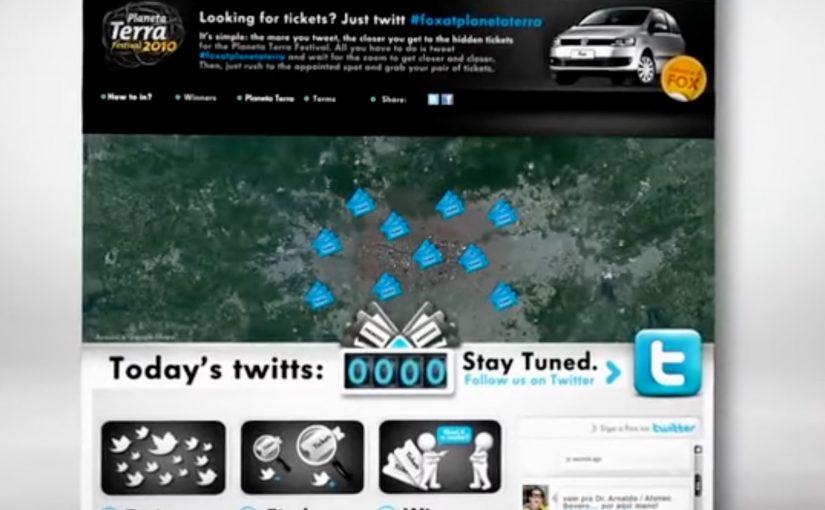
The challenge for AlmapBBDO is clear. Spread the Fox message beyond the festival walls, and reach youngsters across the entire city. The answer is Twitter Zoom. Twitter Zoom is a tweet-to-zoom scavenger hunt where hashtag volume progressively narrows a live map view toward a hidden target.

The real question is how you turn social participation into shared, visible progress that makes people act.

This kind of campaign only earns attention when the audience can see their action change the system.

First, a series of tickets is placed in different locations across São Paulo. Then a simple online platform launches with a Google Maps view of the entire city. The mechanic is straightforward. The more people tweet #foxatplanetaterra, the closer the zoom gets on the map. As the view tightens, the hunt becomes more precise. The first person to reach the ticket wins it. This runs for four days straight.

In large-city youth marketing, a shared, real-time progress indicator can turn social chatter into coordinated action.

Within less than two hours, #foxatplanetaterra hits Trending Topics in São Paulo, and it stays there for the full length of the competition.

Why this works

The loop is simple. Public participation produces visible progress, and visible progress invites more participation because everyone can watch the goal getting closer.

Extractable takeaway: When every audience action creates shared, visible progress, people keep participating and recruit others to accelerate the loop.

It turns social volume into visible progress

Most hashtags create noise with no payoff. Here, every tweet has a clear purpose. It moves the map. People can see the impact building in real time, and that visibility keeps the loop going.

It creates a city-wide scavenger hunt without complex rules

The instruction is easy to understand. Tweet the hashtag. Watch the zoom. Run. The simplicity makes it easy to join, explain, and share.

It makes the audience do the distribution

To win, participants need more tweets. That requirement naturally drives peer-to-peer sharing. The community scales the campaign because the community benefits from scale.

What to measure beyond impressions

  • Speed to momentum. How quickly the hashtag reaches a meaningful participation rate.
  • Unique contributors. How many distinct people tweet, not just total tweet volume.
  • Progress milestones. How many zoom stages are reached, and how long each stage holds attention.
  • Winner validation. Whether the “first to the ticket” outcome is trusted and replayed as a story.

Risks and guardrails that matter

  • Spam incentives. Volume mechanics invite low-quality tweeting. Add constraints or validation to protect credibility.
  • Platform dependency. If Twitter or the map experience glitches, the game breaks instantly.
  • Perceived fairness. If people doubt the winner selection, the campaign turns from fun to frustration.
  • Accessibility. Ensure the mechanic does not exclude people who cannot physically sprint across the city.

Steal the tweet-to-zoom pattern

  1. Pick a “canvas” people instantly understand. A city map, a countdown, a reveal grid, or any visual that can tighten, unlock, or progress.
  2. Convert participation into a tangible system response. Every action must visibly change something, immediately.
  3. Timebox the game. A short window keeps urgency high and reduces fatigue.
  4. Design fairness upfront. Clarify how wins are validated, and prevent obvious spam or gaming.
  5. Make the reward match the audience. Here, tickets fit the festival context and the youth target.

A few fast answers before you act

What is Volkswagen Twitter Zoom?

A city-wide campaign where tweets with #foxatplanetaterra trigger a Google Maps zoom. As the map zooms in, participants race to find hidden tickets across São Paulo.

Why does the mechanic spread so fast?

Because every new tweet visibly improves everyone’s chances. Participation behaves like progress, not just conversation.

What is the core design principle?

Make the audience action directly move a shared system, and make that movement visible in real time.

What is the simplest way to recreate it in another category?

Use a progressive reveal that unlocks with verified participation, then reward the first verified completion, not raw volume.

What is the biggest failure mode?

When the campaign can be gamed, or when the platform experience fails. Trust and momentum collapse immediately.

Volkswagen: Talking Newspaper Ad

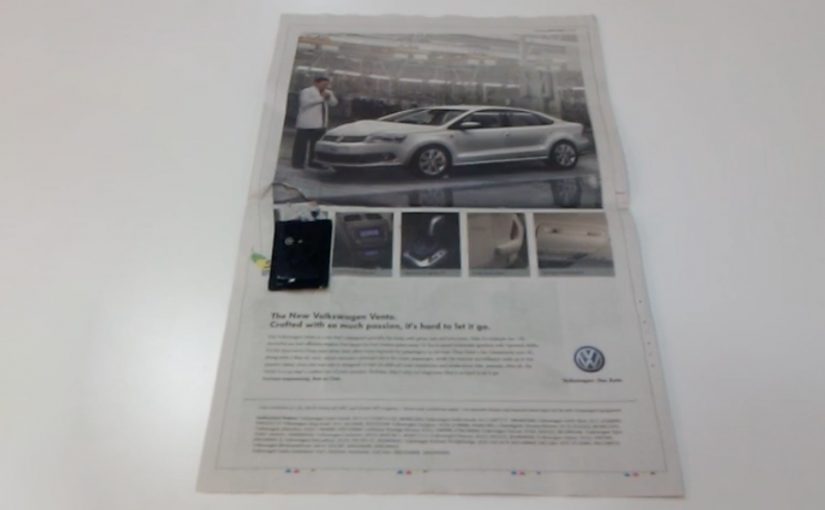
In India, Volkswagen has created a “talking” press ad that makes a newspaper behave like a greeting card. Reports described it as one of the most talked about topics of the day on Facebook and Twitter, because the ad does something print is not supposed to do. It speaks.

If you bought the Times of India edition carrying the special wrap, you would have seen a clutter-breaking execution with a built-in audio module. When you open the newspaper, a light-sensitive sensor acts like a switch and the message starts playing. Fold the paper and the audio shuts off.

The activation is widely reported as part of Volkswagen’s launch push for the Vento, executed at massive scale in India’s daily press.

Print that behaves like a device

The genius here is not the audio file. It is the interface. Open equals on. Close equals off. That single rule makes the experience feel magical, because it requires no instructions and no “tech literacy”. The paper itself becomes the power button.

It also creates a physical moment of surprise in an environment that is normally predictable. You expect ink. You do not expect a voice.

In mass-circulation newspaper markets, turning a silent medium into a sensory one is a reliable way to earn attention, as long as the mechanic is instant and self-explanatory.

Why this spread so fast

The format does the distribution work. People do not share “a new car ad”. They share “my newspaper started talking”. That is the difference between a message and a story.

Extractable takeaway: If the mechanic can be demonstrated in a repeatable loop, the audience becomes your distribution by showing it to other people.

It also turns the reader into a demonstrator. Once you discover it, you want to show someone else by repeating the action. Open. Close. Open again. That loop is built for office desks, breakfast tables, and social feeds.

What Volkswagen is really buying

The business intent is to make “arrival” unmissable. A new model launch needs attention in a crowded category, and this format forces a moment of engagement even if someone is only half-reading the paper.

The real question is whether your format makes the story self-propagate before you pay for reach.

This pattern works when the surprise is tightly coupled to the product story you want retold, not just the novelty of the mechanic.

It also signals “German engineering” through the medium itself. The ad does not just claim innovation. It performs it.

What to steal from a talking newspaper

  • Build a one-rule mechanic. A one-rule mechanic is a single on and off trigger people can explain and repeat in one sentence.
  • Make discovery physical. The more “showable” the action, the faster it spreads.
  • Let the medium carry the proof. If you are selling engineering, make the communication feel engineered.
  • Design for repeat demonstration. A loopable experience gets re-played and re-shared.

A few fast answers before you act

How does a “talking newspaper” ad work?

A small audio module is attached to the printed wrap or page. A light-sensitive sensor detects when the paper is opened and triggers playback. Closing or folding the paper stops the audio.

Why is this more effective than a normal print ad?

Because it forces a moment of attention through surprise, and it creates a story people repeat. The format itself becomes the message.

What kind of campaign is this best suited for?

Launch moments, announcements, and “new arrival” messaging, where the job is to break through clutter and get people talking immediately.

What is the biggest risk with sensory print executions?

Annoyance. If the audio is too loud, too long, or hard to stop, the novelty flips into irritation. The on and off behavior must feel fully under the reader’s control.

What should you measure if you run something like this?

Earned mentions, correct retelling of the mechanic, and immediate brand linkage to the intended message. If people talk about the talking paper but forget the brand, you paid for novelty, not impact.